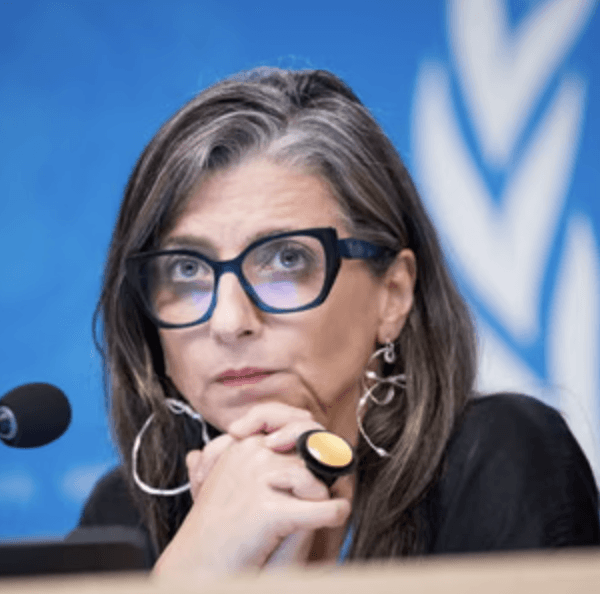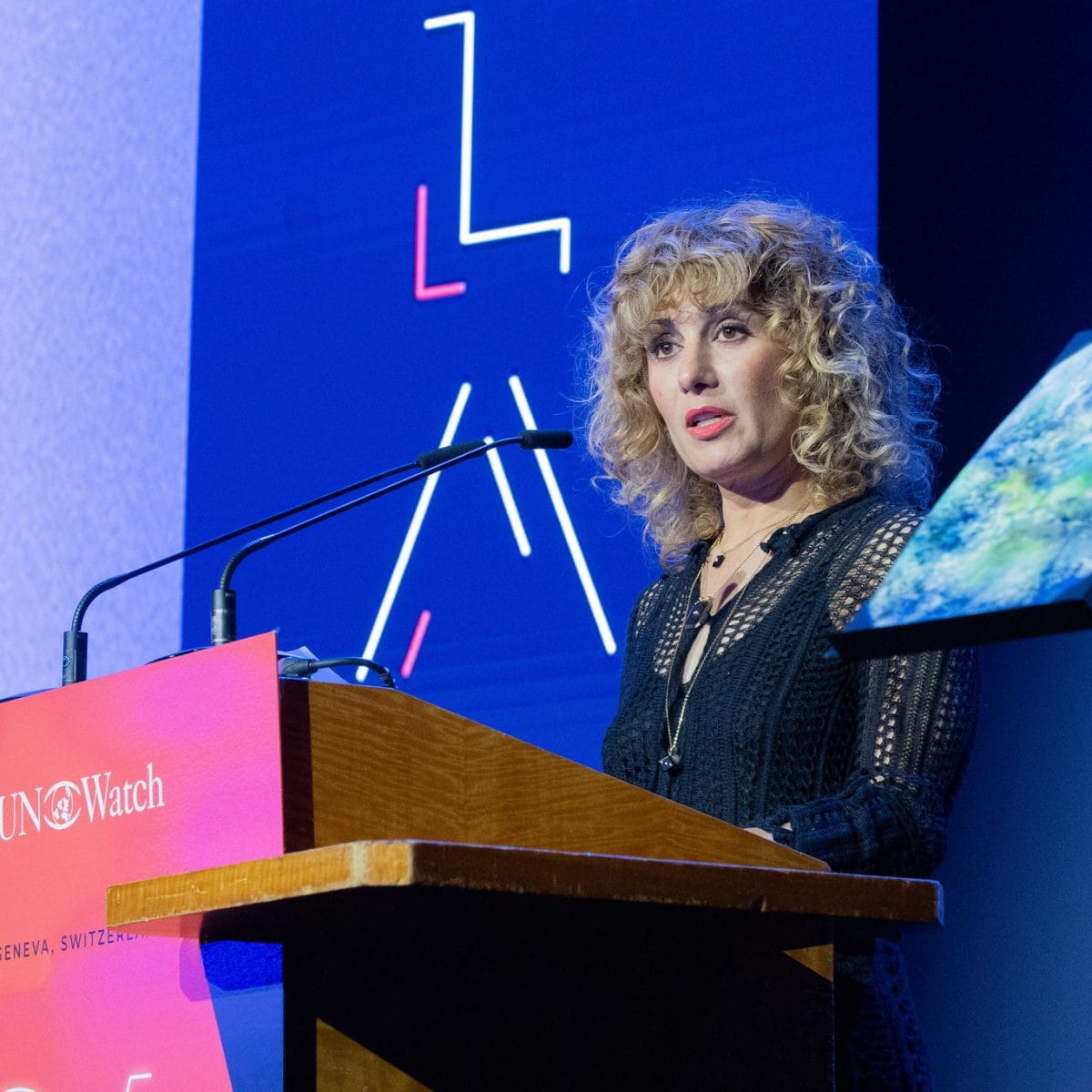

UN Watch is proud to award Abnousse Shalmani, the brilliant French-Iranian journalist, author, and filmmaker who courageously confronts Islamism and defends human dignity, with the Per Ahlmark Award at its sold-out 2026 Gala Dinner on June 4th, in Geneva, Switzerland.
Full Speech (English Translation, Original in French Follows):
Ladies and gentlemen, officials included, thank you. It is an immense honor to receive this prize, and I can only try to live up to the pride it brings me.
There is one word that comes back, naggingly, every time Iran is discussed. In newsrooms, in the hushed salons of foreign ministries, at conferences where condescending experts explain the world to those who endure it.
That word is “complexity.” Complexity as a smokescreen. Complexity as an absolution. Complexity as an elegant way of saying: “The Iranians aren’t quite ready.” Ready for what? For freedom?
For democracy? For the basic rights we have claimed for ourselves since 1789 and which we deny to others in the name of a cultural relativism that is nothing but racism in a frock coat, contempt for the Iranians who have been executed, for protesters gunned down by weapons of war —men and women of every ethnic and religious background— simply calling for a change of regime.
Contempt, then, in all its forms. The contempt of the war correspondent who returns from Tehran with his authoritative analyses without ever questioning the nature of that authority. How many times has he dined with regime officials, congratulating himself on his own diplomatic subtlety?
There is something obscene about boasting of knowing Larijani, about calling him pragmatic, when we know that this man has, with his own voice, called for firmness against protesters whom the regime labeled enemies of God.
The pragmatism of executioners: that is the name cowards give to their own complacency. The contempt of think tanks that publish their convoluted papers. We are expected to read, with a straight face, that the demonstrations of December 2025 risked being counterproductive because they might provoke foreign interference.
That is the logic. Iranians demanding their freedom are treated as a destabilizing factor. Balance. But whose balance? The mullahs’? As if the real problem were not the murderous rule of the mullahs, but the potential media coverage of their downfall, which might prove useful to Israel.
The real compass is the anti-Western agenda. What Iranians don’t understand is why the West refuses to confront a regime that funds Hamas, Hezbollah, the Houthis, and Shiite militias in Iraq and Syria; a regime that has ordered attacks on European soil and assassinated its opponents in Paris, Berlin, and Stockholm.
What the Iranians would like to hear on everyone’s lips is this: “Next year in Tehran via Tel Aviv.”
Because that would mean the end of Middle Eastern chaos, the return of the 3,000 year old understanding between Persians and Jews, and the resumption of the kinship that came to an abrupt halt with the Khomeini revolution in 1979.
47 years of rupture imposed by the mullah regime: what is that compared to 2,600 years of shared history since the day Cyrus the Great freed the Jews from Babylon? The kinship has never died out, and it will burst forth into broad daylight of truth as soon as the mullahs and the Revolutionary Guards are gone.
I am certain of it.
And why do we meet the Iranians’ cries for freedom with this unbearable silence? The answer is simple: we are afraid. Afraid of the Islamists, afraid of the judgment of those who see any support for the Iranians as implicit support for America or Israel.
This is not prudence, nor diplomacy, but contempt. And contempt, in foreign policy as in personal morality, is always a form of complicity. Let us speak, then, of this anti-Western agenda that dominates the institution supposedly entrusted, since 1945, with defending humanism everywhere, on every last patch of earth: the UN.
That every voice should have a say at the table of the world is part of a welcome development. However laudable the principle of automatic rotation may look on paper, it does not require us to accept leadership positions being handed out with no regard whatsoever for human-rights standards — a system that, in practice, systematically places geopolitical balance above values. And not just any values.
Saudi Arabia’s unanimous election, by the 45 members of the UN Commission on the Status of Women, to chair that very commission in 2024. As early as January 2003, Gaddafi’s Libya had already been elected to chair the Commission on Human Rights by 33 votes in favor, 3 against, and 17 abstentions.
Since 2015, the General Assembly has adopted 155 resolutions against Israel, while, during the same period, there have been—brace yourselves—0 resolutions, I said 0 resolutions, against China, Cuba, or Venezuela.
And yet, only 8 resolutions against the Islamic Republic of Iran. 24 against Russia—what a joke. 10 against the United States—that is what they call the balance of power. Since 1948, the Security Council has adopted 229 resolutions concerning Israel, dealing with settlements, the status of Jerusalem, and the return of Palestinian refugees.
With more than 50% of all Human Rights Council resolutions, 86% of General Assembly condemnations between 2012 and 2015, and 100%—I repeat, 100%—of specific UNESCO resolutions, Israel is the subject of an obviously obsessive focus that far exceeds the attention directed against all authoritarian regimes combined, resulting in the loss of credibility of the international organization that is supposed to be the world’s humanitarian watchdog.
And meanwhile, thousands are dying in Syria, Yemen, Sudan, Iran, the Democratic Republic of the Congo, and I’m leaving others out. After the Taliban’s return in 2021, we heard talk of “moderate” Taliban.
For many in the West, it has become self-evident that one must negotiate with the mullah regime in the name of freedom of navigation through the Strait of Hormuz, and so much for the freedom of the Iranian people. We are still debating whether to negotiate with Islamists. The pride in killing, the enjoyment of violent death, the refusal to lay down arms and accept defeat: these are the very definition of an Islamist terrorist group.
To imagine that a future of peace is possible with men who believe only in destruction is a terrifying illusion, an admission of cowardice, and an abandonment of humanism. There are 15.7 million Jews in the world. 7.2 million live in Israel, 6.3 million in the United States, 27,000 in Arab-Muslim countries, including 10,000 in Iran, and 440,000 in France.
Since the pogroms of October 7, antisemitic acts have skyrocketed around the world. The expression of antisemitism has shed its inhibitions, as though the massacre of men, women, and children, the torture, the mutilations, the rapes—filmed with enthusiasm by terrorists delighted to have fulfilled their duty of total annihilation, had given permission to the ordinary person whose antisemitism had been quietly snoring away to express his hatred in broad daylight.
And because this hatred finds justification in the speeches of politicians whose opportunism is matched only by their conviction, and of rancid, Holocaust-denying intellectuals, they pile on with words, deeds, and shouting. They draw up lists of Zionists to be economically destroyed — while waiting for a better solution.
Antisemites no longer hide; they are proud and praised; they are courted. Post–October 7 anti-Zionism is antisemitism with the mask finally off. Antisemitism is a challenge thrown in the face of liberal democracy.
Antisemitism is the moral victory of Islamism in the West. There is one country—just one, not two, not three—that serves as a refuge for Jews. One single country of which the world demands a proportionate response to a pogrom.
There is one country, one alone, not two, not three, that is in the crosshairs of every international organization, guilty by birth, guilty of existing. Israel’s great sin is that it is populated by Jews. If we want to avoid the day when I have to begin a speech with: “Once upon a time, there was a country called Israel,” then it is time to fight, truly fight, against antisemitism, which is anti-humanism and which tomorrow will be our collective shame.
Thank you very much.
Full Speech (Original in French):
Mesdames et messieurs, officiels compris, merci. C’est un immense honneur que de recevoir ce prix et je ne peux que tenter d’être à la hauteur de la fierté que cela représente pour moi.
Il y a un mot qui revient, lancinant, chaque fois qu’on parle d’Iran. Dans les rédactions, dans les salons feutrés des chancelleries, dans les colloques où des experts au regard condescendant expliquent le monde à ceux qui le subissent.
Ce mot, c’est « complexité ». La complexité comme paravent. La complexité comme absolution. La complexité comme manière élégante de dire : « Les Iraniens ne sont pas tout à fait prêts. » Prêts pour quoi ? Pour la liberté ?
Pour la démocratie ? Pour les droits élémentaires que nous réclamons pour nous-mêmes depuis 1789 et que nous refusons à d’autres au nom d’un relativisme culturel qui n’est que du racisme en redingote, du mépris face aux Iraniens exécutés, aux manifestants tombés sous les balles d’armes de guerre, hommes et femmes de toute origine ethnique et religieuse, appelant simplement à un changement de régime.
Le mépris, donc, sous toutes ses formes. Le mépris du reporter de guerre qui revient de Téhéran avec ses analyses autorisées sans jamais s’interroger sur la nature de l’autorisation. Combien de fois a-t-il dîné avec des responsables du régime, se félicitant de sa propre finesse diplomatique ?
Il y a quelque chose d’obscène à se vanter de connaître Larijani, à le qualifier de pragmatique, quand on sait que cet homme a, de sa propre voix, appelé à la fermeté contre des manifestants que le régime qualifiait d’ennemis de Dieu.
Le pragmatisme des bourreaux : c’est est le nom que donnent les lâches à leur propre complaisance. Le mépris des instituts qui publient leurs notes alambiquées. On peut lire sans rire que les manifestations de décembre 2025 risquaient d’être contre-productives parce qu’elles pourraient provoquer une ingérence étrangère.
Voilà la logique. Des Iraniens qui réclament leur liberté constituent un facteur déstabilisant. L’équilibre. Mais l’équilibre de qui ? Des mollahs ? Comme si le vrai problème était non pas la mollarchie assassine, mais l’éventuelle médiatisation de leur chute, qui pourrait être utile à Israël.
La vraie boussole, c’est l’agenda anti-occidental. Ce que les Iraniens ne comprennent pas, c’est pourquoi l’Occident refuse de regarder en face un régime qui finance le Hamas, le Hezbollah, les Houthis, les milices chiites en Irak et en Syrie, qui a commandité des attentats sur le sol européen et qui a assassiné ses opposants à Paris, à Berlin, à Stockholm.
Ce que les Iraniens aimeraient entendre sur toutes les lèvres, c’est : l’année prochaine à Téhéran via Tel-Aviv.
Parce que cela dit la fin du chaos moyen-oriental, le retour de l’entente trois fois millénaire entre Persans et Juifs, la reprise de la cousinade qui s’est brutalement arrêtée avec la révolution khomeiniste en 1979.
47 ans de rupture imposée par la mollarchie : qu’est-ce que c’est entre 2600 ans d’histoire commune depuis le jour où Cyrus le Grand a libéré les Juifs de Babylone ? La cousinade ne s’est jamais éteinte et elle éclatera au grand jour de la vérité dès la fin des mollahs et des gardiens de la révolution. J’en suis certaine.
Et pourquoi oppose-t-on cet insupportable silence aux cris de liberté des Iraniens ? La réponse est simple : nous avons peur. Peur des islamistes, peur du regard de ceux qui voient dans tout soutien aux Iraniens un soutien implicite à l’Amérique ou à Israël.
Ce n’est pas de la prudence ni de la diplomatie, mais du mépris. Et le mépris, en politique étrangère comme en morale personnelle, est toujours une forme de complicité. Parlons-en, de cet agenda anti-occidental qui domine l’institution censée défendre l’humanisme partout, sur n’importe quelle parcelle de terre, depuis 1945 : l’ONU.
Qu’il soit dans l’ordre d’une évolution, bienvenue, que toutes les voix aient leur mot à dire à la table du monde, il n’est pourtant pas nécessaire, au prétexte pourtant louable sur le papier de la rotation automatique, d’accepter l’absence de critères de respect des droits de l’homme pour les postes de direction, qui jouent alors systématiquement en faveur de la prééminence des équilibres géopolitiques.
Et pas n’importe quelle valeur. L’élection au poste de présidente de l’Arabie saoudite, à l’unanimité des 45 membres de la Commission de la condition de la femme de l’ONU, en 2024. En janvier 2003, déjà, la Libye de Mouammar Kadhafi avait été élue à la présidence de la Commission des droits de l’homme par 33 voix pour, 3 contre et 17 abstentions.
Depuis 2015, l’Assemblée générale a adopté 155 résolutions contre Israël, tandis que, dans la même période, on compte, accrochez-vous, 0 résolution, j’ai dit 0 résolution, contre la Chine, Cuba ou le Venezuela.
Et pourtant, 8 résolutions contre la République islamique d’Iran seulement. 24 contre la Russie, c’est une blague. 10 contre les États-Unis, ça s’appelle l’équilibre des forces. Depuis 1948, le Conseil de sécurité a adopté 229 résolutions concernant Israël, portant sur la colonisation, le statut de Jérusalem et le retour des réfugiés palestiniens.
Avec plus de 50% de toutes les résolutions du Conseil des droits de l’homme, 86% des condamnations de l’Assemblée générale entre 2012 et 2015, et 100%, je dis bien 100%, des résolutions spécifiques de l’UNESCO, Israël fait l’objet d’une focalisation de toute évidence obsessionnelle, qui dépasse largement celle dirigée contre tous les régimes autoritaires réunis et dont le résultat est la perte de crédibilité d’une organisation internationale censée être la vigie humanitaire du monde.
Et pendant ce temps-là, des milliers de morts en Syrie, au Yémen, au Soudan, en Iran, en République démocratique du Congo, et j’en oublie. Après le retour des talibans en 2021, nous avons entendu parler de talibans modérés.
Il est devenu évident pour beaucoup en Occident qu’il faut négocier avec la mollarchie au nom de la liberté du détroit d’Ormuz, et tant pis pour la liberté des Iraniens. On débat encore de savoir s’il faut négocier avec les islamistes. La fierté de tuer, la jouissance de la mort violente, le refus de rendre les armes et d’accepter la défaite définissent ce dont tout groupe terroriste islamiste est le nom.
Imaginer qu’un avenir de paix soit possible avec des hommes qui ne croient qu’en la destruction est une terrifiante illusion, un aveu de lâcheté et un abandon de l’humanisme. Il y a 15,7 millions de Juifs dans le monde. 7,2 millions vivent en Israël, 6,3 millions aux États-Unis, 27 000 dans des pays arabo-musulmans, dont 10 000 en Iran, et 440 000 en France.
Depuis les pogroms du 7 octobre, les actes antisémites ont explosé partout dans le monde. L’expression de l’antisémitisme s’est décomplexée, comme si le massacre d’hommes, de femmes, d’enfants, les tortures, les mutilations, les viols filmés dans l’enthousiasme par des terroristes heureux d’avoir accompli leur devoir d’annihilation totale autorisaient le quidam dont l’antisémitisme ronflait tranquillement à exprimer sa haine au grand jour.
Et parce que cette haine trouve justification dans des discours de politiques aussi opportunistes que convaincus et d’intellectuels négationnistes et rances, ils en rajoutent en mots, en actes, en vociférations. Ils dressent des listes de sionistes à abattre économiquement en attendant mieux.
Les antisémites ne se cachent plus, ils sont fiers et applaudis, ils sont courtisés. L’antisionisme post-7 octobre est un antisémitisme enfin assumé. L’antisémitisme est un défi lancé au visage de la démocratie libérale.
L’antisémitisme est la victoire morale de l’islamisme en Occident. Il y a un pays, un seul, pas deux, pas trois, qui est un refuge pour les Juifs. Un seul pays auquel le monde réclame une réponse proportionnée à un pogrom.
Il y a un pays, un seul, pas deux, pas trois, qui est dans la ligne de mire de toutes les organisations internationales, coupable de naissance, coupable d’exister. La grande faute d’Israël est d’être peuplé de Juifs. Si nous voulons éviter qu’un jour, je commence un discours par : « Il était une fois un pays, Israël », il est temps de véritablement se battre contre l’antisémitisme, qui est un antihumanisme et qui sera demain notre honte collective.
Merci beaucoup.