Background
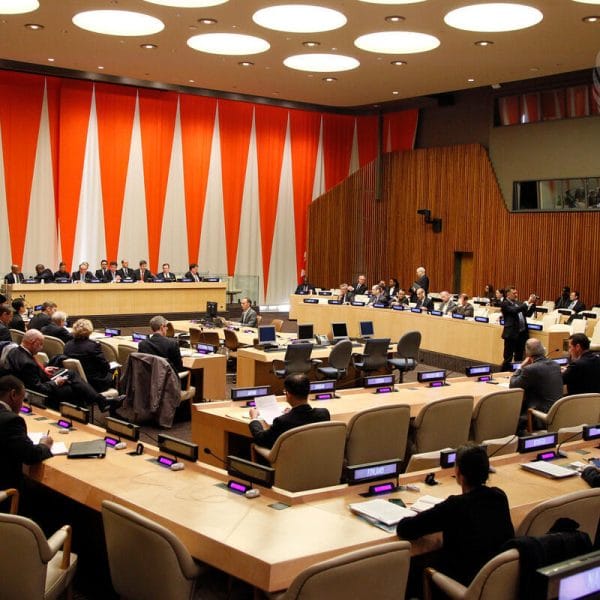
On May 12, 2009, the UN General Assembly will elect 18 new Human Rights Council members. Twenty countries are candidates. However, each is not competing against all of the others, but rather only against the ones from the same UN regional group. In this year’s election, all but two regional groups have submitted the same amount of candidates as available seats. The Asian Group has 5 countries vying for 5 available seats, the Latin American and Caribbean Group (“GRULAC”) has 3 countries vying for 3 available seats, and the Western European and Others Group (“WEOG”) has 3 countries vying for 3 available seats. This does not mean that the candidate countries for these groups will automatically be elected; in order to become a Council member a country must receive the votes of at least 97 of the 192 General Assembly member states (an absolute majority). Competition between the candidates exists only in the African Group, where 6 countries are vying for 5 available seats and in the Eastern European Group, where 3 countries are vying for 2 available seats.
Methodology
According to Resolution 60/251, General Assembly members are supposed to elect Council by “tak[ing] into account the candidates’ contribution to the promotion and protection of human rights and their voluntary pledges and commitments made thereto.” The resolution also provides that consideration ought to be given to whether the candidate can meet the obligations of Council membership, which include (a) “to uphold the highest standards in the promotion and protection of human rights” and (b) to “fully cooperate with the Council.” Guided by these criteria, Freedom House and UN Watch evaluated each candidate’s suitability for election to the Human Rights Council by examining its record of human rights protection at home and its record of human rights promotion at the UN, based on the following sources of information and analysis:
- Its rating in Freedom in the World 2009, an annual survey by Freedom House that measures political rights and civil liberties worldwide, ranking countries as free, partly free, or not free;
- Its rating in The Economist 2008 Democracy Index, which considers a country’s electoral process and pluralism, civil liberties, government functioning, political participation, and political culture, and ranks it as a full democracy, a flawed democracy, a hybrid regime, or an authoritarian regime;
- Its rating in Freedom of the Press 2009, an annual survey by Freedom House that examines the legal, political and economic environments in which journalists work in order to assess the degree of print, broadcast, and internet freedom in every country in the world, ranking each as free, partly free, or not free;
- Its ranking in the 2008 Worldwide Press Freedom Index by Reporters Sans Frontières, which measures the degree of freedom that journalists and news organizations enjoy in each country, and the efforts made by state authorities to respect and ensure respect for this freedom; and
- Its voting record on key human rights proposals, which are classified as positive, negative or mixed based on the following assessments:
- UN Watch analysis of 2007-2008 votes at the Human Rights Council;
- Democracy Coalition Project (DCP) analysis of 2008 votes at the UN General Assembly.
Rating
Based on the above assessment of each country’s record of human rights protection at home and of its UN voting record, we find that 7 candidate countries are qualified for election to the Human Rights Council; 8 candidates have poor records and are not qualified to be Council members; and 5 countries fall somewhere in between, with qualifications that are questionable.
Qualified: Belgium, Hungary, Mauritius, Mexico, Norway, United States, Uruguay
Questionable: Jordan, Kenya, Kyrgyzstan, Nigeria, Senegal
Not Qualified: Azerbaijan, Bangladesh, Cameroon, China, Cuba, Djibouti, Russia, Saudi Arabia
For supporting information, see the charts below.
Candidates from the African Group (for 5 seats)
To replace Cameroon, Djibouti, Mauritius, Nigeria, and Senegal
| Country | FH Rating | FH Press Freedom | RSF Ranking |
Economist Rating |
UN Voting Record |
Suitability for Membership |
| Cameroon | Not Free | Not Free | 129 | Authoritarian Regime | Mixed | Not Qualified |
| Djibouti | Partly Free | Not Free | 124 | Authoritarian Regime | Negative | Not Qualified |
| Kenya | Partly Free | Partly Free | 97 | Hybrid Regime | Mixed | Questionable |
| Mauritius | Free | Free | 47 | Full Democracy | Mixed | Qualified |
| Nigeria | Partly Free | Partly Free | 131 | Authoritarian Regime | Negative | Questionable |
| Senegal | Partly Free | Partly Free | 86 | Hybrid Regime | Negative | Questionable |
Candidates from the Asian Group (for 5 seats)
To replace Bangladesh, China, Jordan, Malaysia and Saudi Arabia
| Country | FH Rating | FH Press Freedom | RSF Ranking |
Economist Rating |
UN Voting Record |
Suitability for Membership |
| Bangladesh | Partly Free | Not Free | 136 | Hybrid Regime | Negative | Not Qualified |
| China | Not Free | Not Free | 167 | Authoritarian Regime | Negative | Not Qualified |
| Jordan | Partly Free | Not Free | 128 | Authoritarian Regime | Mixed | Questionable |
| Kyrgyzstan | Not Free | Not Free | 111 | Authoritarian Regime | Negative | Questionable |
| Saudi Arabia | Not Free | Not Free | 161 | Authoritarian Regime | Negative | Not Qualified |
Candidates from the Eastern European Group (for 2 seats)
To replace Azerbaijan and Russia
| Country | FH Rating |
FH Press Freedom | RSF Ranking |
Economist Rating |
UN Voting Record |
Suitability for Membership |
| Azerbaijan | Not Free | Not Free | 150 | Authoritarian Regime | Negative | Not Qualified |
| Hungary | Free | Free | 23 | Flawed Democracy | Positive | Qualified |
| Russia | Not Free | Not Free | 141 | Hybrid Regime | Negative | Not Qualified |
Candidates from GRULAC (for 3 seats)
To replace Cuba, Mexico and Uruguay
| Country | FH Rating |
FH Press Freedom | RSF Ranking |
Economist Rating |
UN Voting Record |
Suitability for Membership |
| Cuba | Not Free | Not Free | 169 | Authoritarian Regime | Negative | Not Qualified |
| Mexico | Free | Partly Free | 140 | Flawed Democracy | Positive | Qualified |
| Uruguay | Free | Free | 43 | Full Democracy | Positive | Qualified |
Candidates from WEOG (for 3 seats)
To replace Canada, Germany, and Switzerland
| Country | FH Ranking |
FH Press Freedom | RSF Ranking |
Economist Rating | UN Voting Record |
Suitability for Membership |
| Belgium | Free | Free | 7 | Full Democracy | Positive | Qualified |
| Norway | Free | Free | 1 | Full Democracy | Positive | Qualified |
| United States | Free | Free | 36 | Full Democracy | Positive | Qualified |