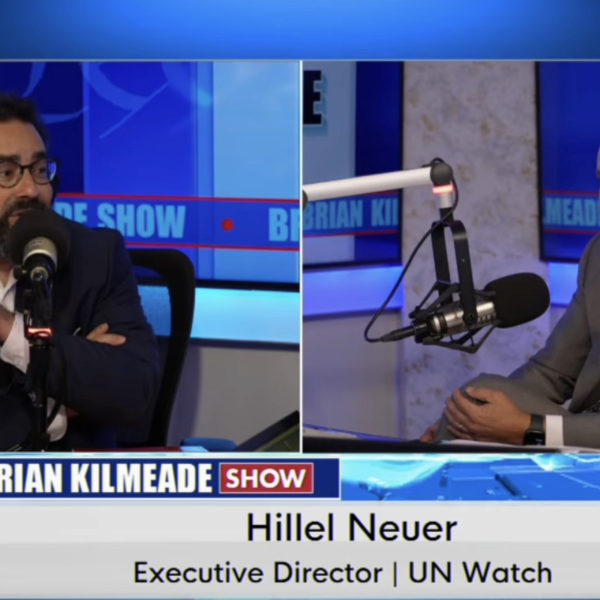
Invited to Harvard to debate whether the United Nations treats Israel equally, Hillel Neuer challenged the university itself: Why does Harvard repeatedly host and support U.N. rapporteurs who justify terrorism, including Francesca Albanese, Tlaleng Mofokeng, and Michael Fakhri?
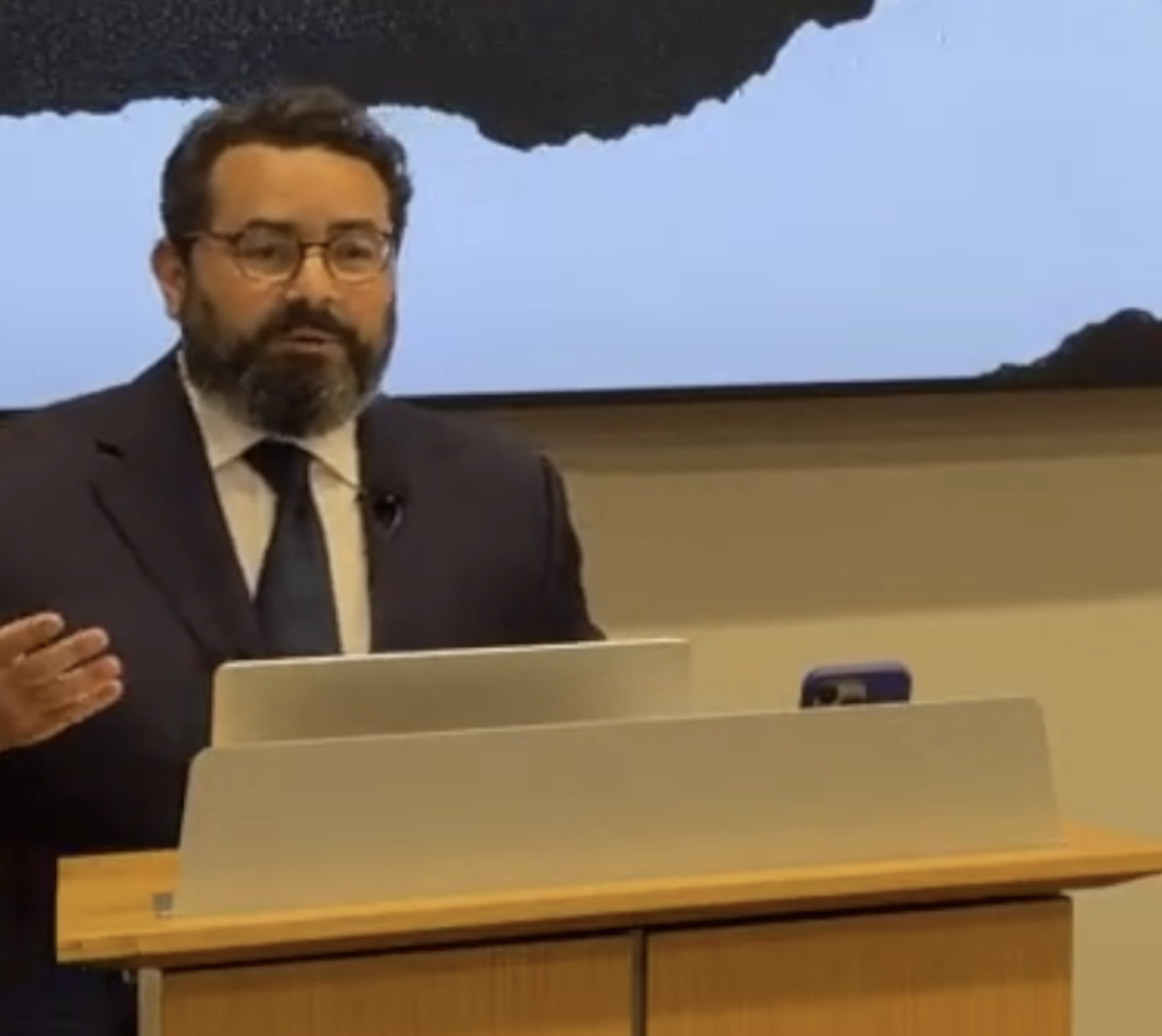
Watch the full debate between UN Watch Executive Director Hillel Neuer and Harvard Professor Kathryn Sikkink, moderated by Professor Patrick Vinck at the Harvard Kennedy School.
The discussion covers the U.N.’s double standards on Israel, Hamas infiltration of UNRWA, outside funding of U.N. rapporteurs, and Harvard’s responsibility to scrutinize the “human rights experts” it promotes.
Includes the complete exchange and audience Q&A.
Opening Remarks:
Thank you for the kind introduction, and thank you to the Kennedy School and the Carr-Ryan Center for hosting tonight’s event.
It is timely to speak about the United Nations, human rights, and Israel. As we meet today, the General Assembly is hosting sessions on these very topics.
The United Nations was founded on an extraordinary promise: that, after the horrors of the Second World War, nations would build an international order grounded in human dignity and the equal rights of nations, large and small.
For the Jewish people emerging from the Holocaust, that promise carried particular meaning. On November 29, 1947, the UN General Assembly voted to recommend the partition of what was then British Mandatory Palestine into Jewish and Arab states.
Jews celebrated in Tel Aviv, Jerusalem, and around the world. The Arab states rejected the plan and invaded Israel to destroy it. In 1949, Israel joined the United Nations.
But today, the very institution that helped give international recognition to Jewish statehood has become a principal arena for its delegitimization.
How did that happen? What does it tell us about the condition of international human rights?
These questions matter to anyone who believes that international institutions should exercise their authority fairly. I’ve come here from Geneva, where UN Watch works to hold the United Nations to its founding principles.
We bring former political prisoners to testify before the Human Rights Council. We give dissidents from China, Russia, Iran, Zimbabwe, Sudan, Cuba, Belarus, and North Korea a platform to confront the governments that tortured them.
We know what the United Nations can mean to people who have nowhere else to turn. And that is why we insist that promises mean something.
If we look at the General Assembly, we see that the deterioration in the UN’s treatment of Israel has developed over decades.
Soviet and Arab blocs mobilized their influence. Its most notorious expression came in 1975, when the General Assembly declared Zionism to be a form of racism. An organization founded in the aftermath of the Holocaust branded the national liberation movement of the Jewish people “racist.”
That resolution was repealed in 1991, when the Soviet Union fell. But the institutional machinery, and you could say the spirit surrounding it, has very much survived.
Year after year at the General Assembly, powerful dictatorships escape scrutiny.
There has never been a resolution in decades addressing the human rights of the 1.4 billion people in China. There has never been a General Assembly resolution on human rights in Egypt, where there are some 60,000 political prisoners. There has never been a resolution on Qatar, which uses slave labor to build sports stadiums.
There has never been a General Assembly resolution on human rights in Pakistan, where a Christian woman was sentenced to death on false allegations of blasphemy. Zero on Cuba, zero on Zimbabwe, and zero on most of the world’s worst abusers.
A handful of countries do get criticized. Typically, each year, as was the case last year, there is one resolution on Iran, one on North Korea, and then fifteen on Israel. Fifteen on Israel.
In addition, the General Assembly has permanent committees, conferences, and divisions that sustain this exceptional treatment.
There are no such mechanisms for the Kurdish people, the Uyghurs, or anyone else.
That’s the General Assembly. At the Human Rights Council, which was created in 2006, there was a debate over whether there should be criteria for membership when the old Human Rights Commission was scrapped and the new and improved Human Rights Council was established.
Should there be criteria to join? They decided yes. In General Assembly Resolution 60/251, they determined that there should be criteria.
And despite that, the members today include China, Qatar, Pakistan, and Cuba. Needless to say, none of those countries has ever been made the object of criticism in any resolution, special rapporteur mandate, or commission of inquiry.
The founding resolution of the Council requires impartiality, objectivity, and non-selectivity.
Yet every session includes a permanent agenda item focused on Israel. No other country in the world has that. There is no agenda item on China, Iran, or North Korea.
What you have here is unequal treatment written into the rules. There are more resolutions and reports on Israel at the Human Rights Council than on Iran, Syria, and North Korea combined.
There are more emergency special sessions and more commissions of inquiry on Israel than on any other country in the world.
There are also UN mechanisms such as rapporteurs and commissions of inquiry. Professor Frédéric Mégret of McGill University Faculty of Law has written that, in many cases, the expert who is appointed is appointed not despite their partisan political pronouncements on the issue they are meant to judge impartially, but because of those pronouncements.
That would be the case with UN rapporteurs, and in many cases, certainly the rapporteur on Palestine. The same applies to the Commission of Inquiry, where Navi Pillay, who had written that Israel must be sanctioned for apartheid and had campaigned on this issue for several years, was appointed chair of the Commission shortly thereafter.
When we submitted a recusal request of some 30 pages documenting how, under the UN Human Rights Council’s rules, partisan political pronouncements create the appearance of bias and should therefore disqualify someone from appointment, she refused to answer it.
Months later, when I handed it to her, I asked whether she had received it. She said, “Yes, I received it, but we can’t respond to everything.”
She couldn’t respond to everything? This was a core challenge to the very impartiality of her mandate, yet she chose not to respond.
That’s the Human Rights Council.
I’ll say a word about UNRWA, and then about some of the voices of dissent we’ve heard over the years.
In Geneva, we have one UN mechanism for refugees around the world. That’s UNHCR. And there’s one just for the Palestinians.
UNHCR’s mission is to resettle refugees. UNRWA is the opposite. It has received billions and billions of dollars, and to date, it has not resettled a single refugee.
UNRWA runs schools. It tells donors, primarily Western states, that the agency is necessary for education.
Unfortunately, those running the schools include people like Suhail al-Hindi, who was a teacher in Gaza for 27 years and head of the UNRWA teachers’ union. He was also on the Hamas Political Bureau.
He’s today one of the leaders of Hamas.
The same thing happened in Lebanon. Fathi Sharif was head of the UNRWA teachers’ union in Lebanon and head of Hamas in Lebanon.
When he was eliminated, Hamas eulogized him as its commander in Lebanon and praised his jihadi education.
So that is UNRWA. Who is running the UNRWA schools?
Historically, even as this injustice and discrimination persisted at the United Nations, there was a powerful tradition of dissent: people who demanded scrutiny.
These included Eleanor Roosevelt. In April 1962, when the UN rushed to unfairly condemn Israel for a raid on Syrian forces, Eleanor Roosevelt called out the world body for placing blame on one side.
In 1968, when a UN human rights conference targeted Israel, René Cassin, the architect of the Universal Declaration of Human Rights, left in protest.
UN Secretaries-General also spoke out. Kofi Annan called out actions by UN bodies that could themselves be counterproductive.
He spoke about those who apply double standards, holding Israel to a standard of behavior they are unwilling to apply to other states.
Ban Ki-moon condemned UN rapporteur Richard Falk when he gave voice to the 9/11 conspiracy theory. Ban Ki-moon appeared on the floor of the Human Rights Council and condemned Falk’s preposterous remarks about the 3,000 innocent people who died that day.
There have been many other instances over the years of people speaking out.
Sadly, more recently, we seldom hear voices of conscience calling this out.
Which brings me to a question here at Harvard. I believe your voice is so important.
Your schools of government and law, your law journals, and your professors have a very important voice.
When UN rapporteurs undertake a propaganda visit to Venezuela, as Michael Fakhri did, you should call him out. But I don’t hear it.
Instead, Michael Fakhri was hosted at the Harvard Law School Clinic, which provided him with a research assistant in 2020.
In April 2024, Harvard’s Palestine Program for Health and Human Rights hosted him for a webinar.
Consider Francesca Albanese at the UN. In 2014, in a fundraising letter for UNRWA, she wrote that America was subjugated by the Jewish lobby. Six years later, the Harvard Center for Middle Eastern Studies hosted Albanese to speak about UNRWA.
On October 7, as the Hamas massacre was unfolding, she posted: “Today’s violence must be put in context.” She was justifying what Hamas had done that day.
Three weeks later, Harvard Law School and the Harvard Center for Middle Eastern Studies hosted her again.
In September 2025, Albanese publicly quoted a Gaza death toll of 380,000 children under five—more children than existed in Gaza at the time.
Would that methodology survive scrutiny in a university seminar? It wouldn’t. And that is why it troubles me that Harvard University would repeatedly host her, including at the Carr Center, to give talks.
Something like that should be held to account.
Some 15 countries have condemned her for Holocaust inversion, including Germany, France, Canada, and many others.
So I’m grateful for tonight’s invitation. I hope it begins a deeper examination.
We need to hear Harvard’s voice when the people it elevates betray the principles they claim to defend.
Those of us on the ground need your help. We ask you to examine these mandates, investigate their funding, test their reports against the evidence, and bring the same intellectual rigor to the UN human rights establishment that you would bring to any other institution exercising power.
The founders of human rights at the UN—and with this I conclude—Eleanor Roosevelt and Hansa Mehta had the courage to speak up.
So I ask you today to help carry that tradition forward. Help us recover a United Nations worthy of its Charter, and a human rights movement in which the Jewish people are entitled to the same fairness, dignity, and protection as everyone else.
Thank you.
The Harvard Kennedy School professor that I debated this week on the topic of the U.N. and Israel is requesting that we not post any social media clips from the debate. I never agreed to such a condition. What do you think, should we share video clips from the debate, or not? https://t.co/5i0vnDFk9U pic.twitter.com/9llrS9l0a6
— Hillel Neuer (@HillelNeuer) October 29, 2026