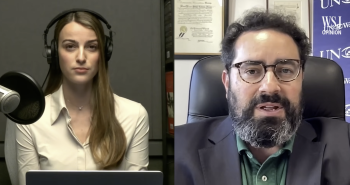
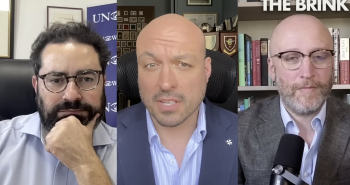
GENEVA — UN Watch today convened an Emergency Panel on Iran to address the Islamic Republic’s escalating crackdown on nationwide protests, as credible reports indicate that thousands of Iranian protesters have been killed since demonstrations erupted in late December. Click here to sign petition
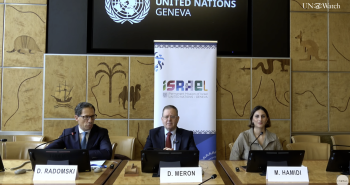
Moderated by UN Watch Executive Director Hillel Neuer, the panel featured Swedish MP Alireza Akhondi and Canadian human rights lawyer Kaveh Shahrooz, who warned that international inaction is emboldening Tehran’s repression.
Neuer underscored the failure of the UN Security Council to act due to vetoes by China and Russia, noting that “the absence of accountability sends a dangerous message to the killers.”
He announced that a coalition of 30 NGOs today issued an urgent appeal to more than 100 UN ambassadors, demanding emergency sessions of the UN General Assembly and Human Rights Council to condemn the regime, establish independent investigations, and press for the release of arbitrarily detained protesters.
Akhondi described harrowing accounts from inside Iran, including security forces firing live ammunition to kill demonstrators and families being forced to pay for the bullets that killed their children. “Condemnations are not enough,” he said. “We need firm action — sanctions, expulsion of regime diplomats, designation of the IRGC as a terrorist organization, and concrete support for free internet and independent media.”
“We need to combine symbolic actions, like deporting the Islamic Republic ambassador, with concrete actions like designation of the IRGC, more sanctions, more pressure — and of course, also to ensure free internet in Iran, free media, and help to the opposition. Some actions are short term, symbolic, some of them are for real and give good results,” added Akhondi.
Kaveh Shahrooz criticized the delayed and muted response from major media, human rights institutions, and Western governments. He argued that ideological bias has led to Iran’s abuses being minimized, despite the regime’s systematic persecution of women, minorities, and dissidents. While acknowledging the current lull in street protests, he emphasized that “this regime cannot survive long-term — it is incapable of reform and survives only through violence.”
“The ideology that is really at the core of a lot of human rights groups and a lot of media is one that, at its core, wishes to side with those that criticize the United States, that criticize Israel,” said Shahrooz.
“So Iran’s regime, because of the position that it takes with respect to the United States and Israel, tends to be treated with kid gloves in these international institutions. It tends to be treated charitably and given the benefit of the doubt when no benefit of the doubt is warranted. Its narrative tends to be accepted and promulgated and disseminated,” said Shahrooz.
“And it’s surprising, because these same institutions regularly speak about their mandate to support women, LGBTQ people, workers, and so on. Iran’s regime brutalizes and persecutes all these groups — and yet in the media, or in these institutions, you don’t hear very much about what it does. So I think what is needed at this point is pressure on these institutions, and perhaps an ideological change in these institutions that takes their own mandates and their own responsibilities more seriously.”
“I have not given up hope. I know that Iranian people want democracy, and that’s what they expect the international community to support. I hope that the international community pushes the Iranian opposition to form a stronger coalition in which every constituency is represented, every ideological view is represented, that is committed to democracy, and I think that’s what Iranians demand of us, and that’s really what we owe them for all their bravery,” said Shahrooz.
Panelists warned that unfulfilled promises of support from world powers risk costing lives and undermining democratic credibility. All three speakers stressed that sustained international pressure is essential to weaken the regime’s repressive apparatus and support Iranians demanding freedom.
UN Watch called on governments, particularly in Europe, to lead efforts at the UN and EU level and urged the public to support its petition demanding immediate international action.