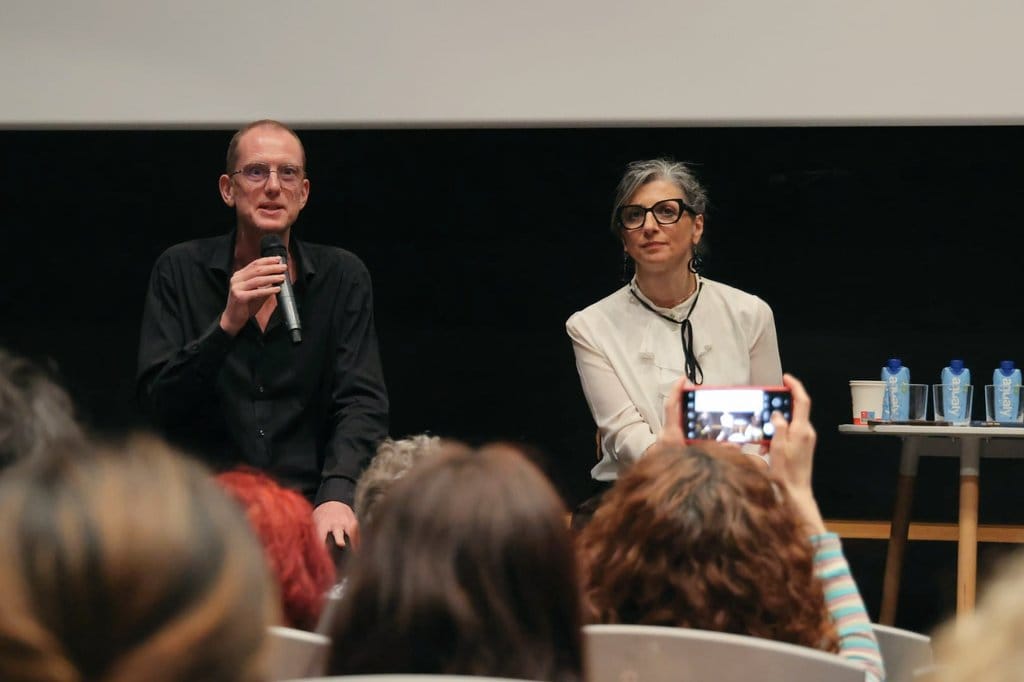
Francesca Albanese is facing widespread criticism after telling Sonja Bohl-Dencker, the mother of German-Israeli citizen Carolin Bohl, who was murdered by Hamas terrorists on October 7, 2023, to “change medication.”
Bohl-Dencker had attended a Berlin screening of Disunited Nations, the ARTE documentary featuring Albanese, and said “I have never been in a room where I felt so much hatred.”
Albanese’s response to a grieving mother shocked many observers.
The incident is also a reminder of a question that deserves renewed scrutiny: how did ARTE’s documentary Disunited Nations come to present Albanese so uncritically despite the extensive public record of controversy surrounding her conduct?
Months before filming, UN Watch warned ARTE that the documentary risked becoming an advocacy project rather than an objective journalistic inquiry.
In response to ARTE’s request to interview Hillel Neuer — “in what they obviously planned as a hit job,” says Neuer — UN Watch sent ARTE a detailed email on August 24, 2025, raising concerns about the impartiality of the documentary’s director, Christophe Cotteret, showing how he demonstrated a clear bias against Israel.
UN Watch informed ARTE that:
• In the aftermath of the atrocities committed by Hamas on October 7th, Mr, Cotteret shared a post entitled “How Israel systematically denies the massacres it commits.”
• In 2017, after President Trump moved the U.S. Embassy to Jerusalem, Mr. Cotteret posted that it is really “Washington rather than Jerusalem that is becoming, for the current and (hopefully) short-lived American administration, the capital of Israel.”
• Even more troubling, the director Cotteret displayed specific bias concerning the object of his film. Despite Francesca Albanese being the first UN rapporteur in history to have been condemned by France, Germany, Canada, and the Netherlands — for antisemitism, Holocaust inversion, or ethical violations requiring the termination of her mandate — Mr. Cotteret has repeatedly expressed support for her.
• On May 5, 2024, on his Facebook account which is open to the public, Mr. Cotteret shared a video of Albanese speaking, with his comment:
For those who are still struggling with the use of the terms genocide and acts of genocide, I invite you to listen to Francesca Albanese, UN Special Rapporteur for Palestine, last night in Tunis.” Mr. Cotteret’s post was then shared by six of his Facebook friends, and liked by 10 others.
• The next week, Mr. Cotteret again promoted one of Albanese’s “genocide” accusations. On May 11, 2024, he shared a photo of Albanese speaking on a panel, and added this comment:
Tunis, right now. “A genocide is not a matter of opinion. But under law defined by genocide conventions. As a lawyer, it’s a genocide” With @Francesca Albanese @RimaHassan and Michèle Sibony, from the Union of Jews for Peace.
• Arte was also warned that there were numerous more examples of Mr. Cotteret’s bias on the matters addressed by the documentary.
These concerns were particularly relevant because Albanese was already a highly controversial figure. By that time, France, Germany, Canada, and the Netherlands had all publicly condemned her conduct, statements, or actions. Questions regarding antisemitism, Holocaust inversion, and repeated breaches of the standards expected of a UN mandate-holder were already well documented.
UN Watch asked ARTE to consider measures to prevent the bias, including to:
– Assign a different director — one who has not publicly endorsed Ms. Albanese’s positions — in order to guarantee objectivity.
– Including an independent editorial reviewer, with no prior record of statements on Israel or Ms. Albanese, to ensure balance.
– Ensure that at least half of the speaking time in segments on the UN in general and Ms. Albanese in particular is given to critics of their records, as opposed to their supporters.
– Disclose to viewers whether any of the film project’s funding partners, NGOs, or advisory contributors have taken public positions on Israel or in support of Ms. Albanese.
– Confirm in writing that no part of the program will characterize Israel’s defensive actions as ‘genocide’ without including immediate rebuttal by credible legal experts.
– Consider including, instead of (or alongside) a monologue by Ms. Albanese, a moderated debate between her and one of her critics.
ARTE rejected these requests.
In its response, the broadcaster instead emphasized its reputation, the director’s professional credentials, and the fact that sharing views on social media “in no way constitutes an editorial line.”
Yet that response largely sidestepped the central issue: whether someone who had repeatedly and publicly endorsed Francesca Albanese’s views was the appropriate person to direct a documentary centered on Francesca Albanese and her critics.
The finished product answered that question. Rather than critically examining Albanese’s extensive record of inflammatory statements, ethical controversies, and repeated condemnations by democratic governments, Disunited Nations largely adopted her narrative. Critics were portrayed as obstacles or antagonists. Serious allegations against Albanese received little meaningful scrutiny. Viewers were presented with a portrait that was overwhelmingly sympathetic to its central protagonist.
In retrospect, the concerns raised to Arte by UN Watch before filming appear not only reasonable but prescient.
ARTE assured UN Watch that its editorial process would guarantee objectivity. The documentary that ultimately aired demonstrated the opposite.
The recent controversy involving Sonja Bohl-Dencker does not stand apart from the broader story. It highlights once again the gulf between the image of Francesca Albanese presented in Disunited Nations and the conduct that has repeatedly generated international criticism.
When journalists are warned about potential bias and choose to dismiss those warnings, they should not be surprised when viewers later question the credibility of the result.
Disgusting: On October 7th, Hamas murdered 22-year-old Carolin Bohl. Her mother recently attended an event with U.N. official Francesca Albanese, which she described as “a room where I felt so much hatred.” Albanese responds: “Change medication.”https://t.co/kYdMauUJ6U pic.twitter.com/i0KeH1FtvT
— UN Watch (@UNWatch) June 9, 2026