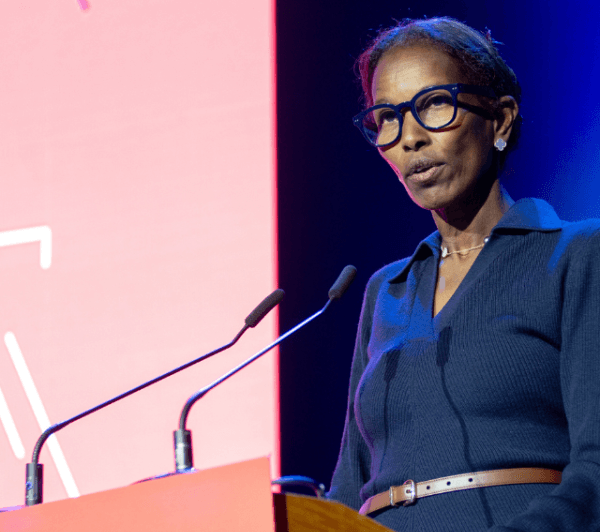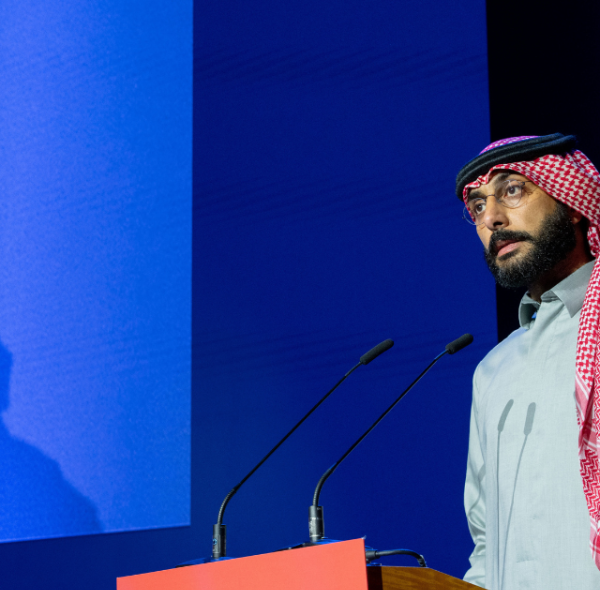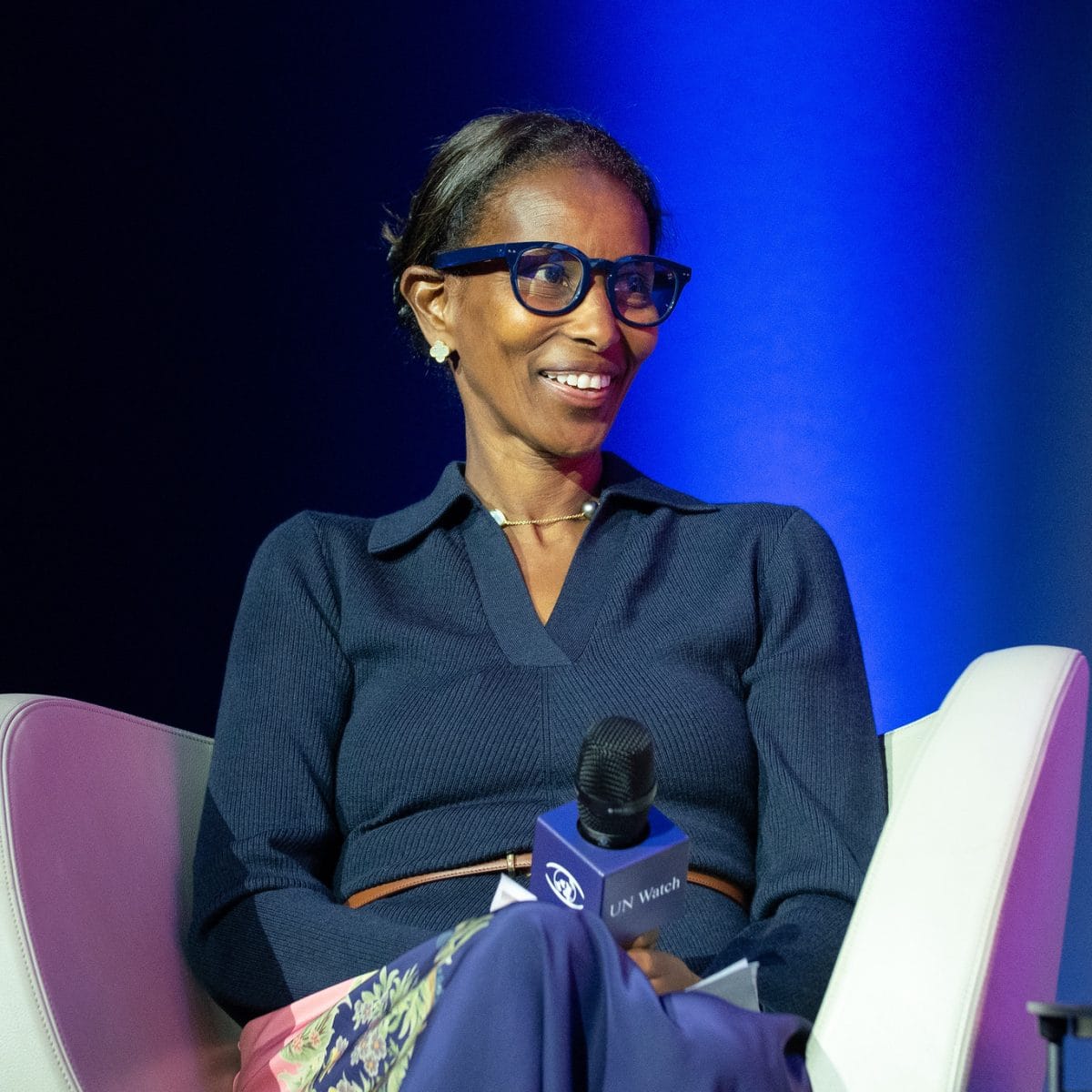

Leading author and intellectual Ayaan Hirsi Ali was presented with the Moral Courage Award before a sold-out audience at the 2026 UN Watch Gala Dinner. Upon receiving the award, Hirsi Ali delivered a powerful speech and was interviewed on stage by UN Watch Chair and former Canadian Senator Linda Frum. Here are some of the highlights from the Q&A:
Hon. Linda Frum: You have lived your life under constant threat, facing real danger and real consequences. Can you talk to us about the personal cost of living your life this way?
Ayaan Hirsi Ali: I think the question I always get is: What is the cost? I almost never get the question: What is the reward? To be honest with you, I think, as the other two award winners tonight will tell you, the reward is a lot greater than the cost. Sitting on the sidelines and watching what we watch and see renders you a complainer. It renders you a spectator.
I think I would be more depressed and downcast if I simply watched than if I stood up and did something about it, however small. The first thing I did seemed very small to me. I didn’t wear a uniform. I wasn’t on the front lines, as members of the IDF are. I didn’t discover anything revolutionary.
I simply spoke up. I was inspired by the insight that evil proliferates when good people do nothing. And I think doing something — however small it is, however small it may seem to you — is much more rewarding than meditating on what the cost might be.
Hon. Linda Frum: You really are a remarkable person. In a way, I suppose it’s unfortunate that such courage is considered remarkable. We admire somebody who has the courage that you do because, while you may downplay it, it is rare and unusual for people to stand up and speak out.
We know the reasons why so many people are afraid to do so. There are consequences — social consequences, consequences for friendships, and consequences for careers. When you want to inspire people to be more like you and to take that kind of stand, what advice do you have for people who feel that fear and need to overcome it?
Ayaan Hirsi Ali: Just do it. It’s hard to give advice. I’ve spoken to different people at different moments and in different settings. I don’t know if we’re completely coming out of it, but in both Canada and the United States we’ve lived through this phenomenon called cancel culture, where fellow academics and people in positions of leadership hesitate to speak out because they may lose their jobs. It might have consequences for their children or their social lives.
The kinds of conversations we have are very different from those I have with a young woman fleeing a forced marriage who comes to me through my organization and asks, “What should I do now? Should I run away from home?” To some of these young women, I have said, “Maybe it’s not the right time to run away.” To those who have already run away and receive a letter from home saying, “Come back,” I say, “I don’t think it’s wise to go back.”
But to a professor of history, classics, or political science, I would say: yes, it is worth speaking out. It may have consequences for your job in the short term, but before long you’ll stand out as a brave voice. The one thing I do know is that I’ve been speaking out for the last 25 years, and not once have I regretted doing so.
Hon. Linda Frum:On the topic of shocking moral inversions, let’s touch briefly on the post–October 7 world. For the Jewish community, it was difficult to comprehend the reaction that followed—in academia, on campuses, within human rights organizations, NGOs, and cultural institutions. Were you surprised by what happened after October 7, or did you see it coming all along?
Ayaan Hirsi Ali: Yes and no. I wasn’t surprised, but I was surprised by how widespread it was. It spread like a wildfire. My husband and I have spent many years in academia. We were familiar with the BDS movement. We were accustomed to hearing critical race theory narratives. I was used to pushback from organizations such as the Council on American-Islamic Relations and what I view as the broader Muslim Brotherhood infrastructure.
I knew these forces existed on American campuses. So I wasn’t surprised by the existence of these attitudes, but I was surprised by their reach and intensity. And, of course, I was saddened by it.
I must also say that I was pleasantly surprised by Israel’s resilience. At that moment, Israel set aside its internal political divisions and focused on the task at hand, and it has continued to do so. I have watched that with great admiration.
My hope is that Israel’s example will inspire Europeans and Americans — not by contributing to the rise in antisemitism that we have unfortunately witnessed, but by encouraging democratic nations to do what Israel has done: regain and nurture their foundational creed.
By that, I mean recovering a sense of doctrinal confidence and passing it on to future generations — young people who can answer fundamental questions such as: Why am I defending this place? What values am I preserving? What am I going to pass on to my children? What, ultimately, is worth sacrificing for?
Those are questions that Israel understands deeply. And I believe Europe and America need to recover that same sense of purpose and conviction.