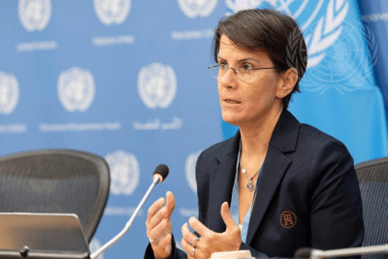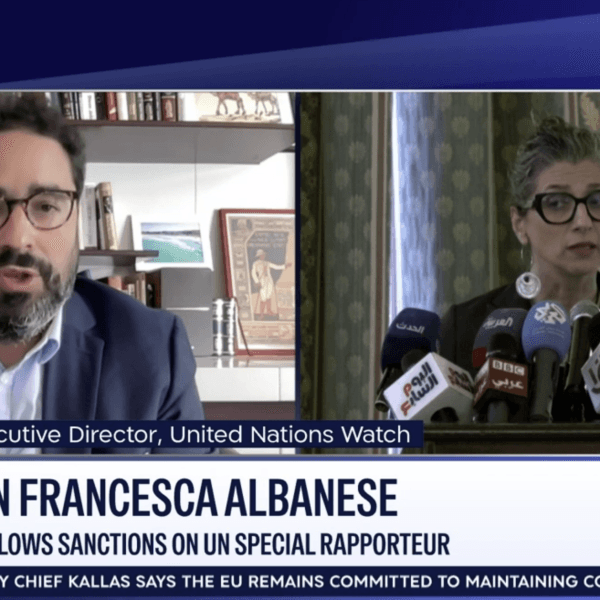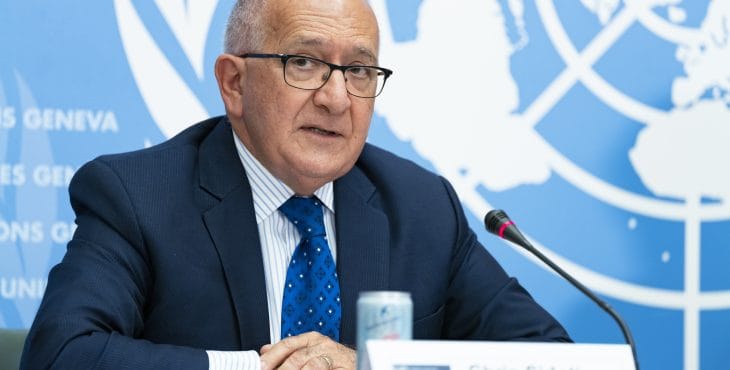
On June 23, 2026, the Pillay Commission submitted to the UN Human Rights Council a 94-page conference room paper titled “The essence of childhood has been destroyed”: Israel’s deliberate targeting of Palestinian children in the Occupied Palestinian Territory since 7 October 2023. Pursuant to its founding resolution, A/HRC/RES/S-30/1, this Commission is mandated to produce two reports per year—one to the Human Rights Council and one to the General Assembly. Having already submitted its annual report to the Human Rights Council, the present report was not required under the Commission’s mandate. The Commission nevertheless chose to devote substantial additional resources to producing a report aimed at substantiating allegations of war crimes and crimes against humanity against Israel for use in international legal and diplomatic proceedings.
This Conference Room Paper appears to be presented under the Commission’s mandate to “collect, consolidate and analyse evidence” in order to “maximize the possibility of its admissibility in legal proceedings,” such as before the International Criminal Court (“ICC”) or the International Court Justice (“ICJ”). The UN Guidance and Practice for fact-finding missions provides that evidence must be evaluated for its “reliability” and “truthfulness,” that investigations must be conducted with “integrity,” meaning “without any bias,” and that factual findings must be “adequately corroborated” by at least two other “independent and reliable” sources.
Yet, as detailed below, the Commission relies on a one-sided evidentiary record and repeatedly draws conclusions regarding intent, knowledge, and targeting decisions from witness testimony that is often impossible to independently verify. It further builds its findings on layers of inference and assumption that are presented as established fact, despite lacking sufficient evidentiary support. At the same time, it disregards key facts that contradict its conclusions, including evidence that Hamas operated from civilian areas and recruited and used children in hostilities. This selective treatment of the evidence raises serious questions regarding the impartiality and integrity of the investigation.
These shortcomings would be troubling in any fact-finding exercise. They are particularly concerning here because the Commission’s findings are intended to inform international legal proceedings, including before the ICC and the ICJ. Findings of this nature—particularly those purporting to establish intent and criminal responsibility—would ordinarily require rigorous testing and corroboration before being relied upon in judicial proceedings. Yet international courts have an established practice of relying on UN reports as evidence. This report therefore undermines not only the integrity of international fact-finding, but also the application of international law and confidence in the UN system as a whole.
A summary of UN Watch’s detailed legal rebuttal follows.
CLICK HERE FOR THE FULL LEGAL REBUTTAL
By Salo Aizenberg
The Independent International Commission of Inquiry on the Occupied Palestinian Territory, including East Jerusalem (“COI”), issued a 94-page report (the “Report”) alleging that Israel deliberately targeted Palestinian children, with a particular focus on the war in Gaza. These are among the gravest accusations possible under international law, carrying implications of war crimes, crimes against humanity, and genocide. Yet despite the extraordinary nature of these allegations, the Report fails to provide even a single verified example demonstrating that Israel Defense Forces (“IDF”) personnel identified an individual as a civilian child and deliberately selected that child for death for no purpose other than killing the child. Instead, the report repeatedly substitutes the tragic fact that children died during the war for proof of deliberate targeting.
The Report’s conclusions are built on layers of speculation and inference unsupported by direct evidence at every stage of the analysis. In each incident recounted, the COI cannot conclusively determine whether Israeli forces fired the shot, whether militants were present, whether combat was occurring nearby, whether any threat existed, or what battlefield circumstances surrounded the incident. Yet despite these uncertainties, it repeatedly reaches definitive conclusions regarding Israeli responsibility and intent. In each case, the COI constructs an entire narrative of intentional killing through stacked assumptions rather than verified facts, transforming uncorroborated allegations into definitive findings of criminal conduct.
At the same time, the COI systematically removes Hamas and Palestinian Islamic Jihad (“PIJ”) from the battlefield narrative, portraying the Gaza conflict as though the IDF, acting under orders from Israeli political and military leadership, was engaged solely in the deliberate killing of civilians, particularly children. Across 94 pages, the Report never acknowledges that the IDF was fighting a heavily armed force of tens of thousands of Hamas and PIJ operatives who constructed hundreds of kilometers of tunnels, embedded military infrastructure throughout civilian areas, and routinely operated from homes, schools, hospitals, mosques, and displacement zones.[1] The result is a fictionalized account of the conflict in which there is no armed opposition, no complex urban battlefield, and no armed actors in Gaza other than the IDF. Combined with the erasure of militant activity in the West Bank, this distortion enables the COI to advance the fabricated narrative that Israeli forces were trained, directed, and deployed to deliberately target children as a matter of policy.
Such deficiencies strip the Report of legal credibility and render it indistinguishable from advocacy framed as serious analysis. The Report’s extreme length is intended to create the impression of rigorous evidentiary and forensic review, yet it still cannot mask the fundamental absence of reliable proof for its central allegations. An accusation that Israeli soldiers deliberately identified and killed children cannot rest on speculative reconstructions of battlefield events while systematically excluding military context and contradictory evidence. This rebuttal examines the central defects of the Report and demonstrates why the evidence presented cannot sustain a finding that Israel deliberately targeted children. A summary of the Report’s principal deficiencies is as follows:
1. Failure to provide corroborating evidence of any incident of IDF soldiers targeting children: A review of the incidents cited by the COI shows no evidence supporting the report’s headline allegation. In none of the cases can the COI definitively establish that a civilian Palestinian child was identified by an IDF soldier and intentionally targeted for death. That conclusion is speculative throughout. The COI’s methodology effectively assumes that a child killed in Gaza was both killed by the IDF and intentionally targeted merely because the child died.
2. Erasure of Hamas as a belligerent: The Report erases Hamas and other armed groups as active belligerents despite their deployment of tens of thousands of operatives throughout Gaza and their extensive military infrastructure built over 17 years, including vast tunnel networks, weapons stockpiles, booby-trapped buildings, and command facilities embedded within civilian areas.[2] There is no acknowledgement or discussion of Hamas’s use of hospitals, schools, mosques, residential buildings, and humanitarian zones for military purposes, or its openly acknowledged strategy of operating from within the civilian population.[3] A reader would come away believing the IDF was deployed in Gaza against only women and children. By ignoring the existence of Hamas and other armed groups as an opposing fighting force in Gaza, the COI creates a framework in which the deaths of children are presumed to reflect deliberate targeting rather than the realities of combat in an urban battlefield.
3. Presumption of no military presence: Throughout its incident-by-incident assessments, the COI repeatedly makes comments such as: “The Commission could not find any indication of a threat towards members of the Israeli security forces” (g., para. 58). But the COI has no way of knowing whether Hamas or PIJ operatives were present, engaged in combat, or operating from the area at the time of an incident, especially given Hamas’s exclusive use of civilian clothes for combat and its operations from apartments and concealed tunnel shafts beneath civilian areas. This assumption is foundational to the entire report. By presuming the absence of active combat or a military presence from the outset, the COI treats the death of a child not as a possible consequence of urban warfare, crossfire, militant activity, or error, but as presumptive evidence of intentional targeting by the IDF.
4. Reliance on local sources: The COI relies on family testimony to determine how children were killed, yet provides no explanation for how family members could know the circumstances of a strike or whether a child was deliberately targeted. Witnesses could not realistically know the full Gaza battlefield environment surrounding an incident, including the positions and movements of IDF and militant forces across a dense, 360-degree urban combat zone. Nevertheless, the COI accepts claims of certainty from family members about the source of fire and responsibility for a death.
5. Doctors as battlefield and ordnance experts: The COI repeatedly relies on medical professionals as expert testimony on military events and ordnance identification, even though doctors and hospital staff are not trained in weapon systems, ballistics, battlefield reconstruction, or combat analysis. This reliance is itself fatal to the report’s methodology. For example, the report cites a doctor who claimed, “she saw around five children shot by quadcopters” (para. 64), yet provides no explanation for how the doctor could determine the source of fire, the circumstances of the shootings, or whether the bullets came from Israeli quadcopters at all. These hospital-based testimonies appear throughout the report as featured evidence.
6. Unsupported attribution of bullets and ordnance: The COI repeatedly cites images of recovered bullets or fragments as proof that IDF forces were responsible for a shooting, yet provides no documented chain of custody, independent forensic verification, or explanation of how the munitions were authenticated. The report simply assumes that photographs or testimony regarding bullets presented by local hospital staff originated from Israeli weapons systems. Militant groups in Gaza also use a wide range of ammunition and captured weaponry, making unsupported attribution methodologically unsound. Without forensic analysis establishing the origin of a projectile and maintaining a verified chain of custody from the scene to investigators, the COI cannot reliably determine who fired a shot, let alone infer intentional targeting.
7. No mention of Hamas’s infiltration of Gaza hospitals: The report simultaneously treats Israeli operations against hospitals as presumptively criminal while also relying heavily on testimony from doctors and medical staff within those same institutions as neutral and authoritative evidence. Yet extensive evidence emerged throughout the war showing that Hamas used hospitals for military purposes, including command centers, tunnel infrastructure, and hostage detention.[4] Numerous healthcare workers and hospital personnel were later identified by Hamas and PIJ themselves as operatives, often commanders. This context is critical both to assessing the legality of military operations involving hospitals and to evaluating the credibility and independence of testimony originating from within institutions infiltrated by Hamas and PIJ.
8. Invention of new Laws of Armed Conflict and application of them to Israel: The COI asserts that if Israel attacks a location knowing civilians, including children, are present and would be killed, the attack is therefore unlawful and constitutes evidence that civilians were intentionally targeted. This directly contradicts the established Law of Armed Conflict (LOAC), which permits attacks on military objectives even when civilian casualties are foreseen, provided the applicable rules governing distinction, proportionality, and precautions are satisfied. Under the COI’s invented framework, military objectives placed in civilian structure or otherwise embedded among civilians effectively become permanently immune from attack, and any resulting civilian deaths are treated as proof of extermination, willful killing, and deliberate targeting.
9. Failure to Address Child Soldiers: Although the COI briefly acknowledges reports concerning the use of children by Palestinian armed groups (para. 11), it does not investigate the issue or acknowledge that not all minors in Gaza or the West Bank are innocent civilians. This omission is highly significant. Hamas and other armed factions have long operated military training camps for minors, promoted armed participation among youth, and celebrated teenage fighters as martyrs.[5] Minors as young as twelve years old killed in Gaza and the West Bank were later publicly praised by Hamas and PIJ as combatants.[6] A report centered on children in armed conflict cannot credibly ignore the widespread exploitation and use of minors by Palestinian armed groups for combat and military activity.
[1] Hamas’ use of human shield in Gaza, NATO Strategic Communications Center of Excellence (June 6, 2019), https://stratcomcoe.org/publications/hybrid-threats-hamas-use-of-human-shields-in-gaza/87.
[2] How Hamas is Fighting in Gaza: Tunnels, Traps, and Ambushes, New York Times (July 13, 2024), https://www.nytimes.com/2024/07/13/world/middleeast/hamas-gaza-israel-fighting.html; The Tunnels of Gaza: How the subterranean maze below the Gasa Strip works, New York Times (November 10, 2023), https://www.nytimes.com/interactive/2023/11/10/world/europe/hamas-gaza-tunnels.html.
[3] Gaza Chief’s Brutal Calculation: Civilian Bloodshed Will Help Hamas, Wall Street Journal (June 10, 2024), https://www.wsj.com/world/middle-east/gaza-chiefs-brutal-calculation-civilian-bloodshed-will-help-hamas-626720e7.
[4] Hamas’s Human Shield Strategy in Gaza, Henry Jackson Society (April 2025), https://henryjacksonsociety.org/wp-content/uploads/2025/05/HJS-Hamass-Human-Shield-Strategy-in-Gaza-Report-WEB.pdf.
[5] Here’s what a Hamas training camp for teens looks like, The Washington Post (January 29, 2015), https://www.washingtonpost.com/world/heres-what-a-hamas-training-camp-for-teens-looks-like/2015/01/29/ef0b4092-a33f-11e4-9f89-561284a573f8_story.html.
[6] The Child Soldiers of Gaza, @Aizenberg55 X (February 17, 2026, 5:35 PM), https://x.com/Aizenberg55/status/2023783492446789844.