By UN Watch | Interview on NewsNation’s Morning in America
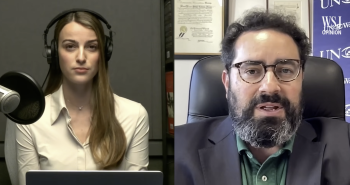
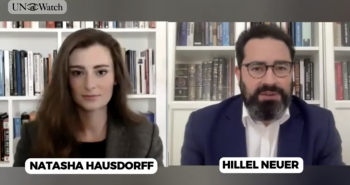
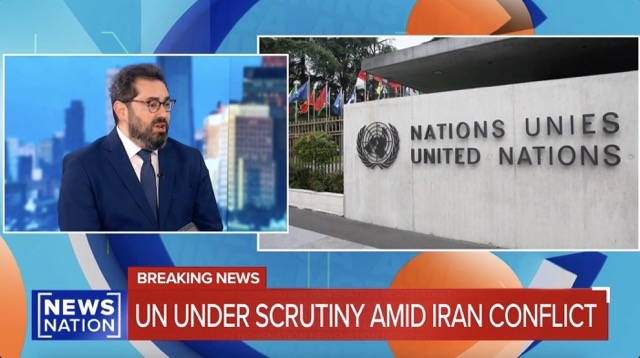
UN Watch Executive Director Hillel Neuer appeared on NewsNation’s Morning in America with host Hena Doba to discuss the ongoing conflict involving Iran, the reaction of the United Nations, and the implications for the Iranian people and the wider Middle East.
During the interview, Neuer argued that while Iran’s actions have destabilized the region for decades, much of the UN system has focused its criticism on the United States and Israel.
“The Iranian regime has the blood of hundreds of Americans on its hands,” Neuer said. “It chants ‘Death to America’ and ‘Death to Israel,’ arms terror proxies across the region, and massacres its own people. Yet UN agencies condemn the U.S. and Israel while ignoring Iran’s crimes.”
UN Response to Iran
“The Gulf Arab states who’ve been hit enormously by Iran got the Security Council to adopt a very strong resolution condemning Iranian aggression against them,” Neuer said. “China and Russia were afraid to veto it, so they abstained.”
However, Neuer said the broader UN system has taken a different tone.
“The rest of the UN agencies, led by Secretary-General António Guterres, have been condemning the United States and Israel very strongly,” Neuer said, “while barely mentioning decades of Iranian aggression.”
Iran’s Threats and Proxy Forces
Neuer described Iran as a central force behind militant groups across the region.
“The Iranian regime chants every day ‘Death to America’ and ‘Death to Israel,’ manufactures missiles, pursues an illicit nuclear weapon, and arms terror proxies,” he said. “Iran has built proxy terror networks — Hamas, Hezbollah and the Houthis — spreading violence across the Middle East.”
He also referenced attempts by Iranian authorities to target dissidents abroad.
“They even tried to kidnap and kill my friend here in New York City, journalist and activist Masih Alinejad,” Neuer said. “They have attempted to assassinate American leaders as well.”
Iranian Protests and Repression
Neuer said the Iranian population has repeatedly risen up against the regime, often facing violent crackdowns.
“I’m in touch with Iranian activists on the ground every day. They want this regime gone,” he said. “They see the regime as occupying their country.”
“The Iranian people rose up in the hundreds of thousands, if not millions,” Neuer continued. “They were gunned down — tens of thousands of people.”
He added that many Iranian dissidents see the weakening of the regime as a potential turning point.
“They’ve been pleading with the international community: help us remove this occupying regime,” he said. “They’ve been terrorizing us for decades.”
Possibility of Accountability
Neuer said the current moment could represent an opportunity to address decades of human rights abuses.
“We’re talking about 47 years of systematic repression,” he said. “The regime has been condemned even by the UN General Assembly for attacking women, minorities, journalists and democracy activists.”
“If this regime is weakened and dismantled, there will be a chance for real accountability.”
Path Forward
Asked about diplomacy, Neuer said any long-term political solution would require addressing what he described as the regime’s military and nuclear ambitions.
“The missile threat, the nuclear threat, and the terrorizing of their own people — that has to be dismantled first,” he said. “Once that happens, if new leadership emerges, there will be room for diplomacy.”
Neuer also pointed to Iran’s influence in Lebanon through Hezbollah.
“Hezbollah has effectively taken over Lebanon for decades,” he said. “They are a terror proxy of the Iranian regime.”
“The path to diplomacy,” he concluded, “will come when the terror network afflicting the Middle East — run by Iran through Hezbollah, Hamas and the Houthis — is dismantled.”