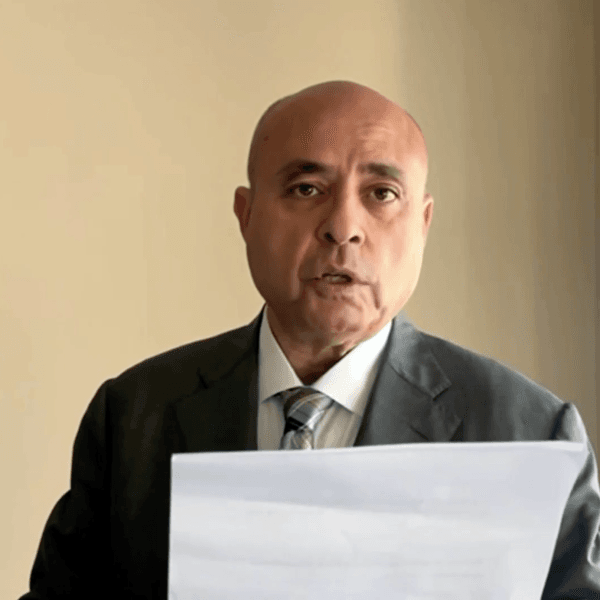
Libyan Dissident Asks UN:
“Why is Qaddafi on the Human Rights Council?”
UN Human Rights Council, 15th Session
Statement by Freedom House, Sponsored by UN Watch
Delivered by Mohamed Eljahmi
Geneva, 20 September 2010
Mr. President,
This Council was created with the promise to elect countries that promote and protect human rights.
We ask: Does the UN’s election of Libya live up to this promise?
For me, this question is not academic. My late brother, Fathi Eljahmi, was a heroic dissident in Libya.
Under the rule of Mr. Qadhafi, membership in political parties or independent labor unions are crimes punishable by death. The fulfillment of citizens’ needs is tied to their absolute loyalty to Mr. Qadhafi.
Ordinary Libyans are accountable to a vast security apparatus. Their actions are scrutinized by Orwellian institutions, punishable by ruthless death squads.
Despite the danger, my brother Fathi chose to speak out for free speech and human rights. He was a courageous man. He was also my mentor and a father figure. He was an unconditionally loving and generous husband, son, and brother. Fathi was blessed with a great mind and a passion for equality and justice.
In 2002, he publicly set out his vision for a constitution, free speech, free enterprise, and an investigation into the massacre of 1200 prisoners at Abu Slim.
As a result, the government imprisoned Fathi for 17 months, until then-Senator Biden, who is now the US Vice President, interceded on his behalf. As soon as he was released, Fathi again spoke out for freedom and human rights. Two weeks later, he was sent back to prison, and subjected to five years of intense torture and isolation, leading to his death on May 21, 2009.
My family asks: When will this council establish an international investigation into my brother’s imprisonment, torture and death?
Why is the government of Mr. Qadhafi, which tortured and killed my brother—and which is one of the world’s worst violators of human rights—now an elected member of the UN Human Rights Council?
When will this council do the right thing, and stand with the Libyan people, to defend their human rights?
Thank you, Mr. President.
LIBYA RESPONDS IN RIGHT OF REPLY
(trascription from English interpretation provided by the UN)
Libya (Ambassador Ibrahim Aldredi): Thank you, Mr. President. I am making this statement to respond to the statements by certain irresponsible and imperious-type NGOs which are trying to put the work of the Council and to immobilize people using allegations which are really groundless and contentious. Mr. President, we would like the interventions by such NGOs to be deleted from the record — last Thursday’s intervention, and some this afternoon. These should be deleted because they are interventions which are incompatible with our procedures.
United States (interrupts with Point of Order): We would like to highlight that the U.S. believes that accredited NGOs must be permitted to speak, and that their speeches be included in the record. As you know, the voices of civil society are extremely important to the work of this council. Though member states, including the United States, may occasionally disagree with the content of their statements, the council should cultivate an environment of openness where we can discuss our differences. Thank you.
Libya: I would state to the honorable Council that this should not be a forum for all sorts of allegations when they are baseless and not grounded in truth. The Libyan Arab Jamahariya under Muammar Al-Qaddafi was honored to be elected to the Council, and the positive role of Libya was estimated in Africa and throughout the world with a view to strengthening human rights. My delegation is fully prepared to cooperate with you, even if other members are not, to promote the work of the council, to ensure it is a genuine forum for protecting fundamental human rights and freedoms.
Human Rights Council President (Ambassador Sihasak Phuangketkeow of Thailand): We take note of the points you raised.
Libya: We are not against the participation of NGOs, only against irresponsible statements by irresponsible NGOs.
(Translation from the original speech in Arabic)
Libya (Ambassador Ibrahim Aldredi): Thank you Mr. President, this statement is meant to clarify things. In order to serve political purposes for specific intentions, some irresponsible, imperialist in nature and with Zionist affiliation NGOs are trying to distort the work of this honorable Council. They recruit some individuals to give testimonies which have no basis of truth and serve political purposes for specific intentions. We hope Mr. President that you instruct the secretariat to delete the statements of these NGOs, who spoke about my country this evening and on Thursday September 16, 2010 from the broadcast and from the Council’s sessions. They should be deleted because they didn’t adhere to following the basis of discussions in our honorable Council or for lack of adherence to the UN’s discussion format.
[US interrupted with Point of Order]
Libya: Mr. President, our honorable Council shouldn’t be a place for fabricated testimonies or lies, which the claimants are trying to delude the Council with what is baseless and untruthful. My country is bigger than this nonsense and the Great Jamaheerya under the Leadership of the Brother Leader Muammar Qadhafi was honored by the entire world with its membership in the Human Rights Council. This was done as a token of appreciation for Libya’s international role in supporting peace and security, specifically on the African Continent and for its participation in the protection and promotion of human rights. And my country’s delegation is fully ready to work with you, Mr. President, and the rest of the membership to raise the work of this Council to higher levels and make it a forum to promote human rights and basic rights. Thank you Mr. President.