FOR IMMEDIATE RELEASE
UN Watch investigation finds the agency substituted paperwork and promises for meaningful change
GENEVA, 14 September 2026 — UNRWA’s claim to have completed 41 of the 50 reforms recommended by the landmark Colonna Review substantially overstates the changes achieved on the ground, according to a major new report released today by UN Watch.
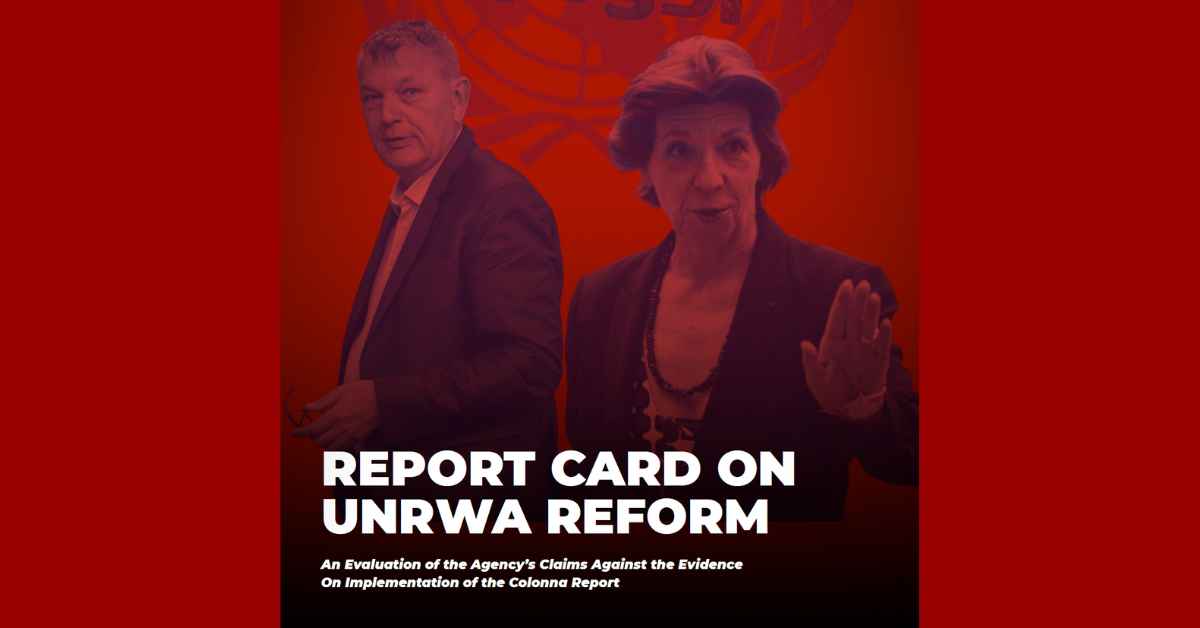
The “Report Card on UNRWA Reform” examines UNRWA’s implementation of every recommendation issued by the Independent Review Group led by former French Foreign Minister Catherine Colonna.
Commissioned by UN Secretary-General António Guterres following revelations that UNRWA employees participated in the October 7 massacre and amid the suspension of $450 million in donor funding, the Colonna Review was intended to determine whether the agency’s neutrality safeguards were “fit for purpose” and to restore donor confidence.
Two years later, UNRWA says that 41 recommendations are completed. Yet UN Watch’s analysis finds that UNRWA frequently measured administrative activity instead of meaningful reform. At most, the new report concludes, 13 of Colonna’s 50 recommendations have actually been completed as prescribed.
“UNRWA has graded its own homework and awarded itself high marks,” said UN Watch Executive Director Hillel Neuer. “But issuing a policy is not the same as enforcing it. Drafting a plan is not the same as implementing it, and closing a recommendation does not mean that the underlying problem has been solved.”
“On paper, UNRWA reports sweeping progress. On the ground, its employees continue to be exposed as members and supporters of terrorist organizations, hateful educational content persists, and Hamas-dominated unions continue to obstruct neutrality and discipline.”
Key Findings
- UNRWA redefined what counts as completion. Under its “Minimum Viable Product” methodology, UNRWA allows itself to classify a recommendation as completed once it considers the recommendation’s “core functional objective” achieved—even where further measures remain necessary and the reform has not been fully institutionalized.
- UNRWA still lacks a demonstrated system for screening its workforce for Hamas membership. Its principal sanctions screening relies on the UN Security Council Consolidated Sanctions List, which does not list Hamas or Palestinian Islamic Jihad.
- External investigations continue to uncover what UNRWA’s internal systems missed. In June 2026, the USAID Office of Inspector General referred 108 current or former UNRWA personnel for suspension or debarment based on evidence linking them to the October 7 attacks or Hamas’s military wing. Days later, UNRWA dismissed 70 Gaza employees following a security assessment, while insisting that the dismissals did not validate the allegations against them. See also UN Watch’s statement on the dismissals.
- UNRWA closed union reforms that were never implemented. The agency classified revisions to its Staff Union Statute as completed after merely drafting and transmitting a proposed statute, even though the unions had not adopted it. Yet within months of this supposed reform achievement, the UNRWA Gaza Staff Union—still under unchanged leadership—mobilized against the dismissal of the 70 terror-linked employees and demanded their reinstatement. UN Watch’s report Schools in the Grip of Terror documents how Hamas-linked officials continue to dominate UNRWA staff unions.
- One recommendation was closed as “unimplementable.” Recommendation 46 called for outsourcing union pay-setting functions. UNRWA determined that the measure could not be implemented, yet still counted the recommendation as closed.
- Vetting reforms remain dependent on funding. UNRWA closed recommendations concerning commercial screening and the vetting of union officials after developing pilots and costed plans, although the actual systems had not been fully deployed.
- Educational reform is measured by procedures rather than content. UNRWA cites reviews, digital platforms, teacher training and engagement with UNESCO as evidence of progress, while post-Colonna assessments by IMPACT-se continue to identify antisemitism, glorification of terrorism and incitement in the 2025–2026 Palestinian Authority curriculum used in UNRWA schools.
- Training cannot prevent deliberate military misuse of UNRWA facilities. The Colonna Review acknowledged that UNRWA lacks the policing, military and investigative capabilities required to detect weapons, tunnels and military activity at its installations. New policies and awareness programs do not remedy this fundamental incapacity. The standard inspection regime still does not operate normally in Gaza, where the most serious allegations have arisen.
- UNRWA declared a “cultural shift” completed while describing it as ongoing. The agency classified all recommendations on enhanced cooperation as complete even as its own reporting acknowledged that the required institutional transformation remained underway.
Structural Failure, Not a Paperwork Problem
The report finds that many of the Colonna recommendations proposed potentially useful administrative improvements. However, they did not adequately address the deeper institutional causes of UNRWA’s neutrality crisis: terrorist infiltration among personnel, Hamas influence over staff unions and schools, the agency’s inability to investigate clandestine affiliations, and an institutional culture deeply embedded in the Palestinian political struggle against Israel.
“The central question is not how many policies UNRWA has written, training sessions it has conducted or recommendations it has marked complete,” Neuer said. “The question is whether UNRWA can prevent its schools, staff and facilities from serving terrorism and incitement. The evidence examined in this report shows that it cannot.”
“The Colonna process was designed to reassure donors. Our report tests that reassurance against the evidence—and finds a profound gap between reform claimed and reform achieved.”
UN Watch called on donor governments not to rely on UNRWA’s self-reported completion figures when deciding whether to resume or continue funding. Governments should require independent verification of each claimed reform and assess whether it has produced measurable changes in staff conduct, educational content, union activity and the protection of UN facilities.
“Donor states were promised reform,” Neuer said. “Instead of delivering proof of results, UNRWA offers policies on paper, pilot projects awaiting funding, or recommendations closed by administrative decree.”
The report concludes that UNRWA’s failures cannot be repaired through managerial adjustments. Its mandate, workforce and role in Palestinian society are inseparable from a political project that perpetuates refugee status, the claimed “right of return” and rejection of Israel. UNRWA employs more than 28,000 people, overwhelmingly locally recruited Palestinians, while only about 120 staff are international.
“The Colonna reforms cannot make politically neutral an institution whose fundamental structure and purpose sustain the grievances and ideology exploited by Hamas,” said Neuer. “Humanitarian assistance for needy Gazans must continue, but it should be delivered through institutions capable of operating independently of terrorism and the political perpetuation of the conflict.”
The Report
The full report, Report Card on UNRWA Reform: An Evaluation of the Agency’s Claims Against the Evidence on Implementation of the Colonna Report, is available here. Related UN Watch resources include the UNRWA Terror Network and Schools in the Grip of Terror.
About UN Watch
UN Watch is a Geneva-based independent human rights organization accredited in special consultative status to the United Nations Economic and Social Council. Founded in 1993, UN Watch monitors the performance of the United Nations according to the principles of its Charter and advocates for victims of human rights abuses worldwide.