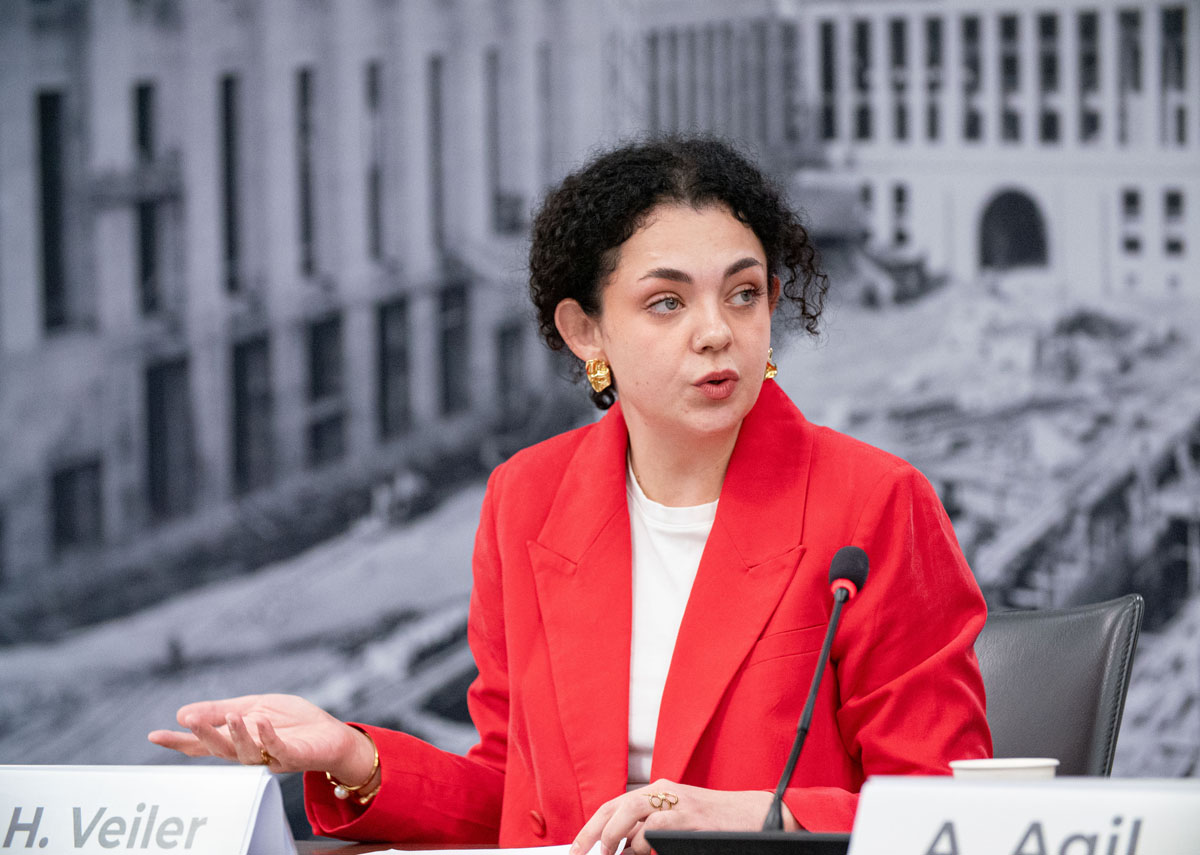
European universities are struggling to protect their own students. Representing over 160,000 Jewish students across Europe, EUJS President Hanna Veiler addressed UN Watch’s official side event at the 63rd session of the UN Human Rights Council, “Empowering Future Leaders through Human Rights Education,”
exposing the severe physical violence and political intimidation happening on campuses, particularly in the wake of the October 7 massacres.
She explains why abstract commitments to human rights are meaningless if institutions fail to translate them into safe, democratic spaces for everyone.
Prepared Remarks:
Excellencies, distinguished representatives of Permanent Missions, dear colleagues,
Fifteen years after the adoption of the United Nations Declaration on Human Rights Education and Training, I believe there is value in reflecting not only on how effectively we teach young people about human rights, but also on whether our educational institutions provide them with the practical capacity to exercise, defend and uphold those rights.
I speak today as President of the European Union of Jewish Students, representing more than 160,000 young Jews across Europe. Much of our work takes place in universities and other educational environments, precisely the spaces in which young people first encounter democratic institutions, organise collectively, engage with opposing views and, in many cases, become politically and socially active.
Our experience has shown us that these environments can be extraordinarily powerful spaces for democratic participation, but also that there can be a considerable distance between teaching human rights as a set of principles and ensuring that those principles shape institutional practice.
This distinction has become particularly visible for Jewish students since the massacre of 7 October 2023 and the subsequent war. Universities across Europe have become important spaces for political debate about Israel and the Middle East. Such debate is a legitimate and necessary part of academic and democratic life. At the same time, Jewish students across Europe have faced harassment, intimidation, exclusion and, in some cases, severe physical violence.
Their connections to Israel, which for many are an integral part of Jewish identity, family life and community, have repeatedly been turned against them. Jewish students have been expected to justify the actions of an Israeli government, pressured to publicly distance themselves from Israel, or treated with suspicion simply for expressing a connection to the country.
Most concerningly, these experiences continue too often to be dismissed, relativized or explained away, while the antisemitic nature of incidents targeting Jewish students is questioned or denied. These experiences have demonstrated the difficulty that educational institutions can face when abstract commitments to human rights have to be translated into decisions in highly polarized environments.
Universities must be capable of protecting freedom of expression and political participation while also recognizing when political discourse crosses into discrimination, harassment or the collective attribution of responsibility to individuals because of their identity. Human rights education therefore cannot end with knowledge of legal frameworks or international declarations.
Young people also need to understand how those principles apply when rights come into tension, when public debate becomes deeply contentious, and when defending the rights of another person may be politically or socially uncomfortable. There is also a broader lesson here that extends far beyond the experience of Jewish students. If human rights education is to be genuinely universal, it must equip young people not only to defend the rights of communities to which they themselves belong, but also to recognize and defend the rights of others.
For Jewish organizations, combating antisemitism cannot be separated from a broader commitment to challenging racism, anti-Muslim hatred and other forms of discrimination. Equally, the defence of democratic freedoms cannotdepend on whether we agree with the person exercising them. The credibility of the human rights framework ultimately depends on the consistent application of its principles.
This is particularly important at a time when young people encounter political information, mobilization and increasingly also misinformation far beyond formal educational settings. Universities and schools therefore have a responsibility that goes beyond transmitting knowledge.
They should provide young people with the capacity to evaluate information critically, understand democratic and human rights institutions, engage constructively across profound disagreement, recognize discrimination and know which mechanisms are available when rights are violated.
They should also provide meaningful opportunities for young people to organize, participate in decision-making and assume responsibility within their institutions.
There is also a broader institutional dimension that we should not ignore. Human rights education cannot be separated from the credibility of the international system in which we ask young people to place their trust. Around the world, young people are taking extraordinary risks to defend fundamental freedoms, often in the face of authoritarian governments that repress dissent, restrict civil society and systematically violate human rights.
Yet some of those same governments continue to participate in international institutions, build political alliances and seek to weaken, obstruct or discredit mechanisms designed to hold states accountable. The Islamic Republic of Iran is one example, but it is by no means the only one.
For young human rights defenders living under repression, this contradiction is not an abstract institutional problem, it directly affects whether international mechanisms can meaningfully support their struggle. If we want young people to believe in the international human rights system, that system must demonstrate that political influence cannot place governments beyond meaningful scrutiny and accountability.
For those of us working with young people, this also means recognizing them not simply as recipients of human rights education, but as actors in the protection of human rights. Across Europe, young people are already leading civil society organizations, responding to discrimination, supporting vulnerable communities and participating in democratic institutions.
If I were to leave one practical recommendation, it would therefore be to strengthen the connection between human rights education and human rights practice. A young person completing their education should understand the principles contained in international human rights instruments, but they should also know how to recognize when those principles are being violated, how to make use of the institutions designed to protect them, how to participate democratically and, crucially, how to defend the rights of people whose identities, experiences or political views may be very different from their own.
If we succeed in doing that, human rights education becomes more than the transmission of knowledge. It becomes part of building the democratic resilience of the next generation.
Thank you.