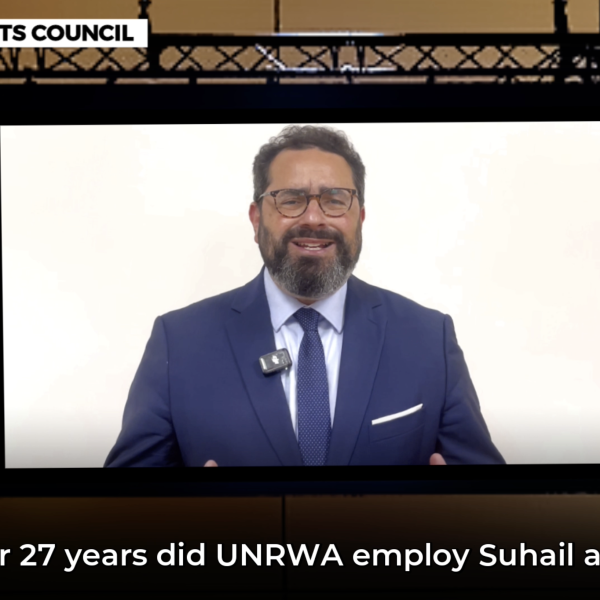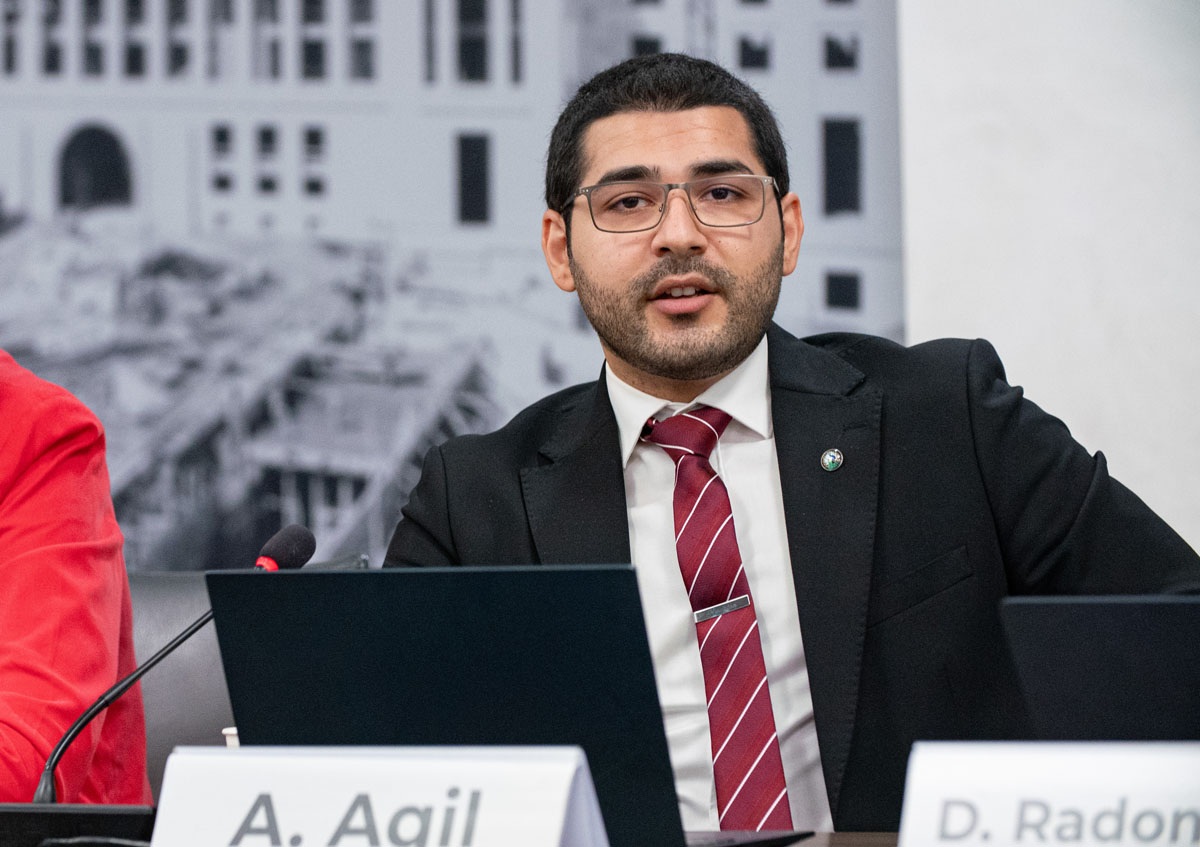
After surviving 280 days as an ISIS hostage in Syria, Kurdish journalist and human rights defender Aram Aqil issues a stark warning to the world at UN Watch’s official side event at the 63rd session of the UN Human Rights Council, “Empowering Future Leaders through Human Rights Education.”
Extremist propaganda thrives where education fails. Aqil breaks down how the erasure of historical atrocities — like the Holocaust and the Armenian, Yazidi, and Anfal genocides — leaves youth dangerously vulnerable to dehumanizing terrorist narratives.
Prepared Remarks:
Growing up under the rule of a dictatorship — I mean here both Assads, the father and the son and coming from a politically active Kurdish family and belonging to a nation persecuted by four governments in the Middle East, human rights education became, for me, far more than a concept; it became something much more personal and embedded in the struggle we have carried on for decades.
From a very young age, I assisted in publishing a political magazine called “Jîn,” a Kurdish word meaning “Life.” That magazine covered topics related to human rights and democracy. Two topics where either one alone could land you in prison for years in the best-case scenario, or cost you your life in the worst.
I’ve spent around twenty years of my life under a dictatorial regime and about a year in the grip of ISIS; since gaining my freedom, I am experiencing the privilege of living in Western Europe where democracy and human rights are privileges that cannot be taken for granted, given that millions of people are deprived of them.
In December 2024, the dictator ran away, but the dictatorship remained standing, albeit with a new flavor. A jihadi terror regime came to power, entirely unconcerned with issues of human rights and democracy; it hasn’t even once mentioned these two topics; on the contrary, they view these concepts as “an abomination or the work of the devil.”
Why do I mention all this? Because here in Europe we speak freely about human rights education, we often think about classrooms, institutions and international conventions. In other corners of the world, it is obviously not the case. In the MENA region, among 25 countries, all UN member states, only a small number have integrated human rights education into their educational systems—no more than we can count on one hand.
My own journey as a youth educator made me see a huge gap: education about atrocities and genocides that took place in history. Many young people grow up with very limited opportunities to learn about the Holocaust, the Armenian genocide, the Yazidi genocide, the Anfal Genocide against Kurds, and other mass atrocities that deeply targeted the region and its communities.
If young people do not learn how genocides happen, how propaganda dehumanizes people, and how looking away makes it even worse, it becomes much harder for them to recognize these patterns when they appear before their eyes. I was a witness to the Yazidi genocide in 2014; I saw how Turkish and Qatari propaganda networks contributed to portraying an entire community as less human and therefore as a legitimate target of violence. Later on, the same happened on October 7; I saw disturbing parallels in the way propaganda and dehumanizing narratives were used to portray civilians as legitimate targets, rather than as human beings entitled to protection.
A big part of what I have experienced changed the way I now understand human rights and its education. Studying and talking about rights is something, and being prepared to defend it is something very different, and that is where I believe human rights education still has a gap. We need to ask young people not only: “What are human rights?” We need to ask: “What will you do when those rights are denied? What will you do for those who are deprived of their rights? Those whose rights are being violated?”
Awareness alone is not enough; young generations need to learn how to practice human rights; they need opportunities to meet people whose histories are different from their own. That means teaching them how to recognize discrimination and extremist propaganda. It means developing critical thinking and media literacy. It means giving young people opportunities to engage with civil society and communities beyond the classroom. And it means creating genuine platforms where people from minority and marginalised communities can speak for themselves.
Thank you.