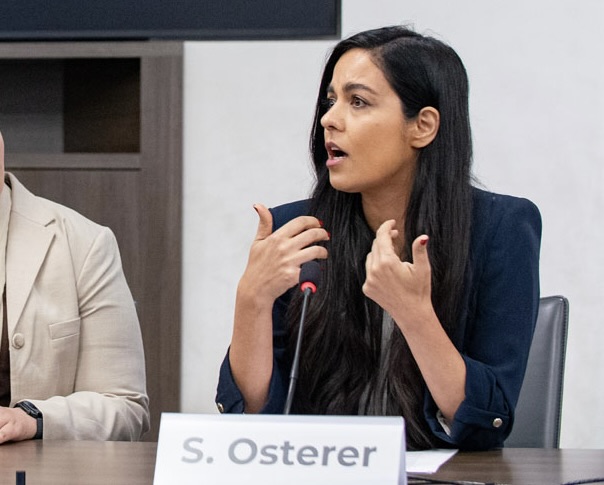
Growing up under the Islamic Republic of Iran taught Shahrzad Eden Osterer exactly how dangerous ideological indoctrination can be. Now a journalist in Europe, she draws chilling parallels between the state propaganda of her childhood and the highly polarized, ideological echo chambers found in Western universities today.
While addressing UN Watch’s official side event at the 63rd session of the UN Human Rights Council, “Empowering Future Leaders through Human Rights Education,” Osterer argues that true human rights education must teach young people to apply universal standards consistently, not selectively based on political convenience.
Prepared Remarks:
Excellencies, distinguished guests, colleagues,
I belong to the generation that grew up in Iran after the Islamic Revolution of 1979.
I grew up under an Islamist dictatorship, in a society in which fundamental rights were systematically restricted and ideology reached into almost every part of public life. Including education.
I remember my first year at school.
Every morning, we stood in rows for the morning assembly. We had to repeat slogans.
“Death to America. Death to Israel.”
There were pictures of Khomeini and Khamenei in every classroom. There were religious rituals, political messages and ideological texts.
And even as a child, I understood that what I heard at school was very different from what I heard at home.
One of the first rules I learned was this: what we discussed at home was not something I could repeat at school.
So very early, you learn to separate what you know, what you think and what you are allowed to say.
And this does not stop when you become an adult.
At university, the ideological education continued.
That experience shaped the way I look at education today.
Education is not automatically a force for freedom.
It can teach people how to think critically, how to examine evidence, how to question authority.
But it can also do the opposite.
It can tell you which conclusions you are expected to reach before you have even looked at the facts.
Years later, I left Iran and built my life in Europe.
And I became a journalist.
I reported on Iran, on repression, on protests, on women fighting for their rights, and on a younger generation that increasingly rejects much of the ideology it has been taught since childhood.
And perhaps because of where I came from, I had a very clear idea of what universities and education in democratic societies were supposed to be, Places where ideology is questioned, Where slogans are examined rather than repeated, Where evidence matters more than political loyalty.
Where young people learn precisely the things that authoritarian systems are afraid of: doubt, contradiction, independent thought.
And then I began to see things in Europe that were strangely familiar to me.
Al Quds marches.
Flags and symbols of the Islamic Republic.
Slogans and political language I knew from the country I had left.
I heard some of the same words I had been forced to repeat as a child.
At first, I saw them mainly on the streets.
Then I saw them in and around universities.
And after October 7, I saw and heard more of them.
That was a profound moment for me.
I am Iranian. I am German. And I am Jewish.
On October 7, people were murdered, tortured and abducted. Families were attacked. Young people at a music festival were hunted down. Hostages were taken into Gaza. There was sexual violence.
And then I watched the reaction.
I watched people and institutions that are normally very precise in the language of human rights suddenly become hesitant.
I watched crimes that would usually require no ideological explanation become the subject of political qualification.
I watched the identity of the victim begin to influence the way the crime itself was discussed.
And I saw this not only in political movements, but in educational spaces.
That is what brought me back to the question I had first encountered as a child in Iran:
What happens when ideology comes before facts?
Of course, a university in a democracy is not a school in the Islamic Republic. I am not making that comparison.
But I recognise a mechanism.
When the political conclusion is already decided, facts become useful or inconvenient.
Language shifts depending on who the aggressor is and who the victim is.
And universal principles slowly become selective ones.
For me, this is where human rights education has failed if it does not intervene.
The purpose of human rights education cannot simply be to teach young people the vocabulary of human rights.
The harder task is to teach them to apply the same standards when doing so challenges their own political worldview.
To recognise propaganda not only when it comes from an authoritarian government, but also when it confirms what they already want to believe.
To ask uncomfortable questions of their own political camp.
To look at evidence before choosing a narrative.
And above all, not to turn human rights into another ideology.
So if I have one recommendation today, it is this:
We need to de ideologise human rights education.
Not to make human rights less political.
But to make their application less dependent on politics.
I learned as a child what ideological education looks like.
It teaches you which slogans to repeat.
A democratic education should teach the opposite.
It should teach young people to stop when everyone around them is repeating the same slogan and ask:
Is it true?
What are the facts?
And would I apply the same standard if the victim were someone else?
If we fail to teach that, then we may teach the language of human rights.
But we are not teaching human rights.