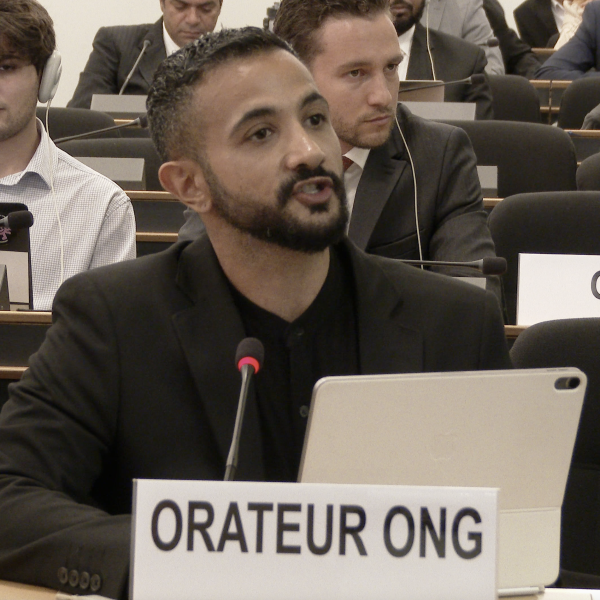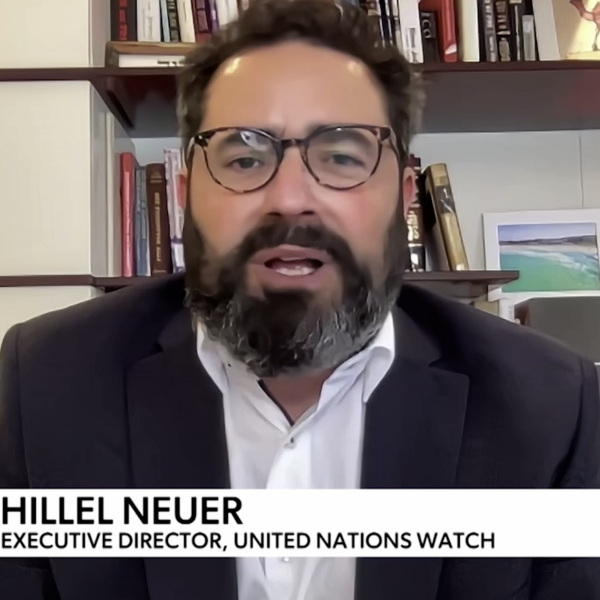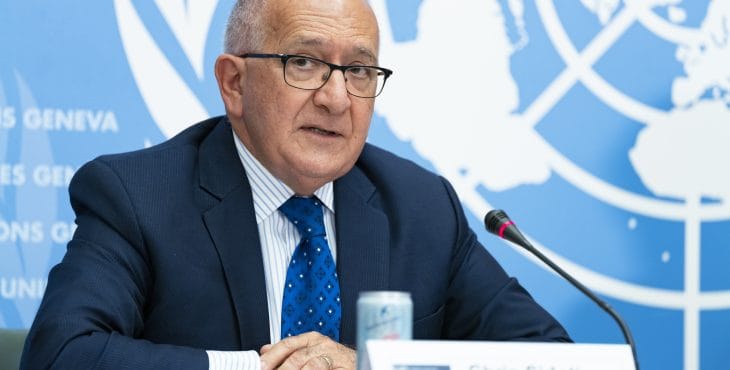
On October 8, 2026, Chris Sidoti, a member of the UN Commission of Inquiry on Israel, and Dr. Brian Cox, an international criminal law expert and former U.S. military lawyer, debated the Commission’s finding that Israel committed genocide in Gaza. The debate took place at Caulfield Synagogue in Melbourne, Australia.
Sidoti is one of three members of the UN’s Commission of Inquiry established in May 2021 to investigate Israel. He previously served as Australian Human Rights Commissioner from 1995 to 2000 and has held various human rights roles at the United Nations.
Cox served in the U.S. Army for 22 years, including as a military prosecutor and Chief of International and Operational Law for Regional Command-East. He also taught international law at Cornell Law School from 2019 to 2026.
Below are key excerpts from their debate, addressing the legal standard for genocide, the Commission’s investigative methods, military operations in Gaza and the evidence underlying its conclusions.
The Standard for Establishing Genocidal Intent
Sidoti: “The test of inference [to establish genocidal intent] is a very, very high test. According to the International Court of Justice, to form a conclusion that the purpose is genocidal on the basis of inference requires that inference be the only reasonable inference available. That’s a really high test. It’s a test, in fact, that in my opinion is higher than the criminal standard of beyond reasonable doubt.”
Cox: “Going back to the Rome Statute as a template, as an example, intentionally directing an attack against civilian population or against a civilian object, it’s possible to infer intent, but it’s almost it is extraordinarily difficult to infer what the intent and the knowledge was after an attack from just looking at the effects of an attack.”
Sidoti: “It is a strategy of total destruction. Now, it may be that it is being done with the goal of destroying Hamas and Palestinian Islamic Jihad, but the strategy has been from the beginning a strategy of total destruction… Hospitals, in their entirety, have been destroyed.”
Sidoti: “The evidentiary standard is the standard that is in the procedures for all of the UN Human Rights Council investigative bodies… It is reasonable grounds to believe or to conclude… as Brian has rightly said in some of his writings, it’s not a high standard. It’s not beyond reasonable doubt. It’s not the balance of probabilities, although it probably comes close to that… [The standard of proof of reasonable grounds in the Commission’s terms of reference] honestly, that definition, which is in the OHCHR manual, is gobbledygook.”
Sidoti: Israel’s Non-Cooperation Increased Commission’s Reliance on Inference
Sidoti: “Israeli authorities do not cooperate with our commission in any way… it does make the job more difficult, and it pushes us back to relying more on inference than on other factors.”
Sidoti: “We Are Not a Court”
Sidoti: “We are not a court. We are not a court. We’re not even prosecutors. We are an investigative body, and we produce the conclusions of our investigation based on the standard of reasonable grounds to conclude.”
Sidoti: “We’re not a court, and I keep on saying this: we’re not a court. We don’t operate on the basis of criminal standards, of evidence and proof. We’re an investigative body, so it’s different.”
Sidoti: “You’re looking front end, and we look back end. And I think that that again is an important difference. You’re looking at the process that the IDF is employing. We’re looking at what has been the results of accountability through the IDF, and we are not satisfied that it is meeting international standards of accountability.”
The Commission’s Unnamed Military Expert
Sidoti: “We have a full-time military expert on our staff who has, I think, around about 20 years of active military service in an armed force before working in the international courts in The Hague before coming to us… We do not give out the names of any of our staff for obvious reasons. I’m responsible. I’m responsible. The other commissioners are responsible, and we will not expose our staff to risk, including from your government.”
Cox: “So, the person has served in a military, somebody’s military. I have no idea what type of experience they have, what type of biases they have, what gaps in knowledge they have… we can’t tell precisely how the military expert influences the commission’s work because we have no idea who he or she is.”
Sidoti: Destroying Hamas Could Still Constitute Genocide
Sidoti: “If we accept that the goal of the Israeli authorities in Gaza has been the destruction of Hamas, that does not preclude the possibility of genocide being the strategy by which that goal is going to be attained, and that is an issue. The fighting, the strategy, can be undertaken in such a way, in our view of the law, that it can coexist with the goal of eliminating Hamas.”
Cox: Selective Use of Israeli Leaders’ Statements
Cox: “[The Commission has] taken snippets of statements from elected officials to support the inference that the goal of the combat military operations is to destroy the Palestinian population in whole or in part, as such, while ignoring the actual stated intent that has been consistent since the very beginning: to repatriate all hostages and to end the enduring security threat posed by Hamas. That is not genocide. That is war.”
Sidoti: Commission Did Not Independently Establish Civilian Death Toll
Sidoti: “No, we didn’t [independently establish the number of civilians killed], because we don’t have that information, nor did we establish that the numbers that the IDF claimed were militants were accurate as well. So we literally do not know, nor does anybody else know, including the IDF, how many militants were there.”
Sidoti: Gazans Had Nowhere to Flee; Israel Should Have Taken Them In
Sidoti: “The situation in Gaza is different from all of those situations [like Russian-Ukraine] because the people had nowhere to go. The fact that Egypt is refusing to admit them, it is no more relevant than the fact. In fact, less relevant than the fact that Israel is refusing to admit them. They had, they were prevented from going into Egypt, and they were prevented from going into Israel, and so unlike the Rohingya and the Ukrainians and the Sudanese and the Syrians who fled in their millions into Turkey, they had nowhere to go.”
Sidoti: “One of the significantly relevant factors is the inability of the people to escape from a military strategy of total destruction, and that is directly connected with the issue of genocidal purpose.”
Cox: The Military Rationale for 2,000-Pound Bombs
Cox: “What the Commission fails to do, just like many NGOs who also operate in the space fail to do, is they fail to acknowledge and account for mitigation techniques that can be utilized by militaries that do use explosive weapons in populated areas… they’re using a 2000 pound bomb because that’s the highest yield that we have for conventional weapons, typically, and they’re trying to get to a bunker, typically, or a tunnel underneath the ground. They delay the fuse. And it does two things: it directs the effects of ammunition against the target, but more importantly, for our purposes, it mitigates the risk of harm to civilians. I see that in almost every single photo or video that comes out of Gaza, and if you know what you’re looking for, you’ll see it too.”
Cox: Commission Fails to Properly Apply International Humanitarian Law
Cox: “what I find as I read the UN Commission of Inquiry’s work is that it fails to articulate an identifiable formulation of specific rules of the law of armed conflict…”
Cox: “These rules have content, and if you don’t include the content, then you’ve lost all context for whether these rules have been complied with … that starts by formulating and articulating the rules, applying the facts to the actual doctrine and reaching conclusions. If you don’t do that, you’re not actually assessing where the law of armed conflict is complied with. You’re just blowing smoke.”
Sidoti Struggles to Explain Commission’s Fertility Clinic Finding
Sidoti: “I can’t give you [a] detailed response because I’ve not looked at this now for two years, that one on the 5000 or whatever… So I said that the tank crew didn’t know [it was a fertility clinic], and we don’t know what the tank crew knew… I’m stumbling, and I know that I shouldn’t be stumbling in front of this particular audience…”
Audience member: “why was your report wrong to the General Assembly, or was your report wrong to the Human Rights Council? Same attack, two methods.”
Sidoti: “I have no recollection of saying. Well, I have no recollection… I have no recollection of ever saying it to them.”
For reference, the Commission’s report to the UNGA in September 2024 attributed the destruction of the Basmah clinic to an Israeli air strike, while Sidoti stated at a UNHRC press conference in March 2025 that it was caused by an Israeli tank shell.
Report to the GA (A/79/232) (September 11, 2024): “The Basmah in vitro fertilization centre, the largest fertility clinic in Gaza, was the direct target of air strikes in December 2023 that reportedly resulted in the destruction of approximately 3,000 embryos.”
Sidoti at HRC Press Conference (March 13, 2025): “There is a question about whether those who were firing the tank shell, because our conclusion is that it was destroyed by a tank shell, knew at the time that it was a fertility clinic”