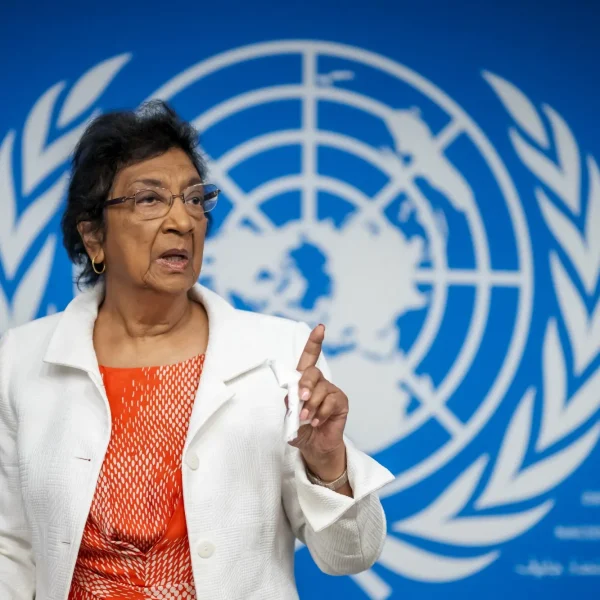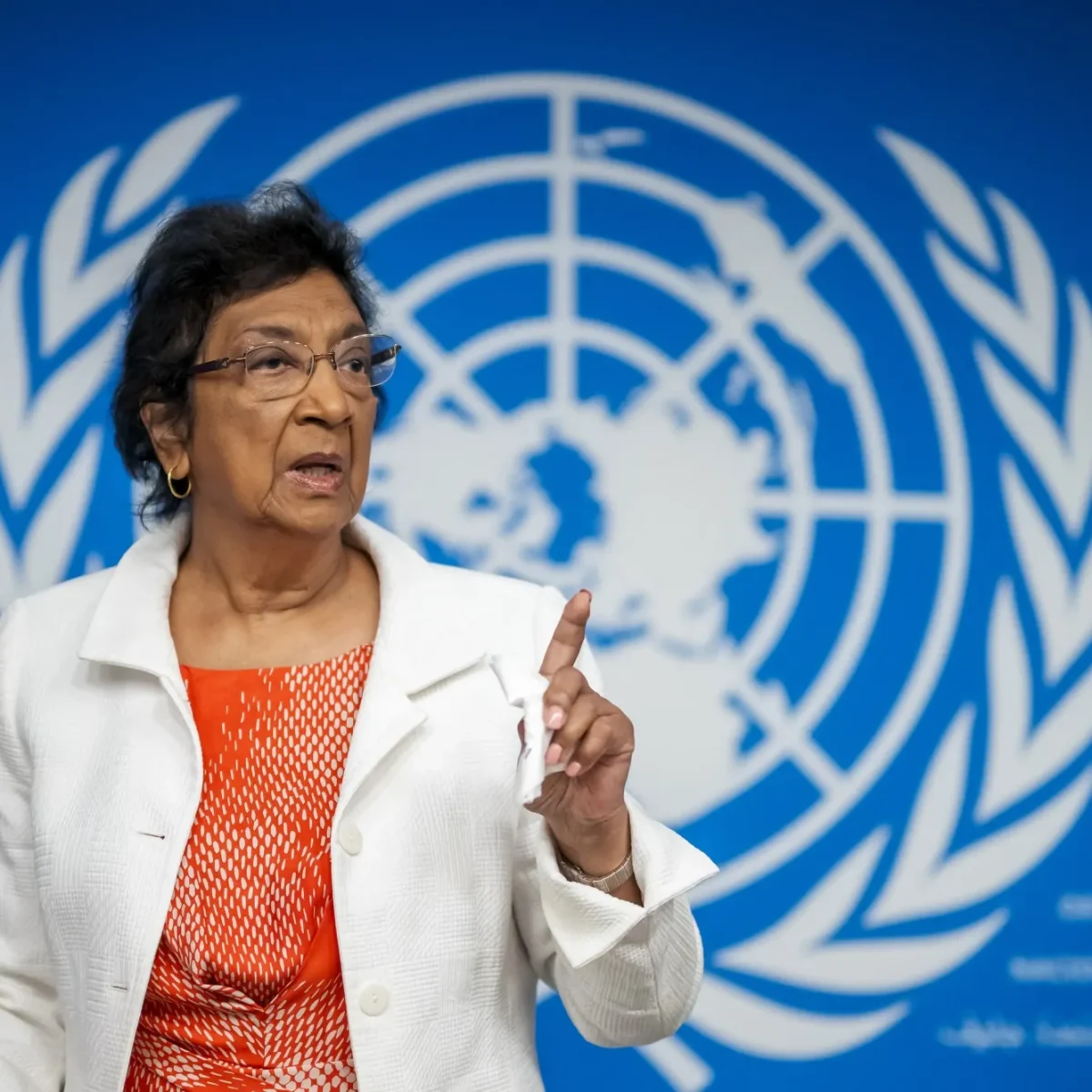
On April 27, 2010, UN Watch Executive Director Hillel Neuer wrote to UN High Commissioner for Human Rights Navi Pillay, demanding that her office remove antisemitic texts from the UN website and challenging her defense of the Human Rights Council’s permanent agenda item targeting Israel. The letter exposed how her office censored criticism of repressive regimes while publishing allegations that Israeli doctors stole Palestinian organs and that “Jews everywhere” were complicit in a Holocaust against Palestinians. The full original letter appears below.
To: UN High Commissioner of Human Rights Navi Pillay
CC: Ambassador Eileen Chamberlain Donahoe, U.S. Rep. to the UNHRC
Ambassador Jean-Baptiste Mattei, Permanent Representative of France to the UN
Ambassador Peter Gooderham, Permanent Representative of the UK to the UN
April 27, 2010
Dear High Commissioner Pillay,
We wrote you on March 24, 2010, requesting that the UN Human Rights Council website cease hosting an anti-Semitic text that falsely accuses Israeli doctors of a racist conspiracy to steal Palestinian organs, giving modern form to the medieval blood libel.
The reply from Chief of Human Rights Council Branch Eric Tistounet, which we recently received, rejects UN Watch’s request while ignoring our argument. We urge you to overturn this decision, for the reasons explained below, and to immediately remove the hateful text from the UN website. More broadly, we call upon you to speak out against the UN Human Rights Council’s moral inversion and systematic application of double standards, which undermine the credibility of the institution and the values upon which it was founded.
First, we address your office’s reply. It justifies doing nothing about the text submitted by the “International Organization for Elimination of All Forms of Racial Discrimination” (EAFORD)—a group created in Libya and closely tied to Col. Kaddafi’s regime—on grounds that the UN purportedly plays no screening role, and merely publishes all submissions as received.
This premise is simply not true.
Mr. Tistounet quotes from the UN cover sheet affixed to NGO written statements, which indicates that the latter are “unedited.” This quote, however, is selective, incomplete and misleading.
The same cover sheet also indicates that such statements are circulated “in accordance with Economic and Social Council resolution 1996/31.” As your officers well know, Article 31 of that resolution requires them to engage in a process of “appropriate consultation” with the submitting organization, with the latter required to give “due consideration” to any “comments” that your officers may make “before transmitting the statement in final form.”
In other words, contrary to the premise of Mr. Tistounet’s reply, the rules are clear that your office does play a screening role.
Not only is this the official legal procedure, it is also standard practice. As already stated in our complaint, your office routinely screens all NGO submissions before deciding to publish them. Following are three examples.
UN Watch recently submitted a written statement—indeed to the very same March 2010 UNHRC session that willingly published the organ-stealing blood libel—and your office refused to publish it as received. We were told to remove the word “regimes” where we had referred to the regimes ruling Burma, Sri Lanka, Pakistan, Sudan and Zimbabwe.
Second, we were then informed that our reference to “Burma” was not allowed—only the junta’s adopted name of “Myanmar.”
The third example concerns a submission UN Watch made in 2005. It was a written statement to the now-defunct Sub-Commission on Human Rights, featuring segments from an article I had published in The New Republic.
Our statement questioned the propriety of Cuba, Zimbabwe and Saudi Arabia sitting on the UN Commission on Human Rights and ruling on individual complaints.
It further pointed out that Ms. Halima Warzazi, then head of the Sub-Commission—and who today serves as Chair of the UN Human Rights Council’s Advisory Committee—was personally responsible for shielding Saddam Hussein from UN censure after Iraq’s 1988 genocidal gassing of Kurds in Halabja.
All of this was unacceptable to your office, which informed UN Watch that “when referring to certain States, Heads of States, or even certain members of the Sub-Commission, the language used was not entirely in accordance with accepted United Nations standards.” NGO submissions, we were told, had to be “imbued with the appropriate level of dignity and respect.” Until we made the required changes, our statement was “suspended.”
Clearly, then, not only does your office screen submissions, but its editorial policy appears to be the following.
Statements that criticize serial human rights violators who sit as members of the UN Human Rights Council are rejected, for being “not entirely in accordance with accepted United Nations standards,” and not “imbued with the appropriate level of dignity and respect.”
But statements that demonize Israelis as Nazi-like perpetrators of “ethnic cleansing” and “pogroms against Palestinians,” and that accuse “Israeli physicians, medical centers, rabbis and the Israeli Army” of a conspiracy to steal organs of “dead, kidnapped and killed Palestinians,” are accepted—and, by necessary implication, deemed to be entirely in accordance with “accepted United Nations standards.”
It is noteworthy that this is not the first anti-Semitic statement by EAFORD to be published, distributed and web-hosted under the imprimatur of the UN Human Rights Council.
In September 2008, your office reviewed, accepted and published an EAFORD written statement calling Israel an “illegal state”—arguably a far harsher term than the word “regime.”
Far worse, the text, in the guise of a rhetorical question, accused “Jews everywhere” of having “forgotten the terrors of the Holocaust to such an extent as to allow Israel to pursue and inflict one on the Palestinian people.”
UN Watch immediately objected to this publication in a private meeting with then UNHRC President Martin Umoibhi. We explained that accusing “Jews everywhere” of complicity in genocide amounts to the characterization of an entire people as absolute evil, which is anti-Semitism by any definition.
Indeed, as the U.S. Special Envoy to Monitor and Combat Anti-Semitism recently testified before a committee of the U.S. Congress, “Criticism of Israel crosses the line to anti-Semitism when, for example, that criticism applies double standards, comparing a current policy of Israel to that of the Nazis, or holds all Jews collectively responsible for actions of the State of Israel, or denies that Israel has a right to exist… At the UN, anti-Semitism and anti-Israel sentiment often overlap.”
Nevertheless, this text accusing “Jews everywhere” of absolute evil remains published on your office’s website to this day.
Madame High Commissioner, this cannot continue.
In 2004, UN Secretary-General Kofi Annan acknowledged that “the United Nations’ record on anti-Semitism has at times fallen short of our ideals,” and he made specific reference to the UN’s 1975 resolution equating Zionism with Racism as “an especially unfortunate decision.” Mr. Annan pledged that “the human rights machinery of the United Nations has been mobilized in the battle against anti-Semitism.”
Madame High Commissioner, where is this mobilization, and where is this battle?
The Secretary General specifically called on your office to “actively explore ways of combating anti-Semitism more effectively in the future,” and he called on “all parts of the Secretariat” to be vigilant.
Madame High Commissioner, where is this vigilance?
Mr. Annan proclaimed that “Jews everywhere must feel that the United Nations is
their home, too.”
Madame High Commissioner, how is this possible when your website continues to host a statement accusing “Jews everywhere” of absolutely evil?
The problem is not confined to written statements. The same morally inverted policy applies to speeches.
In the first year of the supposedly reformed UN Human Rights Council, the president, as shown in this video compilation, thanked a speaker from Zimbabwe after he talked about the “ignorance” of a delegate who criticized human rights under President Mugabe; thanked the delegate from Cuba for insulting a human rights expert who exposed abuses of the communist regime; thanked a Palestinian delegate who asserted that Israel has a “monopoly on human rights violations”; thanked a Sudanese delegate who said that reports of violence against women in Darfur were “exaggerated”; thanked an envoy from Nigeria who asserted that “stoning under Sharia law for unnatural sexual acts [i.e., homosexuality] should not be equated with extrajudicial killings”; and thanked an envoy of Iran who defended the Tehran Holocaust denial conference.
However, when on behalf of UN Watch I challenged the council’s obsession with attacking Israel—and its indifference to the plight of millions of human rights victims in 191 countries—the same president, Ambassador Luis Alfonso de Alba, declared, “For the first time in this session I will not express thanks for that statement.” He announced that he would “not tolerate any similar statements in the Council.” Any statement in similar tones, he warned, “will be taken out of the records.”
This moral inversion extends deeper, into the very essence of the Council’s work:
• Since it was created in 2006, the council has issued 40 condemnations of countries—with 33 of them targeting democratic Israel. As a result, the world’s worst abusers of human rights continue to go ignored.
• Out of the council’s nine emergency sessions that criticized countries, six have been against Israel. Well-publicized killings of innocents over the past year in Iran, China and Nigeria have gone completely ignored.
• The council’s agenda, which governs each session, features a permanent item targeting Israel. No other country in the world is singled out in this fashion. The council’s anti-Israel resolutions, the one-sided Goldstone Report, the statements by EAFORD — all of these appear under the rubric this biased agenda item, which has come to symbolize the council’s systematic discrimination against Israel.
Because your office is independent, we would expect you to speak out against these manifestations of demonization, disproportionality and double standards.
Astonishingly, however, it appears that you are doing the opposite.
During your visit to Kuwait last week, as reported by the Kuwaiti News Agency, you justified the Council’s unequal treatment of Israel, stating that, “While the occupation continues, it (item 7 on the human rights situation in Palestine and other occupied Arab territories) will remain on the agenda.”
This followed a similar statement you made, on March 11, 2010, before an Italian parliamentary committee. When challenged on the council’s one-sided approach toward the Middle East, you defended it, saying, “the occupation must end in order to remove Israel from the agenda,” and implicitly compared that situation to apartheid South Africa.
Your argument is essentially that the special agenda item is automatically triggered by an objective set of facts, and is therefore natural, logical and legitimate.
Nothing, however, could be further from the truth.
If occupation were the trigger, why did the old Commission on Human Rights never institute an agenda item on the Allied occupation of Germany, which officially lasted until 1955, and that of Berlin until 1990?
Why was there no agenda item, from 1948 to 1967, when Jordan illegally occupied the West Bank, and Egypt illegally occupied Gaza?
Why was there never an agenda item on China’s half-century occupation of Tibet?
No, there is nothing about Israel’s presence in the West Bank and Gaza—the result, we remind you, of a defensive war—that explains this special agenda item.
If it were dictated purely by objective human rights concerns, why does the Human Rights Council not have a special agenda item on Sudan’s killing and rape of hundreds of thousands of Darfuris, on the killing of an estimated five million in the Congo, or on the millions of victims suffering today in North Korea’s prison state—all of which exponentially surpass the Palestinians’ own casualty count?
No, the sole cause of the special agenda item on Israel is UN politics. It was adopted by the council in a post-midnight decision on June 19, 2007, under massive pressure by the oil-producing Arab and Islamic states—supported by an automatic majority that included China, Russia and Cuba—while vigorously opposed by the democracies.
In statements delivered before and after its adoption, traditional supporters of human rights opposed the agenda item as biased. The UK said that “the practice of ‘singling out one’ risked undermining the Human Rights Council’s own principles.” France “regretted that the agenda was imbalanced by the singling out of Palestine, which was contrary to non-selectivity.” Australia and the Netherlands expressed similar objections, describing the agenda item as “unhelpful.” Canada said the Council breached its own principles of universality, impartiality, objectivity, and non-selectivity. Targeting any UN member state, said Canada, was “politicized, selective, partial, and subjective.”
Even leading officials of the UN condemned this agenda item. During the 2006 reform debate, the UN Department of Public Information published a chart called “Commission on Human Rights versus Human Rights Council: Key Differences.” It candidly described this item as “the Agenda Item Targeting Israel,” and boasted that the new council would instead feature a “clean slate.”
When things turned out otherwise, on 20 June 2007, Secretary-General Ban Ki-moon—under whose direction and authority you are mandated to work—denounced “the Council’s decision to single out only one specific regional item, given the range of human rights violations throughout the entire world.” Likewise, in a letter to Canadian lawyers, your predecessor, High Commissioner Louise Arbour, criticized the agenda item as being “selective.”
Civil society was equally clear. A statement by 38 NGOs, delivered on 22 November 2005, insisted that the new council rationalize the items of its agenda based on the principle that “every Member State is entitled to equality before the law.”
Finally, it is important to note that one of the reasons that the U.S. has joined the council is the desire to influence the upcoming 2011 review of its work, in which removal of the biased agenda item is a central U.S. goal. In her confirmation hearing, new U.S. Ambassador Eileen Chamberlain Donahoe made it clear that “Israel is the only country that has a standing item on the agenda at the council,” and pledged to “work to get rid of that.”
In conclusion, therefore, we urge you to immediately remove the aforementioned anti-Semitic texts from your website, and to speak out forcefully against double standards that undermine the founding principles of the Human Rights Council and the United Nations Charter.
Sincerely,
Hillel C. Neuer
Executive Director