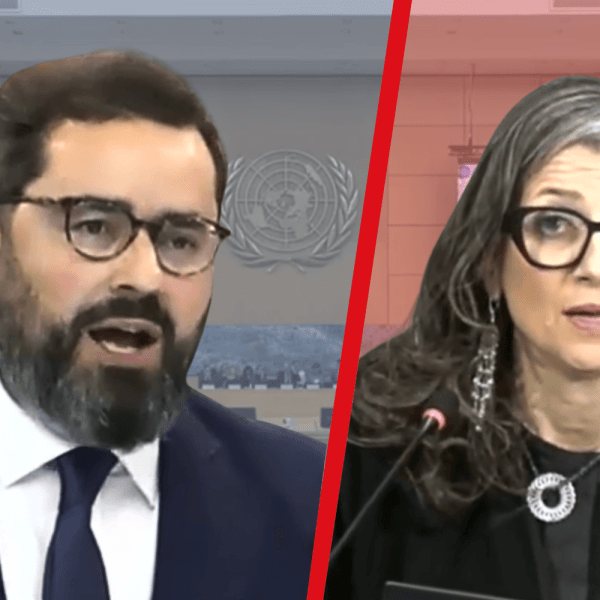
When the United States and Israel launched airstrikes on Iranian regime targets on February 28, the response from the UN’s top human rights officials and agencies was swift and condemnatory, glossing over decades of Iranian aggression across the region and beyond. Yet when the regime was massacring protesters in the streets just weeks earlier, many of these same officials and agencies remained silent—or spoke only after the worst atrocities had already occurred.
Below is a sample of UN responses.
UN Officials
Secretary-General Antonio Guterres
The Secretary-General swiftly condemned the U.S. and Israeli strikes on Iranian military targets, including its nuclear program. Although his statement referenced the Islamic regime’s “subsequent retaliation” across “the region,” by characterizing the Iranian counterstrikes as “retaliation,” Guterres conferred a measure of legitimacy upon them. When Israel launched strikes against Hamas targets in Gaza following the October 7 attack, however, no UN official described Israel’s actions as “retaliation.” Instead, Israel’s defensive response was condemned in the same terms and at the same level as the Hamas attack itself—treating the aggressor and the responding state as morally and legally equivalent, and erasing the distinction between terrorism and a state’s exercise of self-defense.
The statement also failed to name a single country targeted by Iran. In later remarks to the Security Council Guterres stated that he had “also condemned the subsequent attacks by Iran violating the sovereignty and territorial integrity of Bahrain, Iraq, Jordan, Kuwait, Qatar, Saudi Arabia, and the United Arab Emirates,” notably omitting Israel from the list. His initial statement, however, was silent on the targets of Iran’s strikes.
By contrast, while the Secretary-General immediately condemned Israel and the United States, he remained silent when the Iranian regime violently cracked down on protesters who began demonstrating against the government’s economic policies on December 28, 2025. Security forces used live ammunition, tear gas, water cannons, and mass arrests. Even after the regime imposed a nationwide internet blackout on January 8, 2026—widely understood as preparation for a large-scale massacre—Guterres said nothing. He spoke publicly only on January 11, after reports had already emerged that the regime had killed tens of thousands of protesters. His statement was notably restrained, expressing only “shock” at “reports of” “violence and excessive use of force” against protesters “resulting in scores of deaths.” He did not use the words “condemn,” “kill,” or “murder.”
High Commissioner for Human Rights, Volker Turk
Echoing the Secretary-General’s statement, High Commissioner Volker Türk immediately deplored the U.S. and Israeli military strikes on Iran alongside the “subsequent retaliatory strikes by Iran,” without identifying the states targeted. By describing Iran’s actions as “retaliatory,” he lent them implicit legitimacy.
Completely ignoring Iran’s aggression across the region—including its sponsorship of the Houthis in Yemen, militias in Iraq and Syria, Hezbollah in Lebanon, and Hamas and Palestinian Islamic Jihad in the West Bank and Gaza—Türk pronounced that “bombs and missiles are not the way to resolve differences but only result in death, destruction and human misery.” This admonition is especially striking given that the Iranian regime is not merely a regional destabilizer but a government that has waged a decades-long campaign against American and Israeli targets worldwide and against its own dissidents abroad, including assassinations and murder-for-hire plots on European and American soil.
Türk also expressed special concern for civilians, stating that “as always, in any armed conflict, it is civilians who end up paying the ultimate price.” He repeated this sentiment again on March 3, 2026 when he said he was “deeply shocked by the impacts of the widespread hostilities on civilians and civilian infrastructure.”
Yet when the Iranian regime began violently suppressing protesters on December 28, 2025, Türk remained silent for 12 days. He said nothing when the government imposed a nationwide internet shutdown widely understood as preparation for a massacre of its own citizens. Türk issued a statement only on January 9, 2026—after the killings had already begun—saying he was merely “deeply disturbed” by “reports” of “violence during nationwide protests,” including “reported deaths and destruction of property,” and failing to condemn the government sanctioned killings. Only on January 13, 2026, did he finally state that he was “horrified by the mounting violence directed by security forces” and that “the killing of peaceful demonstrators must stop.”
Under-Secretary-General for Humanitarian Affairs and Emergency Relief Coordinator, Tom Fletcher
After issuing two general statements on the humanitarian impact of the “strikes” and the “escalation in the Middle East” on February 28 and March 3, 2026, Under-Secretary-General for Humanitarian Affairs Tom Fletcher said on March 7 that “it breaks my heart” the “staggering amounts of money” that are being spent on war in the Middle East instead of on humanitarian needs. Yet Fletcher said nothing about the staggering sums the Iranian regime devotes to financing terrorism across the region and violently suppressing its own people.
President of the UNGA, Annalena Baerbock
On February 28, 2026, UN General Assembly President Annalena Baerbock issued a general condemnation of the “extremely dangerous military escalation in the Middle East,” calling on “the United States, Israel, and Iran to de-escalate” and “not drag neighboring countries into this conflict.” The statement did not specifically condemn Iran’s attacks on its neighbors. In a March 5 statement, however, Baerbock expressed her “condemnation” of such attacks and made clear that it was “unacceptable that Iran is dragging its neighbors into this conflict.” Notably, Baerbock was silent when the Iranian regime violently suppressed protests across the country beginning on December 28, 2025, and massacred tens of thousands under the cover of an internet blackout imposed on January 8, 2026.
UN Agencies
UNICEF
While UNICEF’s February 28, 2026 press release expressed general concern about the “military escalation in the Middle East,” it highlighted only the impact on children in Iran. A March 6, 2026 post on X, amplified by the UN, likewise lamented the impact of the “recent military escalations” on children, again focusing primarily on Iran. At the same time, UNICEF ignored the regime’s killing of hundreds of children amid its broader massacre of tens of thousands of protesters. It also disregarded that targeted strikes on regime assets aim to end the repression that has already claimed so many young lives. Notably, UNICEF remained silent for two weeks after the regime began killing protesters, including children. Its Middle East and North Africa director, Edouard Beigbeder, spoke out only on January 11, 2026—after widespread reports of killings had already emerged.
WHO
WHO Director-General Tedros Adhanom Ghebreyesus responded immediately on February 28, 2026, expressing concern about the “grave risks to people’s health” from the conflict “expanding across the Middle East,” particularly the possibility that “nuclear facilities” could be impacted. His posts on X detailed the harm only in Iran and Lebanon. In a March 1 post, he used the hashtag #NotATarget to criticize damage to a hospital in Tehran, implying that it had been deliberately targeted, even though the strikes were aimed at nearby military targets.
By contrast, despite his quick response and multiple X posts on the health impact of the U.S. and Israeli strikes, Dr. Tedros remained silent on X for more than a month as the Iranian regime launched a brutal crackdown on protesters beginning December 28, 2025, threatening the health and lives of the Iranian people. When he finally spoke on January 29, 2026, his statement was notably restrained, expressing only “deep concern” about attacks on health workers and facilities without acknowledging the broader massacre.
UN Women
In a statement issued on March 3, 2026, UN Women said it was “gravely concerned” about strikes on Iran. The statement added that “women and girls everywhere have the right to live in safety and in peace, free from violence and discrimination.” Yet when the Iranian regime beat, jailed, and killed tens of thousands of protesters just two months earlier—including many women and girls—UN Women remained silent for 26 days. It addressed the situation on X for the first time only on January 23, 2026, not to condemn or even express concern, but merely to observe that “Women in #Iran have experienced enough violence.” In 2021 UN Women even allowed the regime—while it was jailing, beating, and killing women for refusing the hijab—to sit on its Commission on the Status of Women.
UNESCO
In a March 1, 2026 statement, UNESCO said it was “deeply alarmed” by the impact of the “military escalation” on schools and students, specifically citing the strike on a girls’ school in Minab in southern Iran. The statement condemned the “killing of pupils” as “a grave violation” of international humanitarian law, falsely implying that the school itself had been the intended target. Under international humanitarian law, however, the legal test is based on intent, not outcome, and there is no evidence that the United States intended this tragic result. Its thousands of strikes have clearly been aimed at the IRGC regime.
UNESCO expresses concern about schools only when doing so supports the regime. It has said nothing about the regime’s practice of placing military personnel inside civilian facilities, including schools and universities. An insider has even described a strategy to “manufacture casualties” to sway Western public opinion.
On March 2, 2026, UNESCO issued a second statement—criticizing damage to a UNESCO World Heritage site in Tehran. Yet the organization entrusted with protecting global heritage has never said a word about Iranian missile attacks on Tel Aviv’s White City of International Style (Bauhaus) buildings, designated a UNESCO World Heritage Site in 2003.
UN HRC Mandates
UN Fact-Finding Mission on Iran
In a March 4, 2026 statement, the UN Fact-Finding Mission on Iran—a panel of three supposedly independent experts—said it “strongly condemns the strikes against Iran by Israel and the United States of America.” While the statement ultimately said that Iran’s counterstrikes violated the UN Charter, it nevertheless described them as “retaliatory strikes,” framing them as a response rather than unlawful aggression and thereby lending them a measure of implicit justification.
The panel also expressed concern for the “Iranian population”—“caught between a large-scale military campaign” and “a government with a long record of gross human rights violations”—yet had remained silent during the first two weeks of the regime’s violent crackdown on protesters. The Fact-Finding Mission issued its first statement only on January 10, 2026, after the government’s internet shutdown had been in place for two days and reports of a massacre were already emerging. The statement did not condemn the killings, but merely called for the internet to be restored. Thus, even the UN body established to investigate the regime’s atrocities against protesters chose instead to condemn the only effort aimed at weakening the regime responsible for those atrocities—an intervention that many Iranian protesters themselves had called for.
Special Procedures
Mai Sato, Special Rapporteur on the situation of human rights in the Islamic Republic of Iran
On March 4, 2026, the Special Rapporteur on Iran, Mai Sato, led a joint UN statement by 30 Special Procedures. The statement “condemned” the “military attacks launched by the United States of America and Israel against Iran” as “unlawful,” yet expressed only “serious concern” over Iran’s “retaliatory strikes” across “the Gulf and broader Middle East,” failing to identify the countries targeted or the civilian harm caused. By characterizing Iran’s strikes as “retaliatory,” the statement framed them as a response rather than unlawful aggression, thereby lending them implicit legitimacy.
The statement addressed civilian impact only in Iran. Dismissing the legitimate military rationale for the strikes and implying they were not aimed at military targets, it declared that “these attacks do not strike military abstractions—they strike people.” Despite the fact that many Iranian protesters had themselves called for U.S. intervention, the statement insisted that “unlawful military intervention must not be seen as the solution to the grievances of the Iranian people.”
This followed Sato’s February 28, 2026 post on X stating that the “US-Israeli strikes” were “in violation of the UN Charter” and similarly asserting that “unlawful military intervention is not a solution to the nuclear issue or to the human rights situation in Iran.”
Notably, Sato also led two joint statements addressing the Iranian regime’s violent crackdown on protesters. The first, dated January 13, 2026—fully 16 days after the crackdown began—was joined by only six other experts. The second, dated February 20, 2026, was signed by 29 experts. This stands in sharp contrast to the speed with which Sato was able to assemble 30 experts to sign a statement condemning the United States and Israel just four days after their strikes.
Francesca Albanese, Special Rapporteur on the situation of human rights in the Palestinian territories occupied since 1967
One of the signatories to the March 4 joint UN statement was the UN Special Rapporteur on Palestine, Francesca Albanese. While refusing to speak out on the massacre of Iranian protesters, claiming it was beyond her mandate, Albanese has never hesitated to defend the regime against attacks by the West.
On March 3, 2026, she posted a fake AI-generated image accusing the United States and Israel of deliberately bombing a girls’ school in Iran, while also equating Israel and Iran as equally “illiberal and brutal.” Rather than retracting the image, Albanese doubled down, replying that “The picture is not the issue: the facts are,” and again insinuating that the school had been intentionally targeted and that the strike therefore constituted a “war crime.” This stands in stark contrast to the standards she is supposed to apply in establishing facts—relying on “objective” and “reliable” information from “credible sources” that has been “duly cross-checked.”
Ben Saul, Special Rapporteur on the promotion and protection of human rights and fundamental freedoms while countering terrorism
The Special Rapporteur on human rights while countering terrorism, Ben Saul, was among the signatories to the March 4 joint UN statement. He was also quick to condemn the U.S. and Israeli strikes, posting multiple messages on X on February 28, 2026 that exclusively criticized the two countries. In one post he wrote, “I strongly condemn the Israeli & US aggression against Iran, in violation of the most fundamental rule of international law – the ban on the use of force.” In another he declared, “This is not lawful self-defence against an armed attack by Iran.”
Yet when Iran began cracking down on protesters on December 28, 2025, Saul remained silent for 54 days. During that period he only shared—without signing—a January 13, 2026 joint UN statement by seven Special Procedures. He did not personally sign a statement addressing the crackdown until February 20, 2026.
Reem Alsalem, Special Rapporteur on violence against women and girls, its causes and consequences
Reem Alsalem, the Special Rapporteur on violence against women, signed the March 4 joint UN statement. She also swiftly condemned the “unlawful attacks on #Iran by the US and Israel and the indiscriminate attacks on civilians, including girls” in a February 28, 2026 post on X. In the same post, she drew a parallel with Gaza, writing that the war there had “normalised slaughter of children” and “paves the way for the killing of children in Iran and elsewhere.”
Yet Alsalem remained completely silent on X regarding the Iranian regime’s crackdown on protesters, including women and girls, and did not sign a single joint UN statement on the matter.
Gina Romero, Special Rapporteur on the rights to freedom of peaceful assembly and of association
Gina Romero, the Special Rapporteur on freedom of assembly, was among the signatories to the March 4 joint UN statement. She had already moved swiftly to condemn the U.S. and Israeli strikes against Iran in a February 28, 2026 thread on X. Although she also expressed concern over Iran’s response, the overall thrust of her remarks was to criticize the U.S. and Israel while casting Iran in a defensive light. She concluded by declaring that her “solidarity remains with the Iranians.” Yet when Iran began cracking down on protesters on December 28, 2025, Romero waited five days before issuing a tweet calling “for the respect of lifes and integrity of protestors.” She later signed joint UN statements on the crackdown on January 13 and February 20, 2026.
Mary Lawlor, Special Rapporteur on the situation of human rights defenders
Mary Lawlor, the Special Rapporteur on human rights defenders, signed the March 4 joint UN statement. Yet she remained silent for sixteen days after the Iranian regime began cracking down on protesters on December 28, 2025. She first addressed the situation only on January 13, 2026, after reports of a massacre began to emerge. Although she later joined the February 20, 2026 UN statement on the crackdown, she did not sign the earlier January 13, 2026 statement.
Margaret Satterthwaite, Special Rapporteur on the independence of judges and lawyers
Margaret Satterthwaite, the Special Rapporteur on the independence of judges and lawyers, signed the March 4 joint UN statement condemning the U.S. and Israeli strikes. Yet she remained silent for nineteen days after the Iranian regime began cracking down on protesters on December 28, 2025. She first addressed the situation on X only on January 16, 2026, after reports of a massacre began to emerge. Although she later joined the February 20, 2026 UN statement on the crackdown, she did not sign the earlier January 13, 2026 statement.
Balakrishnan Rajagopal, Special Rapporteur on the right to housing
Although the Special Rapporteur on housing, Balakrishnan Rajagopal, did not join the March 4 UN statement, he rushed to condemn the U.S. and Israeli strikes on X. On February 28, 2026, he wrote, “I strongly deplore the attack on Iran by the US and Israel and the cowardly complicity of States who approve this or stay silent.” Yet he said nothing about the Iranian regime’s indiscriminate attacks on its neighbors in the region or on its crackdown on protesters weeks earlier.
_________________________
The following Special Procedures signed the March 4 joint UN statement but were silent for 16 days after the Iranian regime began cracking down on protesters, signing only the January 13 and February 20, 2026 joint UN statements on the issue:
Cecilia M. Bailliet, Independent Expert on human rights and international solidarity
Richard Bennett, Special Rapporteur on the situation of human rights in Afghanistan
Alice Jill Edwards, Special Rapporteur on torture and other cruel, inhuman or degrading treatment or punishment
Morris Tidball-Binz, Special Rapporteur on extrajudicial, summary or arbitrary executions
The following Special Procedures signed the March 4 joint UN statement but were silent for 54 days after the Iranian regime began cracking down on protesters, signing only the February 20, 2026 joint UN statement on the issue:
Nicolas Levrat, Special Rapporteur on minority issues
Alexandra Xanthaki, Special Rapporteur in the field of cultural rights
Gabrielle Citroni, Aue Balde, Grażyna Baranowska, Ana Lorena Delgadillo, and Mohammed Al-Obaidi, Working Group on enforced or involuntary disappearances
Claudia Flores, Ivana Krstić, Dorothy Estrada-Tanck, Haina Lu, and Laura Nyirinkindi, Working Group on discrimination against women and girls
The following Special Procedures signed the March 4 joint UN statement but had remained completely silent on the Iranian regime’s crackdown on protesters weeks earlier, apart from a few retweets of others’ statements:
Bina D’Costa, Working Group of Experts on People of African Descent
Surya Deva, Special Rapporteur on the right to development (silent aside from some retweets)
Paula Gaviria, Special Rapporteur on the human rights of internally displaced persons (aside from sharing a January 13, 2026 post by Mai Sato)
Mariana Katzarova, Special Rapporteur on the situation of human rights in the Russian Federation
Siobhán Mullally, Special Rapporteur on trafficking in persons, especially women and children
Tomoya Obokata, Special Rapporteur on contemporary forms of slavery (silent aside from sharing some tweets by Mai Sato on January 13 and January 23, 2026)
Astrid Puentes Riaño, Special Rapporteur on human rights and the environment (silent aside from a January 13, 2026 retweet of Mai Sato)
Elizabeth Salmón, Special Rapporteur on the situation of human rights in the Democratic People’s Republic of Korea
Farida Shaheed, Special Rapporteur on the right to education