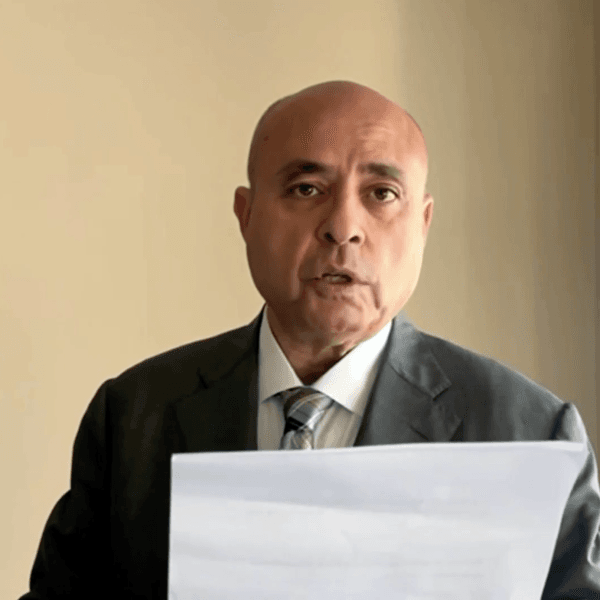
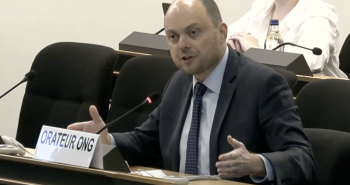
At the 2022 UN Watch Gala Dinner, the group presented its 2022 Per Ahlmark Award, named after the late Swedish author, statesman, and co-founder of UN Watch, to Cairo-born scholar Hussein Aboubakr Mansour. There were his remarks upon receiving the award:
Excellencies, ladies and gentlemen,
Thank you all very much. It’s a great honor and privilege to be here today. With no false pretenses, I must say that it is indeed very humbling to receive such an award from one of the most reputably honest organizations in the world of human rights NGOs, a world that is sadly targeted by so much corruption and subversion from those who do not want its mission to succeed. It is no less humbling that this award is named after Per Ahlmark, one of Europe’s most honest political dissidents whose life is defined by swimming against the irresistible currents of high-handed academic prestige, intellectual conformity, and coercive political piety. To be in such a company tells me that somehow, and despite all my attempts not to do so, I managed to do at least one right thing in my life.
I was born in 1989 in Cairo, Egypt, to a modern middle-class Egyptian family. I’m a child of the 1990s cultural floods of globalization, and I grew up on Nintendo, Playstation, Power Rangers, and MTV as much as I grew up on the local culture, religion, and customs. But these are not the only things I grew up on. I also grew up on stories about the great supervillains of all History, those who are existentially opposed to my national identity, religious faith, and moral heritage, the Jews. I learned that the Jews run international politics, the world’s economy, and the world’s mass culture and use them to eviscerate humanity in general and Muslim societies in particular from their moral content. And the embodiment of such Jewish villainy is the State of Israel, Zionist misanthropes who spend their lives scheming and planning how to kill and oppress more Palestinians.
In the 20th century, such a misanthropic and antisemitic conspiratorial worldview, in this very vulgar form, became a fundamental presupposition, conceived to be of a timeless essence, of Arab, Muslim, and various Middle Eastern national identity structures. Arab culture, both high and low, religious and secular, uncritically endorsed such a view. Conspiracy theories were part of the steady educational and media diet on which I grew up. In this worldview, Palestine is not merely a political cause but a powerful symbolic field that absorbs in itself all conceptions of moral meaning, political legitimacy, and ethics. “Liberating Palestine” is not a concrete political issue that has to do with concrete problems but a salvific longing that gives history its meaning and purpose and defines a total conception of the moral, religious, and political good.
I was a child of such a worldview. I bought my own copies of Mein Kampf and the Protocols of the Elders of Zion, which were sold widely in Egyptian bookstores. Like many in my generation, I came to champion the causes of political Islam, no matter how violent, and centralize my political understanding of the world around my hatred for Israel. This obsession ultimately led me to a life-transforming educational journey through which I was able to see through the profound ideological distortions of antisemitism and to understand myself and my society better. I discovered how such an ideological distortion of reality doesn’t just cause mass sentiments of racism and bigotry but extracts a massive toll on Arab societies and prevents them from addressing the many issues of human rights, religious extremism, and political instability that became a hallmark feature of the 20th and 21st century Middle East.
My obsession with antisemitic conspiracy theories was transformed into an obsession with antisemitism in Arab societies. Where did it come from? What does it mean? And how to challenge it? These questions led me to study modern Arab and Muslim intellectual life, where I found the source of the mass sentiments. When I said I had a life-transforming educational journey, I did not mean one produced by universities, but despite them. The Arab mass antisemitism I grew up with is often the concretization of intellectual, political, and philosophical traditions that originates with professors, intellectuals, theologians, and philosophers, many of whom received education in Western institutions. These intellectuals are the ones who produced the region’s most potent ideologies, wrote the textbooks, and legitimated political power. When I started to openly talk about these issues in Egypt in 2009 and 2010 and attempted to reach out online to Jews and Israelis, I found myself arrested, tortured, and accused of being a Zionist agent and a Mossad spy, delusional accusations that many people who became familiar with such language take them humorously forgetting the real cost of such a way of thinking.
In 2012, after participating in the failed venture of the Arab Spring and after receiving multiple threats from the government, I fled Egypt and received political asylum in the US, and since then, I have dedicated my life to understanding the central role that antisemitism played in the formation of the modern Arab and Muslim culture, identities, and political imagination, and the nefarious role many international academic and political institutions play in empowering such a toxic political force. I spend my time investigating the origins of the antisemitic thought structure and its relationship to the endemic problems of human rights, democratic deficit, political instability, totalitarian political thinking, moral nihilism, and endemic violence. It is my conviction that these endemic problems of Arab political life can not be separated from the issue of modern antisemitism. Moreover, these issues are not part of a timeless Arab or Muslim essence but a result of a complex story of Arab intellectual mimesis of 19th-century German totalitarian thought structure. This way of thinking completely altered the thought and identity perception of generations of Arabs and Muslims, especially those who spent time in higher learning institutions, the incubators of such ways of thinking. This German totalitarian thought structure and its underlying philosophy of History collapsed into the dream to destroy the State of Israel, turning the struggle against Zionism into an all-encompassing struggle that absorbed all ethics and all values and led many societies on a spiral of moral and social collapse.
Moreover, many international institutions, due to the various considerations of economic interest, political expediency, political correctness, and moral condescension have been largely silent on this issue in complete disregard to the lives of both Jews and Arabs damaged because of such a disastrous worldview. Just like Middle Eastern tyrants exploit the salvific symbol of Palestine to retain their power, like it is the case of the Islamic Republic of Iran, there are many Western political forces that exploit the narratives of eternal Arab and Muslim victimhood to convert them to ideological power inside their own societies. For international ideological power structures, we Arabs are nothing but fuel for moral righteousness and claims to power in the names of abstract social justice and fake decolonization.
Today, I remain committed to my personal mission, to do everything I can to help save more young people from the webs of seductive gnostic ideologies and the distortions of sophisticated totalitarian philosophies built on lofty abstractions and disingenuous moral high-handedness. To liberate more Arab thinkers from both the webs of ideology and the chains of the international exploitative political structure using them. The road to building a new culture of human rights and human dignity in the Middle East starts with throwing off the shackles of the delusions of antisemitic conspiracy theories, the mystical hatred for Israel, or the philosophy of historical victimhood. To accept Israelis and Jews as equal partners and neighbors and to use such a new reality as the anchor from which we are able to reconstruct a healthy sense of identity, faith, and political thinking.
Again I’m very thankful and humbled to be here tonight and thank you!