Is the current military action against the Islamic Republic of Iran a violation of international law?
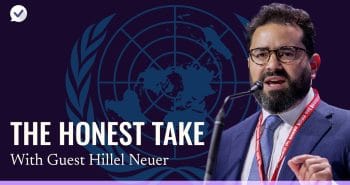
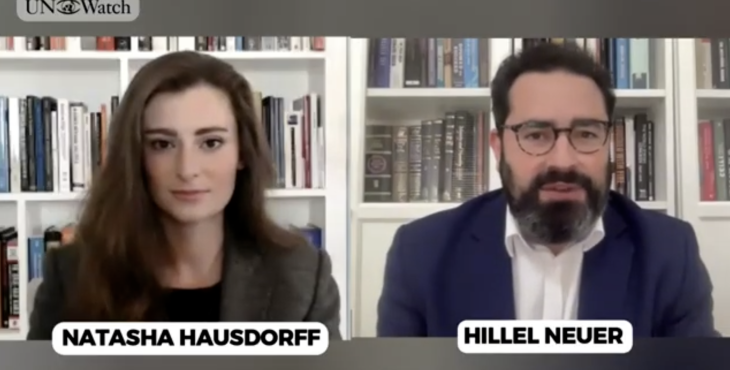
In this exclusive interview, UN Watch Executive Director Hillel Neuer sits down with leading British barrister and international law expert Natasha Hausdorff to dissect the legal realities of the ongoing conflict between Iran, Israel, and the United States.
As European and Canadian leaders raise concerns about “illegal aggression,” Hausdorff argues that many are being misled by a “topsy-turvy” application of the law. She breaks down the critical difference between a “resort to force” and an “ongoing armed conflict,” explains the legal doctrine of preemptive self-defense regarding nuclear threats, and exposes how U.N. agencies are being used to spread IRGC propaganda.
Conversation Highlights:
Hillel Neuer: Is the United States obliged to get approval from the U.N. Security Council, meaning the approval of Russia and China, to undertake any military operation?
Natasha Hausdorff: Of course not to undertake any military operation. It depends what the justification the United States has to begin a military operation. There are certain circumstances. So, for example, under the framework of the responsibility to protect — the justification of violating another state’s sovereignty for humanitarian purposes, say to protect the civilian population — that would require Security Council authorization. However, states also have an inherent right of self‑defense, as recognized by Article 51 of the U.N. Charter. So, it’s absolutely farcical to suggest that one would be required to obtain U.N. approval for the exercise of one’s self‑defense. Likewise, it is farcical that one would require any other form of authority to respond to Iranian aggression, which we have seen both against Israel and against the U.S. for decades.
Hillel Neuer: There is another legal argument that America and Israel didn’t now start a war, but that this operation is just one part of an already ongoing armed conflict or existing war. What are your thoughts?
Natasha Hausdorff: Yes, and that’s pretty trite. It’s very straightforward and the facts speak for themselves. There have been aggressive acts, uses of force by the Iranian regime against Israel and Israeli interests for decades — both indirectly via Iranian proxies, Hamas, Hezbollah, also in Iraq and in Syria — and then latterly also those direct strikes that we saw: ballistic missiles and drone strikes on Israeli civilian communities over the last couple of years. They, of course, also armed Hamas which committed the October 7th massacre. So Iran has been attacking Israel in massive ways for the past several years.
Hillel Neuer: But what about the U.S.? Can we rightly say that Iran and the U.S. have been in an existing armed conflict?
Natasha Hausdorff: As the United States is concerned, I think there are multiple layers of potential justification for their involvement. The first is related to Israel and Iran’s ongoing armed conflict. The right to self-defense is both individual and collective. So the United States supporting its close ally Israel in that ongoing war with Iran is a perfectly legitimate lawful basis for the US to have joined these strikes.
Separate to that, of course, you have the attacks by this Islamic regime on Americans, American service personnel, American national security interests, and the threats that it was posing to America more broadly. That includes the 1979 hostage taking, but also the hundreds of U.S. service personnel that have been killed by the Islamic regime and its proxies in the decades that followed. Thirdly, there is the position that the U.S. President put out in respect of a pre-emptive strike against an imminent threat.
Hillel Neuer: So far, there have been more than 2,000 air strikes by the U.S. alone and clearly the pattern is that they are discriminating between military and non-military targets while trying to target the regime. But it seems like a school was hit by U.S. forces in a mistake. UNICEF issued a statement saying the hit on the school was a grave violation. Is the fact that innocent people died in a school necessarily a violation of international law by the U.S.?
Natasha Hausdorff: Categorically not. International law is not effects-based, it is intention-based. The only way that such a grave violation would have occurred was if the United States deliberately and knowingly targeted a school, knowing that it wasn’t a military target, and did so anyway.
That is not to say that mistakes aren’t made in armed conflict, especially in the context of the fog of war. But even if this was a mistake by the United States — and not an an IRGC attack gone wrong which is still a possibility — it plainly wouldn’t be a violation of the laws of armed conflict if the intention had been to comply with the laws to target a military installation and to do so according to a proportionality analysis on the basis of the facts as they knew it at the time. That’s why it’s important to stress that international law is an intention-based analysis, not an effects-based analysis.