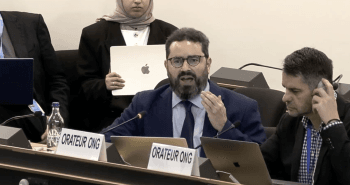
The governing body of the International Labour Organization (ILO), the International Labour Conference, is nearly halfway through its annual three-week meeting. The Conference, consisting of worker, employer and government delegates from 176 member-states, considers ILO reports, determines its budget and decides ILO policies. As at many other UN meetings, the politicization of the Palestinian issue belabors this Conference.
Analysis: By the time it concludes, the Conference will have heard seven major thematic reports on poverty, gender discrimination, the scope of the employment relationship, occupational safety, training for “the knowledge society,” maritime workers and terrorism, and “the situation of workers in the occupied Arab territories.” The first subject alone – poverty – directly concerns 2.8 billion people who live on less than $2 per day. Yet tomorrow, the Conference will hold its only “special session,” and it will be dedicated to the ILO’s report on “workers in the occupied Arab territories.” That report cites 1.94 million persons living on less than $2.15, less than one tenth of one percent of the 2.8 billion in extreme poverty. Though affecting only a minute percentage of the world’s population, other parallel Conference meetings will be suspended to ensure maximum attendance for the session on the Palestinians. Many delegates, however, boycott the session to protest such politicization.
Elimination of discrimination is one of the four fundamental concerns of the ILO. The ILO’s statistics in its report on gender discrimination explain why the Organization of the Islamic Conference (OIC) prefers a special session on the Palestinians rather than on women and the workplace. The ILO selected several countries from each region and presented data on women’s participation in the labor market for the year 2000, the latest available. Pakistan (15.2%), Iran (10.6%) and Syria (16.7%) compare poorly to Thailand (64.2%), Peru (58.1%), South Africa (43.9%) and Israel (47.3%). Another table shows the number of “gender-dominated occupations.” The United States and Poland have fifteen professions that are dominated by women. France and Germany have eight. Russia, Korea and Thailand have five. Iran and Pakistan – zero. Men dominate every single profession. No statistics are given for Arab states, but UN’s Arab Human Development Report asserts that “Arab countries … suffer a glaring deficit in women’s empowerment.”
Both the ILO’s report on training for “the knowledge society” and the UN’s Arab Human Development Report address “information and communication technology,” known as “ICT.” The ILO report stresses that “[l]earning and training for work must … focus on developing those multiple skills that will help countries, enterprises and individual men and women seize new opportunities. Workers will need more knowledge and higher technical skills in order to be able to exploit the productive potential of advanced technologies, particularly ICTs.” The UN’s Arab Human Development Report, however, laments that “[t]he Arab region has the lowest level of access to ICT of all regions of the world, even lower than sub-Saharan Africa.” If the Arab countries were more concerned about their own populations than with political attacks on Israel, they would have instead pressed for a special session on the ILO’s “knowledge society” report.
Instead of wading into the complicated issues of the Arab-Israeli conflict, perhaps the ILO’s involvement in the region should start with a simple and more pertinent question: “Why are there no independent trade unions in Syria, Saudi Arabia, the United Arab Emirates, Oman or Qatar?”