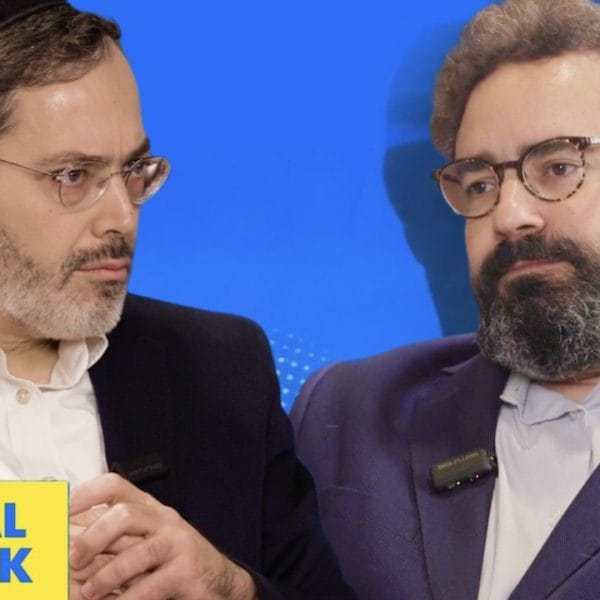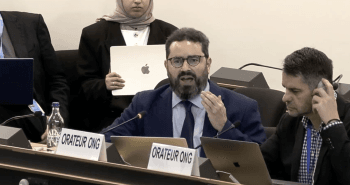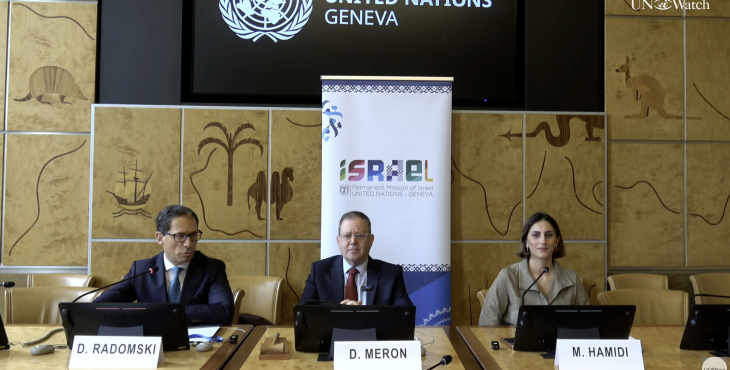
In collaboration with the Permanent Mission of Israel to the United Nations in Geneva, the Swiss human rights NGO UN Watch hosted a side event at the Palais de Nations, addressing the dire situation of human rights in Iran, specifically focusing on the intersection of sports, forced exile, and the systemic oppression of women.
The event was opened and moderated by UN Watch Chief Strategy & Diplomacy Officer Daniel Radomski, with additional remarks by Israeli Ambassador Daniel Meron. The keynote speaker was Marzieh Hamidi, Afghan-Iranian taekwondo champion and activist. Last month, Hamidi received the 2026 International Women’s Rights Award at the 18th annual Geneva Summit for Human Rights and Democracy for her tireless advocacy for Afghan women’s rights.
Marzieh Hamidi’s Full Remarks:
Ladies and gentlemen, my name is Marzieh Hamidi. I am a woman born and raised in Iran from an exiled Afghanistani family — a girl whose identity was defined not by choice but by repression.
My parents came to Iran escaping war. Yet even so, the Islamic Republic denied me the recognition and visibility I deserve. Despite being Persian by language and by heritage, I was never fully seen as an Iranian. My rights, my identity, and my existence were constantly questioned and marginalized by the system.
This denial of identity was not just personal. It reflects the experience of millions of Afghanistanis in Iran whose lives are lived on the margins, without citizenship and without the certainty of human dignity.
For millions of people in Iran, life under the Islamic Republic has meant decades of repression, fear, and control — especially for women and girls. For 47 years, the regime has built a system designed to silence women, control their bodies, and punish those who dare to demand freedom.
But something changed when Ayatollah Ali Khamenei, the supreme leader of the Islamic Republic, was killed in a joint U.S.-Israeli airstrike. The reaction among Iranians was immediate and remarkable. Many celebrated inside Iran and across the world, seeing it as a moment of hope after decades of repression.
Yet I also noticed that some people in the West reacted with anger and sadness — a response I struggled to understand, given the deep suffering the Islamic Republic inflicts on millions.
For many Iranians, it felt as if history had suddenly cracked open. Inside Iran, hope is always mixed with fear — fear that the world will once again look away, fear that the regime, wounded but still dangerous, will regroup if the Iranian people are left alone.
Because the Islamic Republic is not simply a government. It is a system based on violence, repression, and intimidation. Women know this reality better than anyone.
The world watched the tragic death of Mahsa Amini. Her killing ignited the global “Women, Life, Freedom” movement. But Mahsa Amini was not the first victim, and she will not be the last if the system remains unchanged.
Teenage girls have been poisoned in their classrooms for protesting. Women have been dragged across the street for removing their hijabs. Many have been imprisoned, tortured, or killed simply for demanding basic human rights.
When Iranian women chant “Women, Life, Freedom,” they are not repeating a slogan. They are describing the daily cost of living under a system that treats freedom as a crime.
And this repression extends even into sports. As a taekwondo athlete, I know how difficult life is for female athletes in Iran.
Women athletes live in constant survival mode. We are controlled in what we wear, how we behave, what we say, and even who we are allowed to compete against.
There have been many cases where Iranian athletes were forced to withdraw from competition simply because their opponent was from Israel. Athletes spend years training for international competition. But under this regime, political ideology can destroy a career in a single moment.
Even worse, athletes are often pressured to obey orders that go against their own principles.
Recently, the war revealed another shocking example. Members of the Iranian women’s national football team traveled to Australia for international competition. While they were there, they received threats linked to the Islamic Republic. They feared that if they returned to Iran, their safety would not be guaranteed.
So they made a heartbreaking decision. They sought asylum in Australia and became refugees, fearing persecution if forced to return home.
Imagine that athletes representing their country at an international tournament were forced to choose between returning home and protecting their lives. This is not normal. This is what happens when sport exists under an authoritarian regime.
And yet, despite these realities, the Islamic Republic continues to be treated as a legitimate actor on the international stage.
Let me be clear. The Islamic Revolutionary Guard Corps — the IRGC — is officially listed as a terrorist organization. And yet members of this organization, or individuals connected to it, travel freely in the West. They negotiate, they lobby, and they claim legitimacy.
Negotiate with whom? With terrorists.
This is not just hypocrisy. This is dangerous.
I know this danger personally. After the “Women, Life, Freedom” movement, I attended the European Parliament for International Women’s Day, speaking about the situation of Afghanistani women.
There, a lobbyist with connections to the Iranian regime approached me. He knew my story. He knew I had protested against the Islamic Republic.
Yet he proposed, almost casually, that I should return to Iran, train with the national team, and live there. Why?
To use me as a symbol of legitimacy — to create a false narrative: Look, even this girl, born in Iran to Afghan parents, can live under our system. Our regime is not as bad as people claim.
This was not an offer. This was propaganda. This was manipulation.
But I refused.
I refused because I stand for my values. I refused because no achievement, no opportunity, and no future is worth becoming a tool for oppression.
For me, what is most dangerous is not just the violence inside Iran. It is the spread of lies outside Iran. These lobbies operate across Europe and beyond, trying to rewrite the narrative of a regime built on repression, terror, and violence.
The Islamic regime does not end at its borders. It seeks to influence, to control, and to silence voices even beyond its borders.
And as an international community, we must ask ourselves: Why are we negotiating with those whose hands are stained with oppression? Why are we giving legitimacy to systems that terrorize their own people and export violence abroad?
The removal of one of the leaders does not dismantle an entire system. But moments like this can break the illusion that such systems are untouchable.
For decades, the leadership of the Islamic Republic was portrayed as permanent and unchallengeable. Today, that illusion has been shattered.
For women and girls in Iran, that matters — because every crack in a system of oppression creates a space for hope.
This moment belongs first to the people of Iran, especially to the women and girls who risk prison, exile, and death to demand a simple truth: that their lives, their freedom, and their dignity matter.
Many of them did not live to see this moment. But their voices continue to echo in the streets of Iran and around the world.
And their message remains clear:
Women. Life. Freedom.
Thank you.