Activists slam U.N. Human Rights Council tribute to Chavez

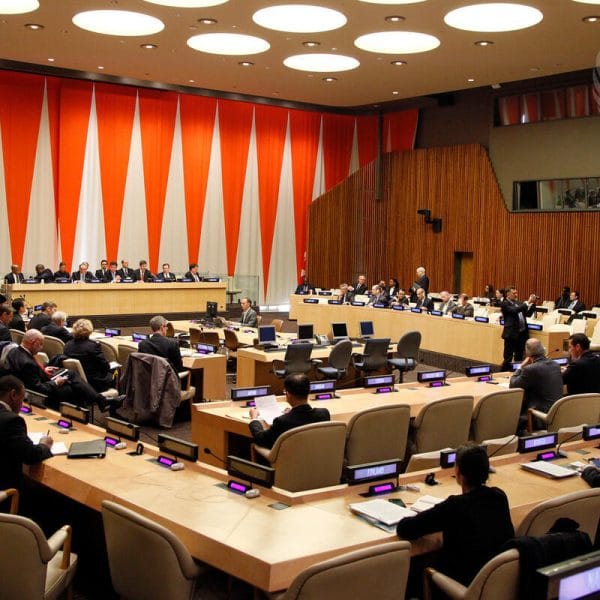
Above: UN Human Rights Council holds minute of silence for dead tyrant Hugo Chavez, March 6, 2013. UN Watch led the campaign against Venezuela’s election to the UNHRC, brought Chavez victims to testify in the council, and organized the draft UN resolution condemning his abuses.
GENEVA, March 6, 2013 – The Geneva-based human rights monitoring group U.N. Watch criticized the chief United Nations human rights body for holding a rare minute of silence today for late Venezuelan strongman Hugo Chavez, saying that the Cuban-led praise (see below) was “excessive, uncustomary, and disrespectful of its own experts’ findings of gross and systematic human rights abuses committed by the Caracas government, and of testimony by Venezuelan victims whom UN Watch had brought before the Council.”
 “Protocol did not require today’s ceremony,” said UN Watch executive director Hillel Neuer, “and the world body must not forget that its founding purpose is to defend basic human rights. Sadly, that message is at serious risk of being blurred today.”
“Now should be a time for the UN to show solidarity with the victims — like Judge Maria Afiuni who was jailed and raped for the crime of releasing a political prisoner arbitrarily detained by Chavez — and not with the perpetrators.”
“Instead of praising an autocrat who persecuted his country’s independent judges, journalists, human rights activists and students — and who vocally supported mass murderers, tyrants and terrorists in Syria, Libya, and Iran — the U.N. should be apologizing for having just elected the Chavez regime to its human rights council, and it should begin to call for accountability, reform and an end to impunity in Venezuela,” said Neuer. READ MORE
_______________

The UN’s Human Rights Credibility Gap on Syria
WORLD AFFAIRS, March 6, 2013
By Joel Brinkley
The United Nations seems ceaselessly determined to discredit itself.
What better evidence could you find than its choice last week for rapporteur of the UN’s Special Committee on Decolonization?
The committee’s job is to monitor human rights in the world’s 16 “non-self-governing territories” such as the Falklands, Guam, and the Western Sahara. And its choice for reappointment as rapporteur: Syria, that bastion of human rights.
Remember, it was the very same United Nations that days earlier had said more than 70,000 Syrians have been killed since the conflict began two years ago. At least 2 million Syrians are now homeless, in many cases because the army destroyed their homes.
 Typhoid and hepatitis are ripping through the country, and for most people health care is not readily available. At least 1 million Syrians have no reliable source of food.
Navi Pillay, the UN high commissioner for human rights, is calling for a war-crimes investigation of Syrian President Bashar al-Assad because, she said, he is committing “crimes against humanity.” In her view, in fact, Assad should be sent directly to the International Criminal Court.
But as the decolonization committee voted to elect Bashar Jaafari, a career Syrian diplomat, UN Secretary General Ban Ki-moon watched passively and didn’t say a word.
“The UN is helping the Assad regime portray itself as a UN human-rights arbiter,” said Hillel Neuer, director of UN Watch, a human-rights group. “That’s indefensible and an insult to Syria’s victims.”
But in fact, Syria has good company on the committee: Iran, Ethiopia, China, and Venezuela. Some of these same cruel dictatorships also sit on the UN Human Rights Council. Among the council’s most-recently elected members is Pakistan, home to rampant incest and a government unwilling to prosecute the perpetrators, as Equality Now, a New York based human-rights group, reported this week. Others elected in the last three years include Nigeria, China, Angola, Saudi Arabia, Cuba, and Nicaragua.
That’s the problem with using the UN to address human-rights problems. Every single state in the world, even the most reprehensible, is an equal member. The United Nations Charter, signed 68 years ago enshrines as a world principle “faith in fundamental human rights, in the dignity and worth of the human person” and “equal rights of men and women and of nations large and small.”
But every nation that ignores those ideals still has an equal vote in the UN General Assembly. Of course a couple of them, China and Russia, are actually permanent members of the Security Council.
Still, it’s difficult to find any country right now that is committing as many egregious human-rights abuses as Syria. As Neuer put it: “It’s time for the UN to stop legitimizing a government that mercilessly murders its own people.”
Source: World Affairs