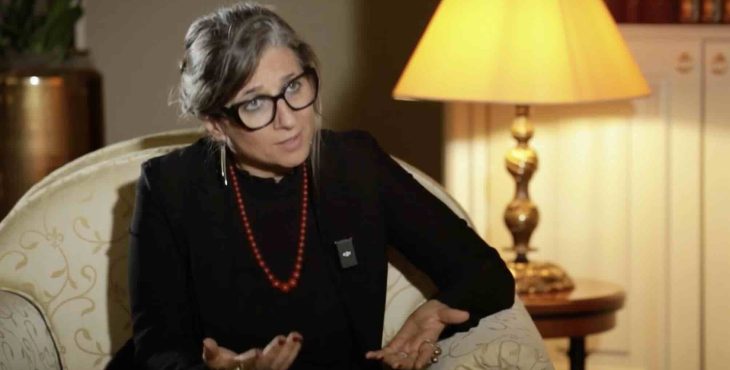
Francesca Albanese:
“The narrative that has been spread including by European leaders is that 7th of October, the crimes that were committed on October 7 were because of antisemitism. This is so false. I do not exclude that there could be antisemitic sentiments among some Palestinians. Who am I to say that? But the motives were not antisemitic — because the attack was against Israel and Israelis, unfortunately Israeli civilians, unfortunately, regrettably, but because they are occupiers — I mean, 75% of the Palestinians who live in Gaza are not from Gaza, are from the lands of the kibbutzim that have been created, first and foremost as military outposts, and then they have become places of civilian places.
But you see this is why I keep on saying unhealed wounds continue to fester. And also, sorry to say but Israelis have lived with the ghetto that Gaza has become for decades. And Israel, many Israelis not those—many of those living in the kibbutzim were really peace activists and active against apartheid and the occupation, this is the tragedy within the tragedy, but average Israelis don’t even care about what the soldiers do in the occupied Palestinian territory. So there is this mental cognitive dissonance that they really believe that there is a dark area that doesn’t belong to their conscience. It does. And this is the reminder of it.”
(Interviewed on podcast of Slovenian president Nataša Pirc Musar, July 24, 2025.)
#####
Sick: UN's Francesca Albanese justified Hamas October 7th attacks which “unfortunately, regrettably” targeted Israeli civilians on Kibbutzim—not out of hate, but “because they are occupiers.”
Attacks were a “reminder” of Israel's sins, and “unhealed wounds continue to fester.” pic.twitter.com/V3ILKWqOZJ
— Hillel Neuer (@HillelNeuer) February 16, 2026
Comment by Hillel Neuer, UN Watch:
Francesca Albanese’s ideology is crystal clear in her own words: the October 7 massacre was not driven by antisemitism, but by legitimate grievance against “occupiers.” She explicitly extends the label beyond the post-1967 disputed territories of Gaza and the West Bank (Judea and Samaria) — the only area in her official UN mandate — to the heart of pre-1967 Israel, branding kibbutz residents as squatters on “stolen” land. In her telling, 75% of Gazans hail from these very kibbutzim, created first as “military outposts” before becoming civilian homes. This isn’t a critique of policy, but a wholesale delegitimization of Jewish self-determination anywhere in Israel. By reframing mass murder, rape, and abduction as a response to “unhealed wounds,” she provides ideological cover for Hamas’s atrocities while stripping Israeli civilians of any claim to innocence or security.
Albanese’s Chilling “Reminder” of Why Israelis Got Massacred
Albanese’s chilling phrase — that the October 7 atrocities served as a “reminder” of Israel’s “cognitive dissonance” and indifference to Palestinian suffering — effectively casts the brutal murder, rape, and abduction of over 1,200 Israeli civilians not as unprovoked terror, but as an inevitable and understandable wake-up call to an occupier society that refuses to confront its own conscience.
This pattern of using violence as a supposed “reminder” or “warning” echoes her November 2025 comments on the pro-Palestinian protesters’ violent raid on the Italian newspaper La Stampa‘s Turin offices, where she condemned the attack but insisted it should serve as “a warning” to the press — to “go back to doing its work” by providing more “facts” and “contextualization” on Palestine — a statement widely condemned across Italy’s political spectrum as justifying intimidation and violence against journalists who deviate from her narrative.
Dehumanization & Historical Revisionism
Albanese’s narrative rests on a fabricated history that inverts victim and perpetrator. Kibbutzim within Israel’s sovereign and UN-recognized pre-1967 borders — many of them pioneering communities built by refugees and Holocaust survivors — are recast by Albanese as illegitimate, colonial military forts deserving retribution. She laments the “tragedy within the tragedy” that many kibbutz victims were peace activists opposing occupation, implying that if Hamas had massacred other Israelis, this would have been less tragic and presumably somehow justified.
Of course, Albanese’s own rhetoric — such as telling Hamas in November 2022 that “you have a right to resist” — armed their killers by designating Israelis as perpetual “occupiers.” Albanese pretends to show empathy, but it’s merely tactical, faux sorrow on her part in order to excuse terror. Her claim that Israelis suffer “cognitive dissonance” for ignoring abuses in the territories rings hollow when she herself exhibits moral blindness: ignoring Hamas’s charter, its rocket barrages from Gaza post-2005 disengagement, and the explicit jihadist ideology behind October 7.
Broader Implications
At root, Albanese’s worldview denies Jews the right to a sovereign homeland free from existential threat. By insisting the attack targeted “Israel and Israelis… because they are occupiers,” she indicts the state’s very existence—not just policies since 1967. This ideology aligns seamlessly with rejectionist movements that view any Jewish presence as theft. As UN Special Rapporteur, she doesn’t merely report; she propagandizes a one-sided narrative that emboldens violence and erodes international law’s impartiality. When a UN human rights expert rationalizes civilian slaughter as payback for “unhealed wounds,” the institution itself is compromised—and the world must demand accountability.