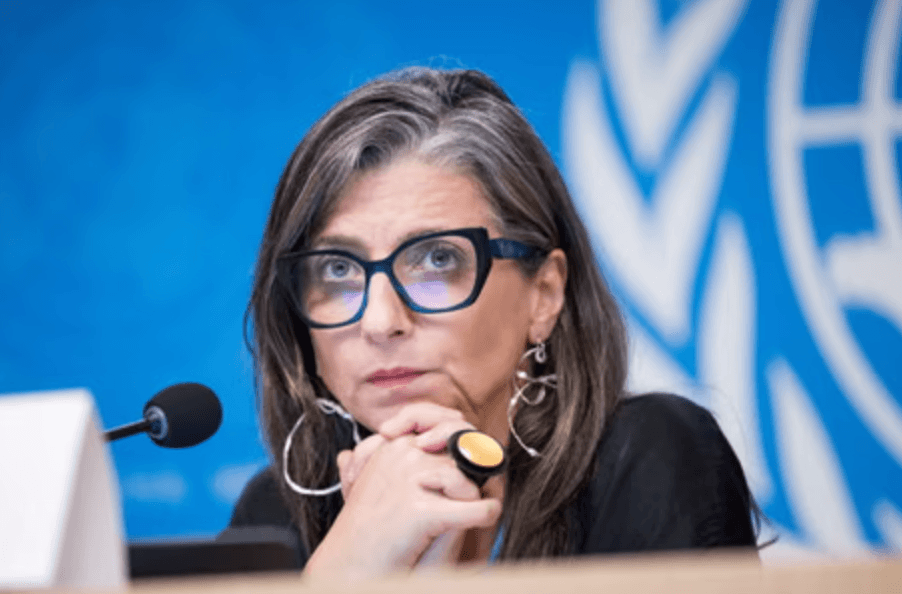
Following is UN Watch’s legal analysis of the October 2026 report of Special Rapporteur on Palestine Francesca Albanese titled “Truth under the rubble: media in the time of genocide.”
By Dina Rovner, Legal Advisor at UN Watch
The report released today by Francesca Albanese is presented as an examination of Israel’s “destruction of truth,” but in reality is itself an assault on truth. This latest iteration of the genocide canard advances a self-sealing theory in which interpretations that support the genocide charge are accepted without question, while contrary evidence is dismissed and transformed into proof of “mediacide.” Thus, Israeli evidence that purported journalists belonged to terrorist organizations becomes a “smear.” Evidence that Hamas operated from hospitals becomes “humanitarian camouflage.” Challenges to famine findings become “genocide denial.” Media outlets that report Israeli arguments are accused of amplifying propaganda, while social-media platforms that carry them face suggestions of complicity. Her framework leaves remarkably little room for legitimate scrutiny, competing evidence or reasoned debate.
Central to Albanese’s charge is the unsupported assertion that Israel intentionally targeted Gazan journalists for “murder” in order to “silence Palestinian journalism” (paras. 13, 19). Albanese dismisses as “smear campaigns” (para. 26) Israeli evidence that 170 of the journalists killed in Gaza after October 7, 2023 were Hamas or PIJ combatants, refusing to engage with it. Yet more than 60 of these have already been admitted by Hamas and PIJ as their combatants through martyr notices published by the terrorist groups. Indeed, since June 2025, the Committee to Protect Journalists (CPJ) has removed 27 “journalists” from its lists of “journalists and media workers killed in Israel and the Occupied Palestinian Territory (IOPT),” after determining that they were Hamas or PIJ combatants.
Journalists admitted by Hamas or PIJ to be combatants include:
- Yahya Omar Abu Manih, eulogized by Hamas as a “martyred field commander.”
- Ahmed Abu Mahti, eulogized by Hamas as a squad leader in Hamas’ Fawzi Abu Qara (al-Khulafa) Battalion in the Northern Brigade.
- Ahmed Al-Helou, eulogized by Hamas as a “mujahid” in the Northern Khan Younis Brigade.
- Assem Adli Ahmed Al-Barsh, eulogized by Hamas as a Qassam Brigades group commander in the Northern Brigade’s Western Battalion.
- Amin Fathi Hamdan, eulogized by Hamas as a platoon commander
- Mohamed Nabil Al-Zaq, confirmed by PIJ as a commander and seen in a PIJ combat training video.
- Mahmoud Abu Shirby, eulogized by PIJ as a commander.
- Saeed Abu Hassanin, admitted by Hamas as a commander.
- Mohamed Jarghoun, eulogized by Hamas as a “Qassami mujahid martyr.”
- Ahmed Abu Eisha, eulogized by PIJ as a platoon commander.
- Mohamed Skheil, eulogized by PIJ as a commander killed inside the Shifa Hospital.
- Tarek Skheil, eulogized by PIJ as a commander who posed as a “journalist” and used Shifa Hospital as a base.
The fact that even Hamas and PIJ contradict one of Albanese’s principal accusations is emblematic of the report’s broader deficiencies.
Albanese claims to expose how “the destruction of truth has become integral to the destruction of a people.” Yet, as the following sections demonstrate, her report substitutes selective evidence, unsupported inferences and distorted legal analysis for rigorous fact-finding. Far from exposing an “assault on truth,” it perpetuates one—under the imprimatur of the United Nations.
1. Genocide Assumed, Not Proven
Albanese’s analysis begins with the conclusion it purports to prove. She refers to Israel’s “genocidal destruction” and describes the current hostilities as “the genocidal phase” of Israel’s “long colonial project” (para. 1). Later in the report, she describes the conflict as the “ongoing genocide in Palestine” (paras. 41, 91) and as established fact, referring to “the genocide” and Israel’s “genocidal campaign” (paras. 28, 42, 64, 70, 81). In circular fashion, she then presents Israel’s alleged targeting of journalists, which she terms “mediacide,” as further evidence of the premise she has already assumed, declaring it “probative of genocidal intent” (para. 41).
Even Albanese’s own authorities undermine her attempt to infer genocidal intent from the alleged systematic killing of journalists. In paragraph 9, she claims that “systematically killing those who document atrocities” may be evidence of an intent to destroy the protected group, citing Bosnia v. Serbia (at para. 373) and Croatia v. Serbia (at para. 148). Yet neither cited passage addresses the killing of journalists or witnesses, much less establishes that such conduct is evidence of genocidal intent. Instead, both establish the stringent standard for inferring genocidal intent from a pattern of conduct under which genocidal intent must be “the only inference that could reasonably be drawn from the acts in question.”
Moreover, in paragraph 89, she herself offers a different explanation for the same alleged conduct—claiming that Israel targeted journalists “to conceal” alleged “mass atrocities” and “also to erode the very possibility of documenting them.” An alleged intent to conceal atrocities or suppress their documentation is not the specific intent to destroy a protected group required for genocide. Yet in paragraph 91, she recasts Israel’s alleged targeting of journalists as “intrinsic to the ongoing genocide.” Albanese neither establishes the specific genocidal intent required under international law nor explains how her allegations satisfy the stringent ICJ standard she herself invokes.
2. “Mediacide”: An Invented Concept Presented as Proof of Genocide
“Mediacide” is not a recognized international crime or established legal category. Yet Albanese uses this invented concept to link fundamentally different forms of conduct to genocide. In paragraph 90, she describes “mediacide” as a “single, integrated phenomenon” that encompasses the alleged targeting of Palestinian journalists, Israeli media coverage, and the reporting practices of Western media and digital platforms. In paragraph 91, she declares these phenomena “intrinsic to the ongoing genocide,” without establishing how they demonstrate the specific intent to destroy a protected group required under international law.
Moreover, Albanese stretches “mediacide” to cover almost anything that affects the information environment—from the alleged killing of journalists and destruction of media infrastructure to Israeli government advertising, television commentary, Western media coverage and social-media moderation. These are fundamentally different acts, governed by different legal standards. Grouping them together under a single label does not turn them into a single legal wrong, much less evidence of genocide.
3. Combatants Recast as Journalists
Albanese misrepresents international humanitarian law when she sweepingly claims in paragraph 7 that “[j]ournalists in armed conflict are civilians, protected unless they directly participate in hostilities,” citing Additional Protocol I to the Geneva Conventions and ICRC Rule 34. In paragraph 15 she reiterates that the “civilian status” of journalists is “presumed,” citing also the ICRC’s Interpretive Guidance. But that is only part of the story. Albanese omits that the same ICRC guidance she cites also recognizes that members of an organized armed group whose “continuous combat function” involves the preparation, execution or command of military operations do not qualify as civilians at all—even when they are not carrying out a particular attack. A Hamas or PIJ fighter or commander does not suddenly benefit from civilian status just because they simultaneously work as a journalist.
Albanese compounds this selective presentation of the law by dismissing evidence of journalists’ military roles. At the outset, she characterizes allegations of terrorist affiliation as journalists being “smeared” while “documenting the destruction of their own society” (para. 3(a)), and in paragraph 7 warns that “mischaracterizing journalists as ‘terrorists’ or combatants cannot negate” their protection. In fact, the opposite applies here: mischaracterizing a combatant as a journalist does not transform him into a protected civilian.
As discussed above, Albanese’s blanket dismissal of Israeli evidence as “undisclosed or discredited” is contradicted by Hamas and PIJ’s own identification of individuals listed as journalists as their combatants, as well as CPJ’s subsequent removal of 27 names from its database after determining that they were Hamas or PIJ combatants. CPJ expressly condemned “the misrepresentation of combatants as journalists or media workers.” The problem is not new. During the 2014 Gaza conflict, UNESCO withdrew its condemnation of the killing of Abdullah Murtaja as a journalist after evidence emerged that he was a member of Hamas’s Al-Qassam Brigades. UNESCO Director-General Irina Bokova expressly deplored “attempts to instrumentalize the profession of journalists by combatants.”
4. Journalist Deaths Do Not Prove Israel Targeted Journalists
Albanese repeatedly treats the killing of journalists as evidence that Israel deliberately targeted them because of their work. In paragraph 3(a), she describes the “systematic targeting” of Palestinian journalists and claims that it “has progressively deprived the world of its primary witnesses” of Israel’s conduct. But these are distinct propositions. The fact that a journalist was killed in an Israeli strike does not establish that the journalist was deliberately targeted, much less that the purpose was to suppress reporting.
Albanese makes a similar leap in claiming that the destruction of more than 150 journalists’ homes “signals an intent to persecute the media sector” (para. 18). But a tally of destroyed homes does not establish that they were deliberately targeted because of their connection to journalists.
5. Destroyed Media Buildings: Motive Assumed Without Evidence
A media facility can become a military objective if, in the circumstances of the particular case, its nature, location, purpose or use makes an effective contribution to military action and its destruction, capture or neutralization offers a definite military advantage.
Albanese dispenses with that inquiry. In paragraph 35, she cites the destruction of Palestine Tower, damage to approximately 50 media offices and the destruction of Press House and declares that the “early and intense targeting of media institutions likely indicates an explicit intention to suppress reporting from the ground.” Yet Albanese simply assumes that the media offices were the intended targets and that suppressing reporting was the objective, without offering evidence for either conclusion.
Palestine Tower illustrates the speculation underlying Albanese’s conclusion. Israel gave an entirely different explanation at the time for the strike, identifying the target as “military infrastructure used by senior Hamas terrorist operatives for carrying out terrorist activity.” Reporting from the time also identified Hamas offices in the tower. Albanese does not address this evidence. Nor does she offer evidence to support her claim that Israel’s actual objective was to silence journalists. The intelligence and contemporaneous targeting assessments that would shed light on the strike’s actual purpose are not publicly available, and Albanese offers no indication that she reviewed them. Yet she attributes to Israel a motive she cannot substantiate.
The Press House example fares no better. Publicly available information does not establish precisely how or why the building was destroyed. Yet Albanese treats its destruction as evidence of an Israeli campaign to suppress journalism, again substituting speculation for evidence.
6. Hamas Erased From Gaza’s “Information Environment”
Albanese claims to analyze Israel’s war “on and through the media” (para. 1), which she characterizes as Israel’s “destruction of truth” (summary), while effectively excluding Hamas from her analytical framework. She focuses instead on Israel’s alleged targeting of journalists, its “architecture of information control,” and the global media’s amplification of Israeli narratives (para. 3(b)). Yet Hamas has controlled Gaza since 2007 and exercises coercive power over the environment in which Palestinian journalists operate.
Hamas’s repression of journalists is well documented. In 2025, the Committee to Protect Journalists reported that Hamas violations against journalists during the war were “vastly underreported.” The Palestinian Journalists’ Syndicate told CPJ that journalists faced threats, interrogations, beatings, arrests, publication bans, interference with content and surveillance, and that many practiced self-censorship to avoid retaliation. Journalists described being beaten and threatened by Hamas security forces and prevented from covering anti-Hamas protests. This predates the current war. During the 2014 Gaza conflict, the Foreign Press Association protested Hamas’s threats and pressure against foreign journalists, reporting that journalists had been “harassed, threatened or questioned” over their reporting. Correspondents, including Italian journalist Gabriel Barbati and Polish journalist Wojciech Cegielski reported on Hamas violations against civilians during the 2014 war only after leaving Gaza.
Although Albanese briefly acknowledges that Hamas has threatened journalists covering protests against it (para. 16), this fact disappears from her analysis of the “destruction of truth” within Gaza. Instead, she portrays Palestinian journalists as continuing “to bear witness” despite “bombardment, displacement, hunger, and exhaustion,” and declares that “every image, fragment of video and testimony” sent from Gaza “stands as an act of resistance against colonial erasure” (para. 5). By scrutinizing purported Israeli influence over reporting while failing to incorporate Hamas’s documented control, intimidation and censorship of journalists into her analysis, Albanese presents a fundamentally distorted account of the information environment she claims to examine.
7. A Double Standard for Evidence: Contrary Evidence Becomes “Disinformation”
Albanese repeatedly brands information that contradicts her narrative as “disinformation,” “denial” or “humanitarian camouflage,” while presenting her own disputed and unverified claims as fact. In paragraph 60, she describes challenges to famine warnings and even “questioning the reliability of humanitarian assessments” as “denial.” In paragraphs 69–70, she attacks media outlets for reporting Israeli arguments concerning evacuation orders, human shields and the military use of civilian facilities, dismissing these arguments as “humanitarian camouflage.” She likewise describes claims that Hamas operates from hospitals and other civilian sites as “unverified.”
Yet there were ample grounds to question the famine assessments. In March 2024, the IPC projected that famine was imminent in northern Gaza. Three months later, its Famine Review Committee concluded that the available evidence did not indicate that famine was occurring, while acknowledging major gaps in the evidence on food consumption, nutrition and mortality and a “very high level of uncertainty.”
Even the IPC’s August 2025 famine finding was highly contested on methodological grounds. The Famine Review Committee acknowledged limitations in the malnutrition data and the absence of direct evidence of nutrition-related mortality, while critics challenged the data, thresholds and assumptions used to reach the finding.
Albanese applies the same tactic to UNRWA. She condemns the “amplification of unsubstantiated allegations” against the agency (para. 68), yet the United Nations’ own Office of Internal Oversight Services found evidence indicating that nine UNRWA employees may have participated in the October 7 attacks, and UNRWA terminated them.
In paragraph 68, Albanese refers to “unverified or false Israeli claims” that Hamas operates from hospitals and other civilian sites. Yet the evidence concerning Al-Shifa alone is substantial. The U.S. intelligence community assessed with “high confidence” that Hamas and Palestinian Islamic Jihad used Al-Shifa and sites beneath it for command infrastructure, command-and-control activities, weapons storage and holding hostages. Israeli forces also uncovered a tunnel network and weapons at the hospital. Released hostages testified that they had been held or taken to hospitals, while security-camera footage showed armed Hamas terrorists bringing two October 7 hostages into Al-Shifa.
Albanese repeatedly criticizes media outlets for what she considers inadequate verification of Israeli claims, yet fails to apply the same scrutiny to evidence supporting her own conclusions. This selective treatment of evidence is particularly troubling because the Code of Conduct requires Special Procedures mandate holders to rely on “objective, reliable information” from “relevant credible sources,” to “duly cross-check” information to the best extent possible, and to act with “impartiality” and “even-handedness.”
Her treatment of evidence falls short of these standards. In the introduction, Albanese quotes an alleged Israeli soldier as saying, “Whoever writes an article or works on a laptop is like someone carrying a Kalashnikov and attacking us” (para. 3(a)). Her only source is a submission by Addameer. She does not identify the soldier, provide the circumstances of the statement or cite any corroborating evidence. Even if authentic, the statement is anecdotal. The views of an unidentified soldier cannot establish IDF policy or prove that Israel targets journalists because of their work. Yet Albanese places the quotation immediately after alleging that Israel systematically kills and intimidates journalists to suppress documentation of its actions.
The same double standard appears in her treatment of Palestinian sources. Albanese describes Palestinian journalists as the world’s “primary witnesses” to the “destruction of their own society” (para. 3(a)) and declares that “every image, fragment of video and testimony” sent from Palestinian territory is an “act of resistance against colonial erasure” (para. 5). These sweeping assertions presume the reliability of Palestinian-produced material. She does not explain how such material is verified, distinguish verified evidence from unverified claims, or acknowledge that Palestinian sources may also require corroboration.
This is consistent with her broader record. As UN Watch has documented, Albanese has repeatedly amplified false or unverified claims against Israel, including claims originating with Hamas-controlled authorities, in one case even admitting that she did so to be “provocative.” In May 2025, she urged the media to stop identifying Gaza casualty figures as coming from the Hamas-run Ministry of Health and instead report the figures simply as people “Israel killed.”
Albanese may disagree with evidence that challenges her conclusions. But dismissing contrary evidence as “denial,” “propaganda” or “humanitarian camouflage,” while accepting claims that support her narrative without comparable scrutiny, is not impartial fact-finding. It is selective treatment of evidence designed to reinforce a predetermined conclusion.
8. Western Media Condemned for Reporting Israel’s Side
In a distortion of ordinary journalism, Albanese attacks major Western media outlets, including BBC, CNN, and The New York Times for reporting Israeli claims and arguments as though reporting them amounts to endorsing them. Her targets are particularly striking: these same outlets have published extensive reporting highly critical of Israel and its conduct in Gaza. Yet Albanese accuses them of amplifying Israeli “humanitarian camouflage,” including claims concerning evacuation orders, human shields and Hamas’s use of civilian facilities (paras. 69–70), and charges them with reproducing narratives that “obscure, justify or legitimize atrocity crimes while marginalizing Palestinian voices, evidence and international law” (para. 90).
In one example, Albanese says Western media “frequently reproduced” Israel’s portrayal of evacuation orders and safe zones as measures to protect civilians “without challenging it” (para. 69). Her supporting footnote cites an April 2024 New York Times report on preparations for an Israeli operation in Rafah. Yet that article did not simply reproduce Israel’s position. It reported that Israel planned to relocate civilians to an expanded humanitarian zone, but also noted that more than one million Palestinians were sheltering in Rafah and that the proposed zone was already overflowing and lacked adequate clean water and sanitation. It quoted a Palestinian former official asking, “Where do these million people go?” and reported U.S. and U.N. concerns about protecting civilians. Far from supporting Albanese’s accusation, the New York Times article she cites directly contradicts it.
The same problem appears in her treatment of Hamas’s use of hospitals. Albanese complains that “unverified claims that Hamas operates from hospitals and other civilian sites” lent credibility to narratives justifying attacks on medical facilities (para. 70). But reporting an allegation, identifying its source and examining the evidence is not the same as adopting the allegation as fact. CNN, for example, repeatedly attributed the claims to Israel, reported Hamas’s denials and distinguished what it could independently verify from what it could not. After visiting Al-Shifa, CNN explicitly told viewers that what it had seen was “not proof of a Hamas command center,” while reporting the evidence presented by Israel and the competing claims about what it showed. Albanese’s characterization therefore obscures the distinction between reporting a contested claim and endorsing it.
In addressing the question of “human shield,” Albanese notes that the New York Times referred to “human shields” 176 times and the BBC 81 times, presenting the frequency itself as evidence that Western media adopted an Israeli “framing” of civilian deaths (para. 70). But counting the words proves nothing. Albanese does not show whether the references were allegations attributed to Israel, findings reported from other sources, statements challenged by the outlet, or conclusions supported by evidence. Nor does she establish that the underlying allegation was false.
9. Stretching the Law to Manufacture Liability
Albanese repeatedly invokes international criminal law to transform speech, journalism and commercial activity by private actors into components of genocide. But the authorities she cites do not support the conclusions she draws from them.
Her reliance on the Rwanda “Media Case,” Prosecutor v. Nahimana, is one example. Albanese claims that statements by Israeli presenters and commentators amount to direct and public incitement to genocide and says that their being “unchallenged and unrepudiated” engages the responsibility of the media organizations themselves (paras. 61-62). But Nahimana does not establish such a sweeping rule. The Appeals Chamber stressed that the specific crime requires a direct public appeal to commit genocide, made with the intent to incite genocide. It expressly distinguished such incitement from hate speech and incitement to violence, holding that speech must amount to more than a “vague or indirect suggestion.” The tribunal examined the specific broadcasts, the intent behind them and the individual defendants’ responsibility for their dissemination.
The facts of Nahimana also bear little resemblance to Albanese’s allegations against Israeli media. The case concerned RTLM broadcasts that directly incited the killing of Tutsis during the Rwandan genocide. Albanese, by contrast, relies on a handful of selected statements by Israeli presenters and commentators, without adequately examining their context, meaning or the intent of the speakers. Instead, she characterizes them as direct and public incitement to genocide and invokes Nahimana to suggest that media organizations bear responsibility for statements left “unchallenged and unrepudiated” (paras. 61-62). But the judgment provides no basis for drawing such sweeping conclusions from isolated statements without establishing the required elements of the crime.
Albanese makes the same legal leap when accusing social-media companies of potential complicity in international crimes. She says Google and X accepted Israeli government advertising that disputed famine claims and other allegations against Israel (paras. 50, 85). From there, she jumps to the possibility of criminal complicity (para. 88), citing Furundžija, a war-crimes judgment from the International Criminal Tribunal for the former Yugoslavia.
But Furundžija does not establish criminal liability merely for accepting payment to publish an advertisement. It requires assistance that had a “substantial effect” on the commission of a crime, together with knowledge that the assistance facilitated the crime. Albanese establishes neither. She identifies no international crime that was substantially assisted by a Google or X advertisement, no evidence that carrying the advertisement facilitated such a crime and no evidence that the platforms accepted it knowing that it would do so.