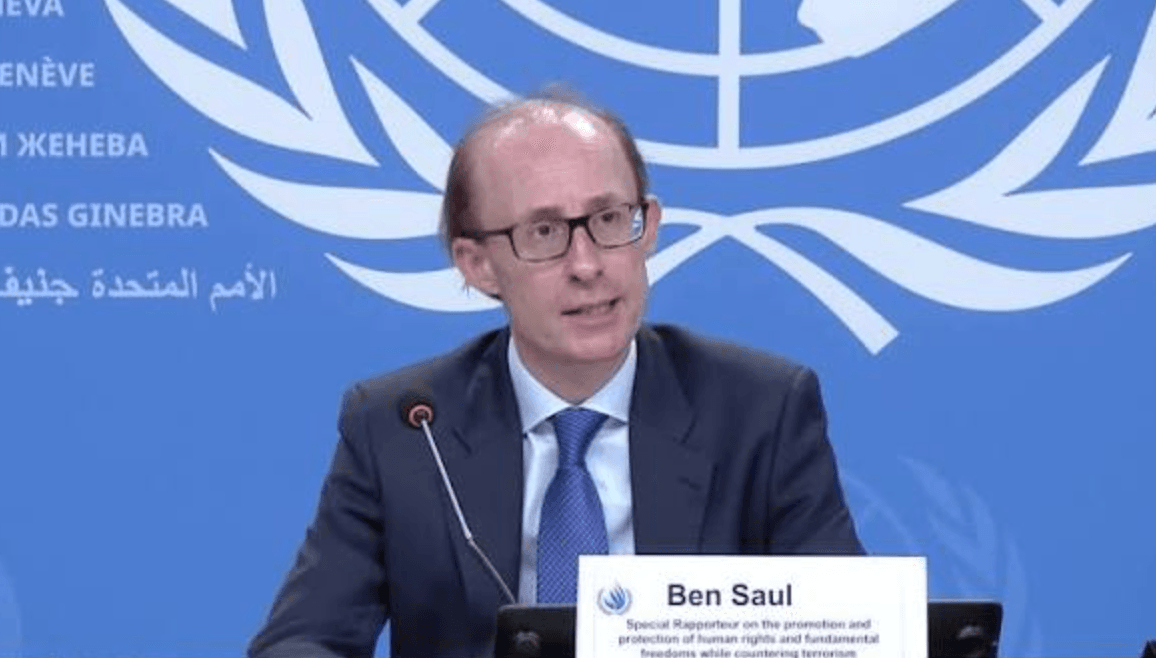
In a report (A/81/227) to be presented this week to the UN General Assembly, Ben Saul, the UN’s China-funded expert on counterterrorism and human rights, makes a series of extraordinary allegations against the United States, including that its military strikes on suspected drug-trafficking vessels may constitute crimes against humanity. He also advocates drug legalization and argues against designating violent, profit-driven criminal organizations as terrorist groups.
China provided $150,000 in funding for Saul’s mandate in 2024. For more information on funding to UN Special Procedures, see UN Watch’s Special Procedures Funding Database.
Below are some of the report’s most striking statements and recommendations, with excerpts in Saul’s own words.
1. Accuses the U.S. of possible crimes against humanity
The report alleges that U.S. military strikes on suspected drug-trafficking vessels since September 2025 have killed at least 221 people. Saul characterizes the strikes as unlawful killings and states: “The organized policy of multiple murders may further involve a systematic attack on a civilian population, constituting crimes against humanity.” He calls for military and civilian leaders to be investigated and held accountable. (Para. 25)
2. Accuses the U.S. of aggression against Venezuela and unlawful threats against other countries
Saul characterizes the January 2026 U.S. military operation in Venezuela as “aggression,” alleging violations of Venezuelan sovereignty, the right to life and liberty, and the prohibition on transboundary abduction. He further states that “the United States has also illegally threatened force against Colombia, Cuba and Mexico” and alleges that it participated in “possibly unlawful military attacks” in Ecuador in May 2026 and Venezuela in June 2026, followed by a lack of accountability. (Para. 26)
3. Argues that violent drug cartels should generally not be classified as terrorist organizations
Saul acknowledges that some criminal groups use extreme violence to terrorize populations and coerce governments, but argues that terrorism requires a political or ideological purpose. He concludes: “An organized criminal group that is foremost motivated by profit—even if, to that end, its violence intimidates a population or compels a Government—will not qualify as terrorist.” (Para. 17)
4. Advocates legalizing drugs to weaken criminal cartels
Saul states that governments “should not only decriminalize personal possession of drugs but consider legalization and responsible regulation.” He argues that “legalization is ultimately the only tool that could seriously reduce drug profits” and proposes regulating supply through medical prescriptions, specialist pharmacies, licensed retail outlets and consumption premises. (Para. 57, 66(c))
5. Suggests negotiating ceasefires with criminal gangs
Saul recommends strengthening government institutions and law enforcement in areas controlled by criminal organizations, but adds: “In certain contexts, it may be justifiable to tactically engage criminal groups in ‘ceasefires’ or negotiations to mitigate violence, pending longer-term strategic efforts to reassert State capacities.” (Para. 63)
6. Criticizes U.S. sanctions against Colombia’s president
Saul argues that U.S. counterterrorism measures can undermine international cooperation, stating that “the United States counterproductively sanctioned the President of Colombia and associates in 2025 for alleged links to ‘narco-terrorism’ and his ‘total peace’ plan to control drugs.” He later characterizes the sanctions as a misuse of unilateral sanctions. (Paras. 43, 60)
7. Calls for public disclosure of all international intelligence and military cooperation arrangements
Saul recommends that states “ensure that all arrangements for international law enforcement, migration, security, intelligence and military cooperation are publicly disclosed.” The sweeping recommendation contains no express exception for classified intelligence, sensitive military operations or other national security considerations. (Para. 65(d))