UNRWA, Hamas, and DER SPIEGEL
An Unholy Alliance
Excerpts – some paraphrased – from Jean Pierre Muller’s book, Between Humanitarianism and Political Agenda: A Critical Look at the UN Relief and Works Agency for Palestine Refugees. ISBN 9-783819-229459. 890 references (In German). Page and reference numbers in the text below refer to those in the book, which also contains further details and numerous additional examples.
The Role of the Media
The United Nations Relief and Works Agency for Palestine Refugees (UNRWA) is the only UN organization that exclusively provides assistance to the descendants of a specific group of former refugees. Thanks to a hereditary and repeatedly expanded eligibility for UNRWA refugee status, their number has risen from an original 750,000 (in 1950) to 7 million today. Every year, 100,000 new recipients are added, regardless of whether they live in stable, prosperous, or even politically secure circumstances. Neither vulnerability nor social distress nor poverty are among UNRWA’s criteria. With refugee status, UNRWA also grants the so-called right of return. The agency sees itself as the ultimate guarantor of this right and demands that its aid recipients eventually be accepted in Israel. With 7 million UNRWA Palestinians, the Jewish population in Israel would immediately become a minority. Measures for resettlement and integration in the host countries are not part of UNRWA´s mandate, and the agency strictly rejects these.
In the Gaza Strip, key UNRWA positions are held by known Hamas members or sympathizers. UNRWA Director-General Krähenbühl assured the terrorist organization: “We are united” and “No one can separate us.” Despite this proximity, on the international stage and for large segments of the domestic public, UNRWA is still regarded as the irreproachable aid agency which supposedly with no alternative, provides for millions of descendants of former refugees who fled or were expelled from the former British Mandate of Palestine, a lifetime ago. Some are now descendants in their fourth generation. UNRWA’s anachronistic mandate has been renewed every few years for decades by the UN General Assembly with an overwhelming majority and essentially without debate. Although they always voted in favor, the states of the Arab-Muslim bloc remained conspicuously reticent regarding the funding of the aid organization for their Palestinian brothers. They have recognized that the agency is one of the greatest obstacles to a lasting peace in the region. Thus, it is primarily the EU and its member states, led by Germany, that keep UNRWA alive with billions of dollars, despite its problematic mandate. Before the fateful October 7, 2023, Germany had even become the largest regular donor to UNRWA, while the Arab-Muslim states reduced their contributions from 25% (2018) to a mere 3% (2026). Why Germany, one of the loudest advocates of the two-state solution – even though this is incompatible with the UNRWA mandate?
For a long time, UNRWA has succeeded in obscuring its political agenda, and donor countries have willingly looked the other way. In this risky gamble, the German media play a key role. They can either portray UNRWA as a neutral aid organization or warn against its political instrumentalization against Israel. In his recently published book, [1] the author conducted a systematic media analysis to examine trends in German reporting, using the weekly magazine Der Spiegel as a case study. This revealed a dangerous tolerance for UNRWA’s ties to radical Islamist groups, for which the book provides numerous examples.
Masters of Omission
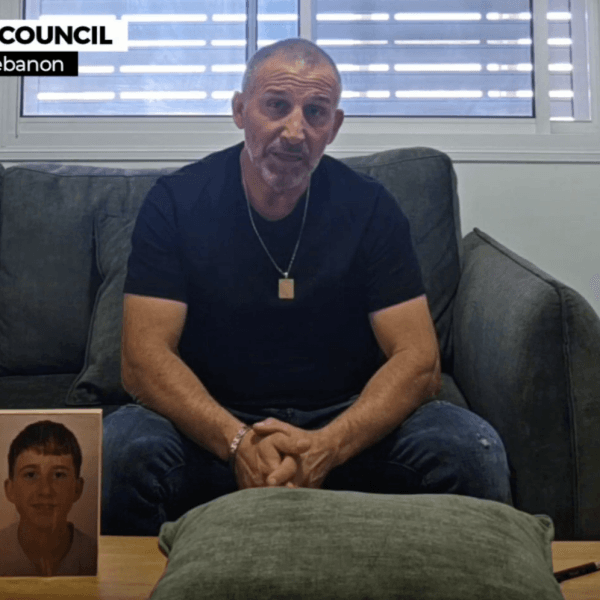
(p. 218) “Can one say goodbye in the spotlight?” asks Der SPIEGEL on September 14, 2024 (Issue 38), expressing deep sympathy for the Louk family’s grief. The body of Shani Louk, the daughter with a German passport, had been discovered a few months earlier by the Israeli army in a tunnel—along with three other murdered hostages—twelve meters beneath an UNRWA building that had been financed by German taxpayers. At least, that is what was written on the plaque at the entrance, as Israeli military correspondent Kadosh had already reported to the German BILD newspaper back in May. The circumstances of the discovery of the body must have been a worst-case scenario for Der SPIEGEL’s pleasing UNRWA narrative. Is that why it was simply omitted ? “Several meters underground, soldiers discovered three bodies. The tunnel is dark and cool; the bodies are well preserved,” the magazine wrote. On more than three pages of emphatic reporting, Der SPIEGEL readers did not learn that Shani´s body was hidden directly beneath an UNRWA building, that was funded by Germany.
(p. 185) In February 2024, the Israeli army made a spectacular discovery: 18 meters directly beneath the UNRWA headquarters, it stumbled upon large, top-secret server rooms belonging to a key Hamas command center. These were directly connected to the UNRWA’s main server via power and data lines—a finding of explosive political and moral significance. Der SPIEGEL, however, reduced this discovery to merely a “tunnel [that] ran in sections beneath a UN school and the UNRWA headquarters. “At a depth of around 20 metres […] [journalists] reportedly saw several large computers and a data centre (Der SPIEGEL #11, March 9, 2024).”
(p. 183) SPIEGEL Online provided other examples of selective journalism, for instance when it reported that during heavy fighting in Khan Yunis, “nine [Gazans] were killed in a fire at a UN facility”,127 “75 were injured.” What went unmentioned: According to the Times of Israel, 24 IDF soldiers were killed in these clashes when Hamas caused a building to collapse,128 at the time the deadliest attack on Israeli forces since the start of the ground offensive. Der SPIEGEL, however, remained silent on this and instead left it to human rights organizations to call for an arms embargo against Israel and—as if out of a sense of duty—against “armed Palestinian groups” [sic].129,130
(p. 145) Another example: Der SPIEGEL repeatedly echoed the assurances of UN Secretary-General Guterres and UNRWA Director Lazzarini that UNRWA staff involved in the massacres of October 7, 2023, would face criminal prosecution. However, Der SPIEGEL failed to inform its readers that UNRWA itself was unwilling to waive UN-immunity even in these serious cases.
(p. 205) Also in historical digressions, omissions quickly create a distorted picture. Just one month after October 7—the initial empathy for the attacked state had apparently evaporated—Der SPIEGEL recalled the Nakba in detail, no fewer than nine times in just a few pages (Der SPIEGEL Issue 46, 2023). One cannot help but feel that this was more an attempt to downplay the massacres than to provide historical context. A single sentence recalling the simultaneous expulsion of one million Jews from Arab countries at the time, would have provided at least some resemblance of historical fairness on those seven SPIEGEL pages. (p. 39) When Der SPIEGEL notes that a large proportion of Palestinians remain stateless to this day— for which Israel is usually blamed — it fails to mention that Egypt occupied Gaza for nearly twenty years, but deliberately left its inhabitants without citizenship. (p. 162) Likewise, the fact that 90 percent of UNRWA “refugees” in Jordan keep their refugee status despite their Jordanian citizenship, went unchallenged by Der SPIEGEL.
(p. 231) By deliberately omitting compromising facts, Der Spiegel tries to protect UNRWA while taking a hostile stance against Israel through manipulative and misleading language. For example, when it refers to “disproportionately frequent admonitions” (Rügen) 307 or “several UN-resolutions” 308 against Israel. In fact, the UN General Assembly has reprimanded Israel 173 times in 20 years—more than twice as often as all other states combined. Nevertheless, the magazine finds a commentator who dismisses Israel’s criticism of the UN as “political theater.”
Who gets a voice in Der SPIEGEL?
(p. 226, p. 172) The selection of voices featured in Der SPIEGEL is neither random nor neutral. Popular with the magazine are politically motivated NGOs that consistently and indiscriminately accuse Israel of human rights violations, breaches of international humanitarian law, etc., and that usually do not even mention Hamas: These include typically Human Rights Watch (“45 or 100 civilians must die to kill one Hamas fighter” 274), Amnesty International (“Where have all the bodies gone?”275 ), Doctors Without Borders (which covers up Hamas’s presence in clinics), the International Crisis Group (“Israel’s criticism of the UN is ´political theater´276), Save the Children (“Cutting off the lifeline of an entire population” 277 ). This is how the searching captured terrorists for hidden weapons quickly becomes framed as “torture”, “war crimes” and “crimes against humanity”. An impression that was further reinforced by the fact that Der SPIEGEL claimed it could not show the images for “reasons of press ethics.” Yet the photos of the prisoners in their underwear were completely harmless.77 Attempts to stir up resentments against the Israeli army are all to common in Der SPIEGEL.
(p. 228) In connection with serious allegations regarding problematic content in UNRWA schoolbooks, Der SPIEGEL had a Hamburg-based “Islamic scholar” broadly discredit hundreds of pieces of evidence of the glorification of hatred and terror—evidence that had been painstakingly documented with screenshots by renowned institutes in Germany, Israel, and Switzerland. These were summarily dismissed as the work of “pro-Israel think tanks”—allegedly “not confirmed by solid research.” 287
The genocide allegation from South Africa is repeated in numerous variations in Der SPIEGEL by NGOs, activists, and others. Even Nicaragua is given ample space for its ridiculous genocide accusation against Germany (p. 214). Although the lawsuit was unsuccessful, the allegations of genocide (seven times), war crimes (twice), and violations of international law (three times) likely did not fail to have their intended effect. Criticism of the Jewish State is likely to be particularly convincing when it comes from where one does not necessarily expect it—from Israel itself, for example from Israeli opposition figures and NGOs. Or, for instance, from a Jewish activist in Germany (p. 215) who stated outright in Der SPIEGEL that the evacuations by the Israeli army were ordered so that Gazans could be “better bombed.”
(p. 117) It is particularly problematic that the reader is regularly denied insight into the ideological bias of these activists. (p. 70) For example, despite the obvious political bias of its members—who have for years espoused anti-Israel rhetoric and taken a pro-UNRWA stance—Der Spiegel persistently referred to the so-called Colonna Commission as “independent”. (p. 227) Similarly, the UN Special Rapporteur for the Palestinian Territories, Francesca Albanese, a true wolf in sheep’s clothing, is quoted with her wildest accusations against Israel, without any warning about her longstanding, notorious activism against the Jewish state.
(p. 168) When Donald Trump presented his Middle East peace plan in late 2019, Der SPIEGEL did not give a voice to its supporters in the region—such as Saudi Arabia, Bahrain, Oman, or the United Arab Emirates—but rather to its harshest critics. First and foremost among them were UNRWA and Turkish President Erdoğan, whom Der SPIEGEL even quotes with his battle cry “betrayal […] of all humanity.” When it comes to peace initiatives involving or for Israel, Der SPIEGEL likes to turn to Erdoğan or the mullahs in Iran—inviting calculated rejection. This was already the case with the Abraham Accords of 2020: criticism instead of analysis, outrage instead of context: In a short piece by Raniah Salloum, presented as an “analysis”, titled “Good for Business,” the main focus was on showering President Trump and the agreement with scorn and ridicule. At the time, Turkey sensed “hypocritical behavior” and “betrayal of the Palestinian people.” The Iranian Foreign Ministry railed against the “criminal Israeli occupation regime.” The rejection was reported without comment and repeated by Der SPIEGEL authors. The magazine systematically avoided referring to the historical Abraham Accords by name.
(p. 203) The reporting was similarly distorted when it came to the conflict between Israel and Iran—a euphemism for Iran’s openly declared intention to destroy the “Zionist entity.” Der SPIEGEL, however, portrayed Iran as the victim—and Trump as the dangerous provocateur “lighting the fuse on the powder keg” as stated in the title of the piece. 200
(p. 229) Half-truths or untruths also arise when the actors are allowed to speak directly, without commentary. In this case, there is no need to worry about the truthfulness of their statements. The truth, after all, is that they (probably) actually said it. Der SPIEGEL, in a sense, lets its interviewees speak for it. This allows false and even radical views to be disseminated among the public without the magazine having to get its own hands dirty.
(p. 229) Voices critical of UNRWA are usually dismissed with a few lines or immediately and succinctly relativized, for example by a Hamas leader: “Israel is throwing around false claims 288.” Anyone who criticizes UNRWA is likely to be systematically discredited in Der SPIEGEL. For example, it states that “right-wing Israelis and Americans” claim the agency exacerbates the problems of the Middle East conflict—a rhetorical dismissal that delegitimizes any dissenting opinion from the outset.
(p. 231) This attitude is particularly evident in the treatment of those who have significantly shaped American Middle East policy under Donald Trump. Jared Kushner, who played a key role in shaping the Abraham Accords and the Gaza ceasefire, is subjected to ridicule and malice in Der SPIEGEL in a uniquely scathing piece: as a “prince without a plan”, driven by “naivety and arrogance”, a purveyor of “flowery PR phrases”, “aimless” and allegedly an economic failure, along with a dozen other such gems. The then U.S. Ambassador to the United Nations, Nikki Haley, is lectured in a similarly condescending manner: Her legitimate question as to whether countries receiving American support also share its values is dismissed by Der SPIEGEL as “inquisitorial.” Instead of addressing her arguments, she is mocked as an “accountant” and misogynistically: “She has long hair and long legs”—a quote that says less about Haley than about the misogynistic contempt of her critics at Der SPIEGEL. Haley was by no means the simple accountant, that Der SPIEGEL described. From 2011 to 2017, at the age of 39, she was one of the youngest governors in the U.S. and was subsequently confirmed by the Senate as U.S. Ambassador to the UN by an overwhelming majority. During the election campaign, she was Trump’s most promising Republican rival. Even the U.S. Vice President was not spared such condescension. Because of his religiosity, he was derisively mocked as an “unwanted Christian.” This mixture of malice, mockery, and schadenfreude runs like a common thread through the entire coverage of Donald Trump’s Middle East policy. It is full of ideological rejection and unrestrained in its choice of words, as the next example shows.
(p. 199) Der Spiegel took a similar approach in its reporting on the suspension of funding that President Trump imposed on UNRWA during his first term in office. All over the world, a lack of funds leads to layoffs – a normal procedure. Less than 10% of UNRWA’s 12,000 employees in Gaza lost their jobs as a result of the U.S. funding suspension. One of them was a “school psychologist specializing in the treatment of post-traumatic stress disorder in children”. Nevertheless, Der SPIEGEL took no offense at him taking his seven-year-old son to violent demonstrations where people got killed. Not a single child had to leave an UNRWA school. Nevertheless, Der SPIEGEL accused the American president of conducting a “human experiment” [sic]. And repeated the comparison six times, even adding “like lab rats.” Der SPIEGEL seems to resort to such a language only when it comes to UNRWA, Trump, and Hamas in Gaza. One may wonder whether also in Germany layoffs for economic reasons are considered “human experiments”?
Hamas’s mouthpiece
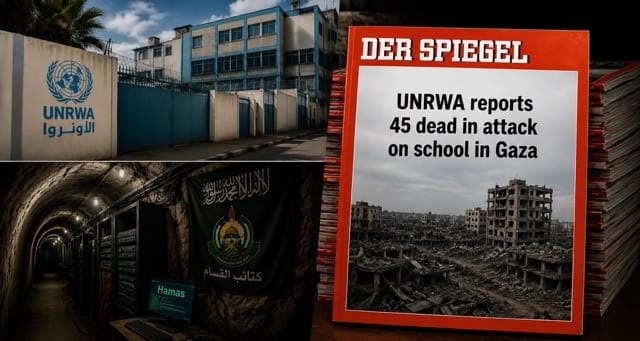
(p. 184) Der SPIEGEL also repeatedly positions itself as a direct mouthpiece for Hamas. Numerous examples illustrate this journalistic bias: “Terrorists are claimed to have been operating out of an UNRWA school. This school was now attacked, resulting in numerous deaths and injuries,” reports Der SPIEGEL. The Israeli army cited 20 to 30 deaths, while Hamas and UNRWA reported 35 to 45 deaths. Der SPIEGEL’s headline echoed Hamas’s figures: “UNRWA reported 45 deaths in attack on school.” What the reader did not learn, however, was that the Israeli armed forces published the names and photos of 17 killed terrorists, explaining that the attack took place only after civilians had left the premises. Photographic evidence also confirmed the use of precision weapons that caused minimal damage. Nevertheless, the magazine steadfastly stuck to its version: “45 dead,” “mostly women and children.” Inflated casualty figures are accepted uncritically, while detailed figures provided by the military spokesperson are ignored.300 The army can present satellite images and other evidence, yet the report states: “The figures could not initially be independently verified.”301 Apparently, Der SPIEGEL lacked confirmation from Hamas.
(p. 208) Correspondent Osang repeatedly reported page after page from Gaza, uncritically and without journalistic distance: Hamas organizes “summer camps”, is a “martyr”, “negotiates [Osang’s] entry”,” gives money”, “is available to Western interview partners” and fires “homemade rockets into the sea [sic].” Into the sea? Not a shred of criticism of Hamas’s terror against its own population and against Israel, except on the very day of October 7th. Instead, images dominate of children traumatized by Israel (not by Hamas). Osang did not mention that his stringer (i.e. the compulsary Hamas assigned ”facilitator”) had to vouch for the “conformity” of his texts. (p. 203) It is only a short step from loyalty to a stringer—with whose family one may have shared tea, and who may be punished by Hamas—to collusion with the terrorist organization.
(p. 232) In Osang’s reporting, as elsewhere in Der SPIEGEL, dead and traumatized children play a central role—they are the most effective weapon in Hamas’s propaganda war. Lead stories featuring suffering children do not fail to have an emotional impact; this has also been recognized by the Hamburg magazine. German readers tend to think of schoolchildren. But according to the UN definition, every person under 18 counts is a “child”—including many teenage combatants who take part in armed attacks, are killed in the process, and thus fulfill their final, cruel destiny in the statistics as “children” killed. Without compliant media and interest-driven journalists, Hamas´ brutal, propagandistic exploitation of “children” would come to nothing. Hamas provides undifferentiated, often inflated figures of dead children, women, and fighters; UNRWA adopts them; and Der SPIEGEL disseminates them as quasi-official UN figures. Through the media, they reach the “streets” and shape national policies.
(p. 233) If the magazine were truly concerned with the plight of children, it would have looked beyond Gaza: In Sudan, nearly three million children were at the time y acutely malnourished, and one million were suffering from extreme hunger. Yet in 2024, Der SPIEGEL Online’s internal search engine recorded 1,837 hits for “Gaza” but only 129 for “Sudan”: Gaza thus received more than fourteen times the attention given to Sudan. Presumably, every child in Sudan would be grateful to receive even a fraction of the attention and aid given to the children in Gaza, but it is only in Gaza that Israel can be blamed.
Credibility and Discrediting
(p. 230) “Israel [reports] the discovery of alleged children’s explosive belts,”298 wrote Der SPIEGEL. “Alleged” is usually (only) used when the source is Israeli. Statements from the IDF are apparently particularly often deemed “not independently” verifiable,299 while statements from Hamas apparently require such confirmation less frequently. Where Israel presents “evidence,” Der SPIEGEL prefers to speak of “justification.”297 Claims by Hamas are accepted uncritically; for the Israeli armed forces’ statements, even evidence is insufficient. Credibility is with the terrorists!
(p. 230) The discreditation of the IDF is also a popular trope for delegitimizing it and ultimately targets the very existence of Israel. How long would the country survive without its army? Yet for months, Der SPIEGEL repeated the same widely circulated allegations of torture against the IDF page after page in half a dozen articles, without even mentioning the brutal torture practices of the Gaza authorities. The accusations were based on a self-serving, selective report by UNRWA (p. 224). UNRWA has always turned a blind eye to torture in Hamas’s dungeons 257, 258, 259, 260 and in the hostage prisons, but now it has leveled one-sided allegations of torture against the IDF 261, 262, 263, 264, 265, 266, 267, 268, 269. And Der SPIEGEL has been repeating them, filling pages over a period of nine months.
(p. 134) Also in its situation reports, UNRWA accuses the Israeli army of attacks on UNRWA facilities, without even mentioning Hamas, which had entrenched itself there. For Der SPIEGEL, however, this omission is no reason to criticize UNRWA. The fact that the civilian infrastructure has lost its protection under the laws of war due to Hamas’s systematic misuse of it in combat is not a topic worth addressing for neither UNRWA nor Der SPIEGEL.
Unholy Alliance
Despite its problematic mandate, UNRWA enjoys surprisingly uncritical support in Western media. The billions in payments to the agency have gone unquestioned for decades. This media analysis of Der SPIEGEL exposes a form of reporting on UNRWA that uses humanitarianism as a façade to morally cloak its own political goals. This is a form of journalism that promotes its own biased UNRWA narrative through partisanship, half-truths, one-sided portrayals, suggestive questions from interview hosts, interest-driven commentaries or so-called analyses, manipulative language, and a lack of transparency. The study on Der SPIEGEL in the book by the author provides numerous examples of this. Thus, a narrative is reinforced that one-sidedly highlights the agency’s charitable work, while the inherent dangers of its mandate and its scandalous implementation remain largely hidden and unknown to the public. As a result, the agency was able to weather all scandals and missteps unchallenged, and the renewal of its mandate regularly devolves into a purely bureaucratic formality.
But that is not all: critics of UNRWA, which pointed out legitimate grievances were not only hardly heard but also found themselves quickly subjected to rhetorical attacks, with journalistic impartiality repeatedly falling by the wayside. Der SPIEGEL seems to do its best to protect UNRWA from legitimate criticism—even at the expense of its own professionalism. Not least thanks to journalistic support, UNRWA was able to conceal its political agenda for a long time and keep Western donors on board. As Israel, following the massacres of October 7, presented more and more evidence of UNRWA staff involvement and of Hamas infiltration of the organization, Der SPIEGEL steadfastly clung to its favorable portrayal of UNRWA and targeted Israel’s credibility instead. The magazine appears to see its mission as protecting UNRWA, and it seems to do so best by discrediting Israel.
His unwavering sympathy for UNRWA revealed at the latest by October 7, an alarming degree of tolerance on the part of Der SPIEGEL toward the deepening entanglements between this UN agency and Hamas. The apparently consensual sharing of “tasks” between UNRWA and Hamas—one providing for the population, and the other concentrating on military build-up and terrorism—seems to be generally accepted by donors, Der SPIEGEL and many other media outlets. This creates the impression that Hamas is being spared not only by UNRWA but also by Der SPIEGEL. Presumably, UNRWA did not want to fall out with its long-standing, ruthless partner and was hoping for more billions “the day after.” On this backdrop, UNRWA’s partnership with Hamas is interest-driven. But what is stopping Der SPIEGEL from exposing and denouncing this collusion between UNRWA and Hamas, rather than joining in the wall of silence?
It was also striking that Der SPIEGEL’s initial journalistic restraint toward the small Israeli population of just under ten million people had already evaporated within a few weeks of October 7. The precarious geographical situation—wedged between hundreds of millions of opponents and potential enemies, and in the midst of a forced existential defensive struggle on seven fronts—was no reason for Der Spiegel to show leniency or even empathy. The existential threat to the Jewish state was not a consideration in Der SPIEGEL’s reporting on UNRWA to contextualize the events. On the contrary, the articles were peppered with accusations, reproaches, and demands, detached from the difficult context. The intention to brand Israel as a pariah state, to stigmatize it as the “Jew among nations,” ran through the articles on UNRWA like a common thread. Such journalism does not demonstrate independence, but rather ideological loyalty—an unholy alliance between parts of the media, UNRWA, and Hamas. Whether the old, deep-rooted resentments or the new “progressive” anti-Israel fetishism are spreading through some newsrooms: both make Der SPIEGEL an accomplice of a strategy that increasingly and openly questions Israel’s right to exist and is willing to drive the people of Gaza deeper and deeper into misery and despair.[2]
Jean Pierre Muller
__________________________________
[1] Jean Pierre Muller, Between Humanitarianism and Political Agenda: A Critical Look at the UN Relief and Works Agency for Palestine Refugees. ISBN 9-783819-229459. In the media analysis, all print and online articles in SPIEGEL containing the keyword “UNRWA” were recorded for the period from January 1, 2018, to December 31, 2024 (p. 160). Only a few examples are given here.
[2] The book is a plea for a world in which Palestinians can free themselves from dependency and build a self-determined and dignified life for themselves and their children, rather than being exploited in an endless cycle of waiting with no prospects for the future and for an illusory ‘return’ to a land that is alien to them. The book describes in a final chapter how this can be achieved without losers on either side of the conflict.