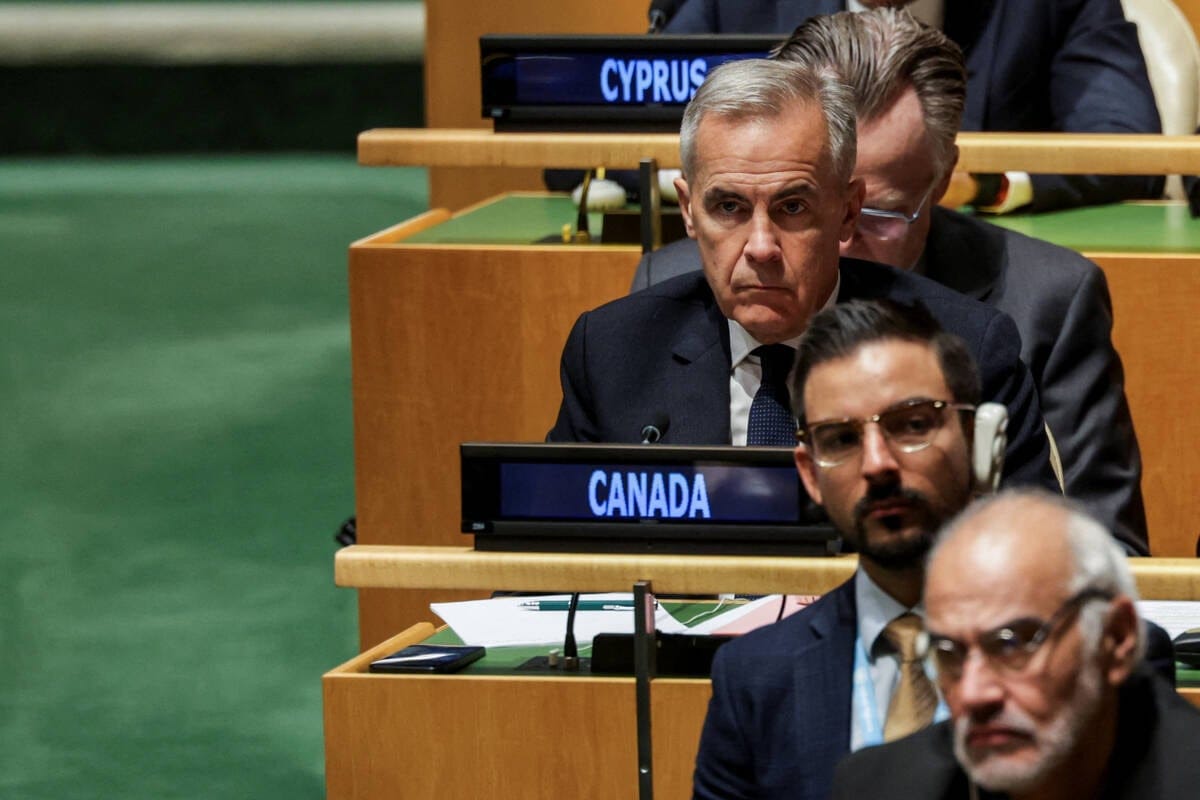
Canada’s foreign ministry got swiftly slapped with a Community Note on X for its misleading statement that tried to mask the fact it allowed the nomination of the Islamic Republic of Iran to a UN committee that addresses critical issues including women’s rights and terrorism prevention — having failed to take the floor at the UN and object, as the US did, and as Canada and EU states had done in the past.
The fact is that Canada, as a member of the 54-nation UN Economic and Social Council, participated in the consensus nomination of the Islamic Republic of Iran to the UN Committee for Programme and Coordination on April 8, 2026.
This committee deals with budget priorities and program coordination on critical issues, and will meet soon, May 14-21, to address women’s rights, human rights, and terrorism prevention. (See here.)
At a minimum, Canada should have taken the floor to object that it is wrong to nominate a regime that only months ago massacred thousands of protesters, and that brutally oppresses women, tortures political prisoners, and systematically violates basic human rights.
This is exactly what the United States did in that meeting. It was the only country that formally objected and disassociated itself from the consensus decision, citing Iran’s appalling record on women’s rights.
Canada and other Western democracies, however, remained silent and allowed the consensus to pass in ECOSOC, a body of which Canada is a member.
Notably, in a similar scenario at ECOSOC in April 2022, Canada, the UK, the EU, and several other democracies took the floor to object to the election of a Russian candidate, months after Russia’s invasion of Ukraine.
At that time, Canada rightly took the floor, on behalf also of New Zealand, to object to and disassociate from the election of the Russian national, and to condemn “Russia’s unprovoked and unjustified attack on Ukraine.” Canada stressed that it did not want to provide “tacit endorsement” of the appointment of the Russian national.
This precedent from 2022 confirms that Canada clearly had the option on April 8, 2026 to likewise object to the nomination of Iran’s regime — but the Carney government made the decision not to do so.
Canada’s Reply is Misleading
Canada’s foreign ministry posted a series of tweets, saying:
There have been incorrect reports on social media about Canada’s position on the nomination of Iran to the United Nations Economic and Social Council Committee for Programme and Coordination – an advisory body with no decision-making role. Iran was nominated as part of the Asia-Pacific Group. Canada is not a member of the group and did not endorse or vote for this nomination. There was no vote, as per established procedures. Canada does not support Iran for positions of influence within the United Nations. We will continue to actively work with partners to counter Iranian candidacies.
The truth:
• It is false and misleading to claim that the “nomination” of Iran was done by the Asia-Pacific regional group. Although it is the regional groups that first propose candidates, the UN procedure is very clear that the formal “nomination” is effected by the members of the Economic and Social Council (ECOSOC). It is a fact that the nomination of the Islamic Republic of Iran was done by Canada and the other members, in a consensus decision. Saying or suggesting otherwise is false and misleading.
• Saying that the Canada “did not endorse or vote for this nomination” is misleading if not outright false. In fact, as UN Watch first exposed in this viral tweet, Canada joined ECOSOC’s nomination of the Islamic Republic of Iran. Therefore, Canada by definition “endorsed” the nomination. All the more so when Canada failed to take the floor and dissociate itself from the decision — as the U.S. did at that meeting, and as Canada had done in April 2022 with the stated purpose of countering any interpretation that it provided “tacit endorsement” of the appointment.
• Implying that the regional group made the nomination, one which Canada did not endorse, is false. While the regional groups propose candidates, it is only Canada and the other ECOSOC members who have the power of “nomination.” (See UN ECOSOC Resolution 2008 (LX) and additional sources here.)
• Canada’s assertive statement here sounds great: “Canada does not support Iran for positions of influence within the United Nations. We will continue to actively work with partners to counter Iranian candidacies.”But the “we will continue to counter” line is forward-looking rhetoric that doesn’t erase the fact that, on this specific occasion, Canada in fact did not counter it.
– Iran’s diplomat took a seat on the UN Human Rights Council Advisory Committee (focusing on women’s rights)
– May 14: Gender Equality & Empowerment of Women
• Reviewing the UN’s medium-term strategic framework and programme budget
• Recommending priorities among programs • Guiding the Secretariat on program design
• Examining the totality of the Secretary-General’s work program (including areas like human rights, women’s rights/gender equality, disarmament, and terrorism prevention)
Iran was nominated as part of the Asia-Pacific Group. Canada is not a member of the group and did not endorse or vote for this nomination. There was no vote, as per established procedures.
— Foreign Policy CAN (@CanadaFP) April 19, 2026
4/ @MarkJCarney By way of reminder, here is how Canada rightly objected to an ECOSOC election on April 13, 2022, and what you should have done to object to Iran's nomination 12 days ago.@CanadaUN: “Madam President, I would like to make a brief statement on behalf of New… pic.twitter.com/jN7B72KCsS
— Hillel Neuer (@HillelNeuer) April 20, 2026
.@MarkJCarney Mr. Prime Minister, this is misleading if not outright false. On April 8th, your 🇨🇦 government participated in the consensus decision to nominate the Islamic Republic of Iran—to a committee that meets soon to address women's rights & terrorism prevention. 👇 proof https://t.co/02VufE1F4l
— Hillel Neuer (@HillelNeuer) April 19, 2026