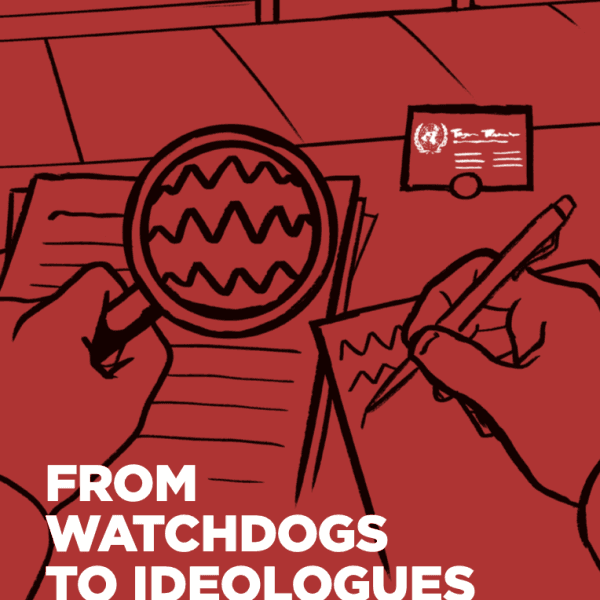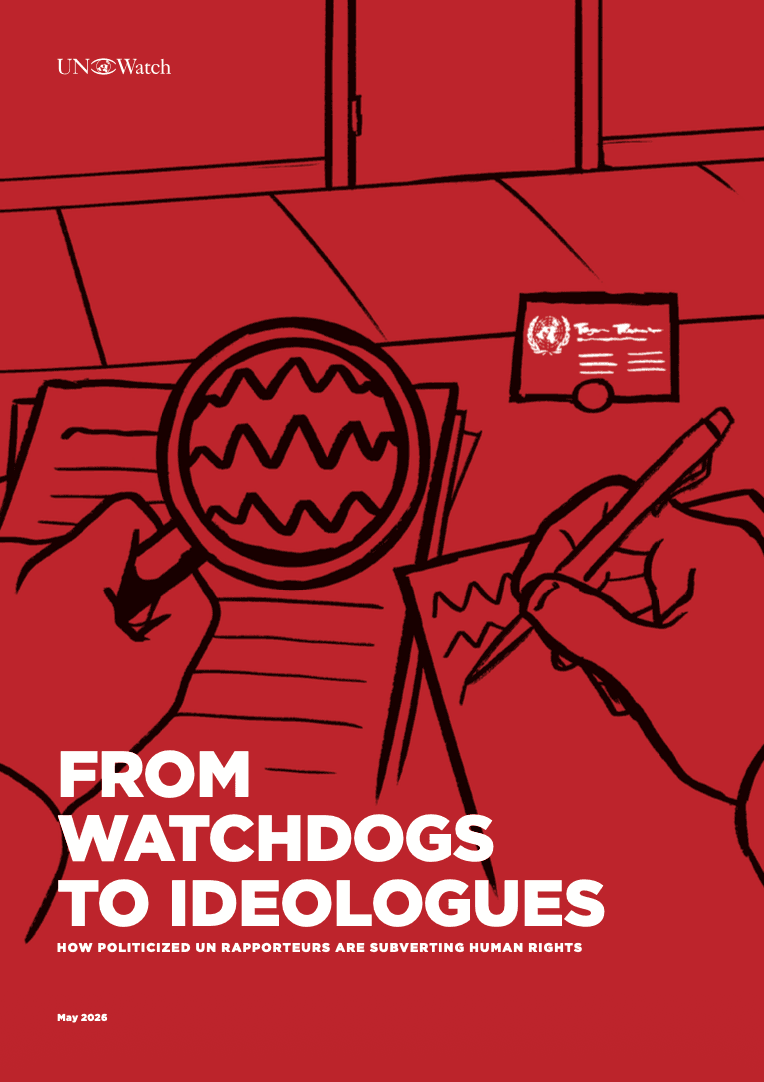
GENEVA, May 26, 2026 — UN Watch today released “From Watchdogs to Ideologues,” a 104-page investigation finding that the United Nations’ top human rights experts have abandoned the role of independent monitors and are advancing politicized agendas that erode the credibility of the international human rights system.
The report profiles 13 of the UN Human Rights Council’s Special Rapporteurs, representing more than a fifth of the 59 thematic or country-specific mandates to report on human rights, and finds a pattern of ideological bias, financial conflicts of interest, and conduct that would end careers in any other institution. Yet none has been removed; all retain their UN platforms.
“The UN’s human rights system was founded to protect victims of abuse,” said Hillel Neuer, executive director of UN Watch. “Instead, it is being manipulated to attack democracies and shield some of the world’s worst human rights violators.”
Among the report’s most striking findings:
- Alena Douhan, the UN special rapporteur on the negative impact of unilateral coercive measures, received $1.3 million in funding from China, Russia, and Qatar. Her official visits—including to Tehran, Beijing, Damascus, Doha, Caracas, and Harare—were conducted exclusively to support authoritarian regimes, not their victims.
- Ben Saul, the UN special rapporteur on counterterrorism, received $150,000 from China. Though he routinely castigates Western states, he has refused to issue any statements on China’s persecution of the Muslim Uyghurs, which Beijing justifies as “counterterrorism.”
- Tlaleng Mofokeng, the UN special rapporteur on the right to health, said “Hamas are not terrorists,” and endorsed “the legitimacy of armed struggle.” She was found guilty of unprofessional conduct and fined by South Africa’s health authority for bringing the medical profession into disrepute, after she attacked UN Watch’s Hillel Neuer as “evil scum.”
- Michael Fakhri, the UN special rapporteur on the right to food, accuses Canada of committing genocide. Though Venezuela routinely bars UN monitors, Fakhri was specifically invited for a visit, which he used to lavish praise on the Maduro regime.
- George Katrougalos, a former Greek foreign minister serving as the UN independent expert “on a democratic and equitable international order,” received $100,000 from China in 2025 — in the same year that he promoted Xi Jinping’s book, praising the Chinese dictator’s “vision of openness, development and dialogue” and “shared future for humanity.” In November 2025, Katrougalos traveled to Tehran and met with the Iranian regime’s Deputy Foreign Minister Kazem Gharibabadi. The two lamented Israeli and American “crimes.”
- Irene Khan, the UN special rapporteur on freedom of expression, turned a blind eye to gross and systematic violations of free speech by the regimes in Saudi Arabia, Venezuela, and Myanmar, as well as internet shutdowns by Iran and Turkey, yet she devoted an entire UN General Assembly report to condemning Western states for allegedly repressing pro-Palestinian protests.
- Reem Alsalem, the UN special rapporteur on violence against women, has refused to acknowledge the October 7th massacre, denied Hamas sexual crimes against Israeli women, and amplified Hamas-aligned propaganda.
- Balakrishnan Rajagopal, the UN special rapporteur on housing, questions whether the U.S. is morally distinct from China, and says international law is an “imperial” system that “legitimates the exercise of raw power by the USA.” He routinely excoriates the U.S. while excusing or ignoring abuses by China, Russia, and Iran.
“Alena Douhan, the UN special rapporteur on unilateral coercive measures, who defines Western sanctions on dictatorships as illegal, received $1.3 million from China, Russia, and Qatar,” Neuer said. “No one is even checking how this money is being used. If a judge took $1.3 million from one of the parties, they would be immediately disqualified and removed from the bench. If a journalist openly endorsed a terror group on social media, they would be fired on the spot. Yet the UN’s rapporteurs operate without ethical constraints or consequences — and there’s not even a procedure to remove them. The result is a powerful bloc of compromised officials who enjoy not only diplomatic immunity, but complete impunity.”
The report finds that the UN mandate-holders frequently rely on unverified NGO submissions and anonymous sources, weakening evidentiary standards. Despite these concerns, their reports continue to be cited as authoritative sources by international courts, governments, and media outlets.
“We examined 13 of the UN’s 59 Special Rapporteur mandates—more than a fifth of the entire system—and found patterns of ideological bias, financial conflicts, and conduct that would trigger investigations in any serious institution. Yet at the UN, there is no real mechanism even to review misconduct. That’s why we’re calling for major reforms, to institute independent oversight, transparency, and consequences for wrongdoing.”
UN Watch is calling for 12 concrete reforms, including:
- Creation of a coalition of democratic states to regularly assess, publicly rate, and hold Special Rapporteurs accountable
- A complete ban on Special Rapporteurs receiving earmarked funding from governments or other external entities
- An independent external mechanism to review, audit, and discipline mandate-holders
- External vetting of candidates by democracies, independent of the UN’s politicized selection process
- Strengthened mandatory evidentiary standards to end reliance on unverified and anonymous sources
ABOUT UN WATCH:
UN Watch is a Geneva-based non-governmental organization dedicated to holding the United Nations accountable to its founding principles of human rights, equality, and justice. Founded in 1993, UN Watch monitors UN institutions, exposes bias and misconduct, and advocates for reforms that strengthen the UN’s credibility and effectiveness. Through research, advocacy, and engagement at the UN, UN Watch works to ensure that universal human rights are upheld for all.