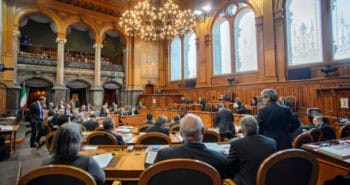
Dictators Fidel Castro of Cuba and Alexander Lukashenko of Belarus will be celebrating the UN Human Rights Council’s likely adoption tomorrow of a reform package that will see both regimes dropped from a blacklist, while Israel is placed under permanent indictment.
Contrary to all the promises of reform issued last year, the proposal released today by Council President Luis Alfonso de Alba targets Israel for permanent indictment under a special agenda item: “Human rights situation in Palestine and other occupied Arab territories,” which includes “Human rights violations and implications of the Israeli occupation of Palestine and other occupied Arab territories”; and “Right to self-determination of the Palestinian people.” No other situation in the world is singled out — not genocide in Sudan, not child slavery in China, nor the persecution of democracy dissidents in Egypt and elsewhere. Moreover, the council will entrench its one-sided investigative mandate of “Israeli violations of international law”—the only one not subject to regular review after a set term—by renewing it “until the end of the occupation.”
At the same time, the proposal eliminates the experts charged with reporting on violations by Cuba and Belarus, despite the latest reports of massive violations by both regimes. As for the experts on other countries — on Burundi, Cambodia, North Korea, Democratic Republic of Congo, Haiti, Liberia, Burma, Somalia and Sudan — all of these may soon be eliminated, as threatened by the Council majority comprised of dictatorships and other Third World countries, under a gradual “review” process. Pending their fate, all experts will be subjected to a new “Code of Conduct,” submitted by Algeria in the name of the African group, designed to intimidate and restrict the independence of the human rights experts.
The one positive innovation on the Council’s horizon is the universal periodic review, which requires that all countries subject their human rights records to review. Except that this was already authorized by the General Assembly resolution that created the Council last year, whereas the package to be adopted tomorrow merely elaborates on the details. Regrettably, the proposed procedures are hardly encouraging. First, the review will occur only once every four years. So if a Tiananmen Square massacre occurs, the victims will need to wait up to four years for redress. Even then, the duration of the review—for China as for every other country—is limited to a mere 3 hours. If all of that were not enough, the process itself, the proposal takes pains to emphasize, is a “cooperative mechanism,” with the very country reviewed “fully involved in the outcome.” Translation: it’s largely toothless.
The complete reform package is expected to be adopted by consensus tomorrow—unless the governments of Canada and other Western democracies uphold principle by opposing the entrenchment of bias as a permanent feature of the new council.
Highlights from last week:NAM, the OIC, the African Group, and the Asian Group continue to press to single out Israel through both a special agenda item and a permanent, non-reviewable expert mandate, even while demanding that all other country expert mandates be dropped. So far the West has been resisting (and the EU reportedly even has threatened to walk out), but this resolve may fade as the deadline for decision approaches. At the UN, unfortunately, the desire to achieve consensus too often outweighs everything else, including the will to stand up for principle.
Aside from discussing institutional issues, this week the Council also heard reports from 13 independent experts on a number of human rights themes (such as the independence of judges and lawyers, racism, the right to food, and the right to adequate housing) as well as on the human rights situations in Belarus, Cuba, Cambodia, the DRC, Somalia and Haiti. The Council also heard several reports following up on resolutions from its four previous special sessions, three of which have been on Israel and one on Darfur. Some highlights—or lowlights, as the case may be—follow.
The sessions on Belarus and Cuba were particularly colorful due to the vehement objections of these countries, and their allies, to these mandates’ very existence. Cuba called the report about it a “gross spectacle” and accused the expert of being an instrument of the West. North Korea, Syria, Sudan, Russia, Iran, Venezuela, Viet Nam, Malaysia, Libya, India, South Africa, Bolivia, Angola, Nicaragua, Palestine, Zimbabwe, Bangladesh, Belarus, Indonesia, Pakistan and Uzbekistan all supported Cuba, praising its human rights record, criticizing the U.S. and the West, and calling for an immediate end not only to the Cuba mandate but to all other country mandates—except, of course, the one investigating “Israeli violations of international law” in the Palestinian territories. (The latter point was repeated so much that the representative of Germany wondered aloud whether the session was on institution building or on Cuba.) The representative of Palestine was especially animated, praising “Arafat, Castro and Che Guevara as standing tall in worldwide influence, stature and inspiration” He also crowed that the “mandate against Cuba should be terminated and it will be terminated. This is the will of the majority.” He promised “his good friend” the Cuban ambassador that within a few days they would be able to celebrate the end of the Cuba mandate by singing “Guantanamera” together. Sri Lanka also gave an impassioned speech about how wonderful Cuba and the Castro regime are, including calling it “one of the most ethical and moral states in the world today” and asserting that Cuban soldiers had never in history committed violations of international human rights or humanitarian law. Only Germany, Canada, the U.S., and the Czech Republic attempted to seriously discuss the contents of the Cuba expert’s report.
The sessions with the thematic experts also had some interesting moments. Commenting on the report of the expert on the problem of racism, the Algerian ambassador asserted that anti-Semitism refers to discrimination against Arabs as well as Jews and complained that while it is “not politically correct” to be anti-Semitic against Jews, it is considered completely acceptable to be anti-Semitic against Arabs. Sudan, having been mentioned in several presentations, asserted that all of the violence in Darfur is caused by the rebels.
In the follow-up to the special sessions on Israel, South African Archbishop Desmond Tutu and British Professor Christine Chinkin reported on their investigation into an incident last November at Beit Hanoun, Gaza, in which Palestinian civilians were tragically killed by errant Israeli shells fired in response to Palestinian rocket attacks. As mandated by the original resolution of the Islamic-dominated Council, their report placed a singular focus on Palestinian suffering. Still, for a Human Rights Council presentation on a Middle East issue, their report atypically included some balance, such as condemnation of the suffering of civilians caused by both sides and the call for a joint monitoring mechanism, made up of one expert appointed by the Israelis and one by the Palestinians, to report on violations in both Gaza and Israel. Nevertheless, as pointed out by Canadian MP, former Justice Minister, and UN Watch board member Professor Irwin Cotler, who declined to participate in the investigatory mission, the Council mandate under which they were acting was fundamentally flawed.