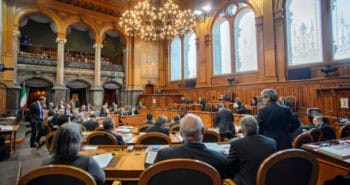
For possibly the first time in the history of the United Nations, one of its major bodies has ruled that a consensus vote was achieved even though one of its members—one with a particular reputation for honesty—insists it never gave consent, much less even saw the text that was voted upon. In its most aggressive Orwellian move to date, the UN Human Rights Council declared that this week’s package of new procedures was adopted by consensus, on the night of June 18. (In fact, the rushed declaration of council president Luis Alfonso de Alba was made past the legal midnight deadline, already in the early moments of June 19, but that’s another story.) Canada’s challenge to this interpretation was then overruled by the Council, 46 members to 1, the lone vote being Canada’s. Sure enough, speeches by Council members today and yesterday are crowing about the fact that the newly formed body was born in the purity of consensus. And so the official record will reflect.
Following is Canada’s June 19 statement to the Human Rights Council plenary:
Canada (Point of Order): I have to intervene on a point of order to challenge the interpretation that the proceedings of June the eighteenth constitute an effect that a decision was taken on the package under consideration yesterday. Last night’s decision to adjourn action until today was express in stating that the matter would be brought for action today, and I quote from the President’s statement: In paragraph five of the President’s statement, he notes, “It is literally impossible, because of logistic difficulties, I would like to propose that you accept this text as a compromise under the understanding that it also includes the code of conduct, and that tomorrow the Council can take action on them.”
This did not, and could not, constitute adoption of the package under discussion, as Canada never agreed to it and had expressed its concerns to this effect. In fact, Canada had not even seen the final version of the text until the end of the session, and the draft resolution contained in doc L.2 has only been circulated today. Any other view would forever preclude the ability of a UN committee to adjourn decisions and debate for further consultations. Striking the table with a gavel while stating that action has been postponed does not constitute a decision on a substantive point.
Even the press release of the President clearly states that he had invited the Council members to take action on June the nineteenth, which is today. By denying Canada its right to call for a vote on this subject, this Council threatens to undermine not only its own rules of procedure and those of the General Assembly, but more than sixty years of established practice of the UN, which is based on the fundamental principle of equality of all of its members states. I need not remind the members of the Council that such a precedent stands to affect more than the interests debated today.
[By vote then introduced by the President, the Council ruled 46 to 1 against Canada’s interpretation, effectively ruling that the post-midnight text announced by De Alba was passed by consensus.]
Canada (Explanation of Vote): Allow me now, firstly, to welcome you to the post of President and to also congratulate all the other members of the Bureau. In establishing the Council, the General Assembly set out its guiding principles. These include universality, impartiality, objectivity, and non-selectivity. Canada therefore regrets that the inclusion in the proposed agenda of the Council of an item that singles out one situation for politicized, selective, partial, and subjective treatment. The proposed agenda item on Palestine and the occupied Arab territories is not consistent with the founding principles of the Council. If this Council is to be credible and effective, we must hold it to standards set out by the General Assembly.
[Egypt, in its first act as new Council member, interrupts Canada with a point of order, but Chair rules that Canada may continue.]
Canada (continuing): We note that while not perfect, there are many positive elements in the proposed package before us today. However, Canada cannot agree to a package that includes an item so clearly contradictory to the principles upon which the Council was founded. In addition, the text fails to treat all mandates equally. While all other mandates have limited terms, the mandate on the Occupied Palestinian Territory does not. The text also fails to renew, and subject to renew, only the mandates on Cuba and Belarus, both situations that clearly warrant continued scrutiny by specific country mandates.