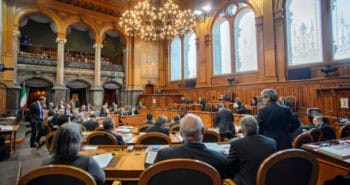
Today the Human Rights Council concluded its 11th session. Click here for the session’s report, including texts of resolutions and decisions.
The only country-specific resolution addressed Sudan. See previous blog posting here for more information about the narrow victory of the European Union in securing passage of the text, which extended the mandate of the country’s independent expert for one year, though down-grading its status.
Cuba was very active this session in proposing a number of resolutions with the backing of the Council majority. Cuban text “Enhancement of the System of Special Procedures” sought to do the opposite of what its title suggests. Its purpose was to limit the independence of the Special Procedures mandate holders, one of the U.N.’s non-political mechanisms to investigate country situations. This is one of the many regular acts of intimidation by regimes interested in hiding their abuses.
In presenting the resolution, Cuba stated, “Despite the existence of a code of conduct for Special Procedures, the Council continues to witness violations of its provisions.” As examples, it cited the mandate holders “making public provisions which should be confidential,” “directly interfering in States’ internal matters, such as elections of members of governments,” “the practice of making declarations endorsed without a mandate” and avoiding addressing subjects before the Council while speaking about them to the press.
Cuba’s comments had been echoed throughout the session as well as during the special session on Sri Lanka in May, in which a number of Sri Lanka’s authoritarian allies expressed dissatisfaction with the joint statement of the Special Procedures mandate holders, which condemned the government’s actions against civilians.
Although the resolution on Special Procedures passed without vote, Canada disassociated itself from the “consensus” and Switzerland and the EU issued clarifying statements regarding their acceptance of it.
Canada called the resolution a “deeply regrettable and inappropriate attempt to stifle and intimidate Special Procedures,” adding that human rights victims depend on the independent advise and reporting of these mandate holders for “voice and remedy.” Canada stated: “This resolution’s supporters have not been able to pinpoint which part of the code of conduct has been violated. This resolution will cast a chill on the work of Special Procedures. It sends the wrong message on the Council mechanisms and undermines their credibility. Instead of issuing a rebuke to the system of Special Procedures, the Council should be urging cooperation with them. It sends the wrong message to victims and betrays the hope represented by the System of Special Procedures created to speak out with them.”
Switzerland said it “hopes Special Procedures does not consider this [resolution] a measure of intimidation.”
The EU said it could only accept the text after a paragraph was added concerning the duty of states to cooperate with mandate holders.
Cuba also proposed the resolution, “Promotion of the Rights of Peoples to Peace” that seeks to focus attention of the Human Rights Council away from violations by states against their own people, while digging at countries engaged in international conflicts e.g. Western countries for the Iraq and Afghanistan wars. The vote was 32 in favor, 13 against (the EU 7, Switzerland, Canada, Bosnia, Ukraine, Japan, and South Korea), and 1 abstention (India).
Germany, speaking for the EU, said the text “omits to state that absence of peace cannot justify failure to address human rights. It deals almost exclusively with relations between states and not between states and citizens and states respect for human rights, which is the core mandate of this Council.” Germany noted that other U.N. bodies (e.g. the Security Council) already deal with international disputes.
Cuba‘s resolution on the effects of foreign debt on human rights passed with a similar vote of 31 in favor, 13 against, and 2 abstentions (Chile and Mexico). The text represents another attempt by Cuba to distract the Council from its main mandate and duplicate the work of other U.N. bodies. Germany for the EU reiterated that the mandate of the Council remains state obligations not a lack of government resources.
A resolution reaffirming the outcome document of the Durban Review Conference passed without vote, though Canada and Italy dissociated themselves from the consensus. Canada said it rejects the politicized elements of the Durban declaration and statements on the Middle East. Italy said it notes “with regret that pre-ambular part of the text references the Durban Review Conference event in which we did not take part since we considered that it and its outcome document, despite efforts, did not meet the criteria required by such a crucial endeavor.”
To bring the EU (minus Italy) on board the resolution, its sponsors agreed to remove the clauses that welcome the Human Rights Council decision that mandated the elaboration of complementary standards on racism. This was the mandate that established the Algerian-chaired U.N. committee that is seeking to rewrite the Convention on the Elimination of Racial Discrimination to define criticism of religion (i.e. defamation of religion) as a violation.
A Canadian text, “Accelerating Efforts to Eliminate All Forms of Violence against Women,” passed without vote, though Egypt, backed by Saudi Arabia, expressed reservations. Egypt stated that it is only joining consensus with the understanding that “multiple forms of discrimination” are limited to those universally agreed upon within the U.N. and that the Special Rapporteur on violence against women will not “be used to import new definitions of discrimination” (i.e. discrimination on the grounds of sexual orientation or transgender identity).
Russia decided not to call a vote on its text promoting “the traditional values of mankind,” explaining it was not certain that consensus could be reached at this time so it will hold off and perhaps propose it at the next session. The resolution would enable reactionaries like Islamists and Putinists to undermine individual rights with the claim that they are upholding the morals of their societies.