Deutsche Press-Agentur
May 14, 2009
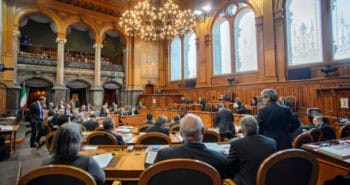
New York – Criticized for boycotting the United Nations Human Rights Council for the past three years, the United States has come under new scrutiny now that it has won a seat on the council with a pledge to reform it. The US won membership on the 47-nation council with 167 votes of the UN General Assembly’s 192 members after President Barack Obama sought a seat in the group, reversing a policy of his predecessor George W Bush.
But questions being raised at UN headquarters in New York and among human rights organizations have cast doubts on how effective the US presence in the Geneva-based council can be. The main concern is that the US will be isolated by the majority of Islamic nations on the council who are opposed to US foreign policy.
Since it began work in 2006, the council has been criticized for paying undue attention to the Israel-Palestinian conflict because of the domination of Islamic countries such as Saudi Arabia and Egypt. Some non-governmental organizations devoted to the protection of human rights note that Islamic countries continue to dominate the council.
Bush refused to support the council in 2006 when it was established, after condemning the election rules, which allow all countries to run for seats regardless of their human rights records.
The General Assembly on Tuesday elected the US for the first time. Countries maligned for their human rights records, such as Cuba, China, Saudi Arabia and Russia, were re-elected.
China was re-elected for a three-year term with 167 votes, the same as the US. Cuba was re-elected with 163 votes, Mexico 175, Jordan 178, Russia 146, Saudi Arabia 154 and Bangladesh with 171 votes.
The council’s new composition post-election would still leave the foxes guarding the hen house, complained UN Watch, a Geneva-based human rights NGO.
UN Watch’s executive director Hillel Neuer said the US presence would make no difference unless it acts vigorously to end the assault on some of the most obvious human rights principles such as freedom of speech and religion.
UN Watch urged the US to initiate resolutions and debates to spotlight the genocide in Sudan’s Darfur region, religious repression in China and execution of homosexuals in Iran.
The conflict in Sri Lanka, which has been condemned by the UN, has so far not been discussed by the council because of the opposition of many governments, which consider the fighting a domestic issue.
Susan Rice, the US ambassador to the UN, has rejected the assumption that it would be impossible for Washington to change the council’s behaviour as it has shown a strong penchant for criticism of Israel rather than dealing with the killing in Darfur.
The council is heir to the discredited UN Commission on Human Rights, which nearly all countries in the world supported abolishing in 2006.
“We don’t think it’s impossible,” Rice told reporters minutes after the US was elected to the council on Tuesday. “We wouldn’t be running if we thought it was impossible for the council to fulfil the vision that we all had when it was established.”
“Obviously there will always be some countries whose respect and record on human rights is sub-par; we have not been perfect ourselves,” she said candidly.
The UN Association of the United States of America (USA-UNA) saw a good opportunity for Washington to strengthen the human rights council. But it, like other groups, acknowledges that the US won the election because of the geographical distribution of seats on the council rather than its laudable human rights records.
The US was able to run uncontested for one of three seats that became vacant for Western European and other states. The previous holders of the seats – including Germany and Canada – did not seek re-election. Belgium and Norway, the other candidates, also easily won their seats.
Had more Western European nations wanted to run, the US may have had difficulty in the election because of its human rights record in the war against terrorism under the Bush administration.
Under the equitable geographical distribution of seats in the 47- nation council, Africa has 13 seats, Asia 13, Eastern Europe has six seats, Latin America and the Caribbean have eight seats and Western Europe has seven seats.
Copyright 2009, Deutsche Presse-Agentur
Original URL: https://www.earthtimes.org/articles/show/268723,us-membership-in-un-human-rights-council-raises-concerns–feature.html