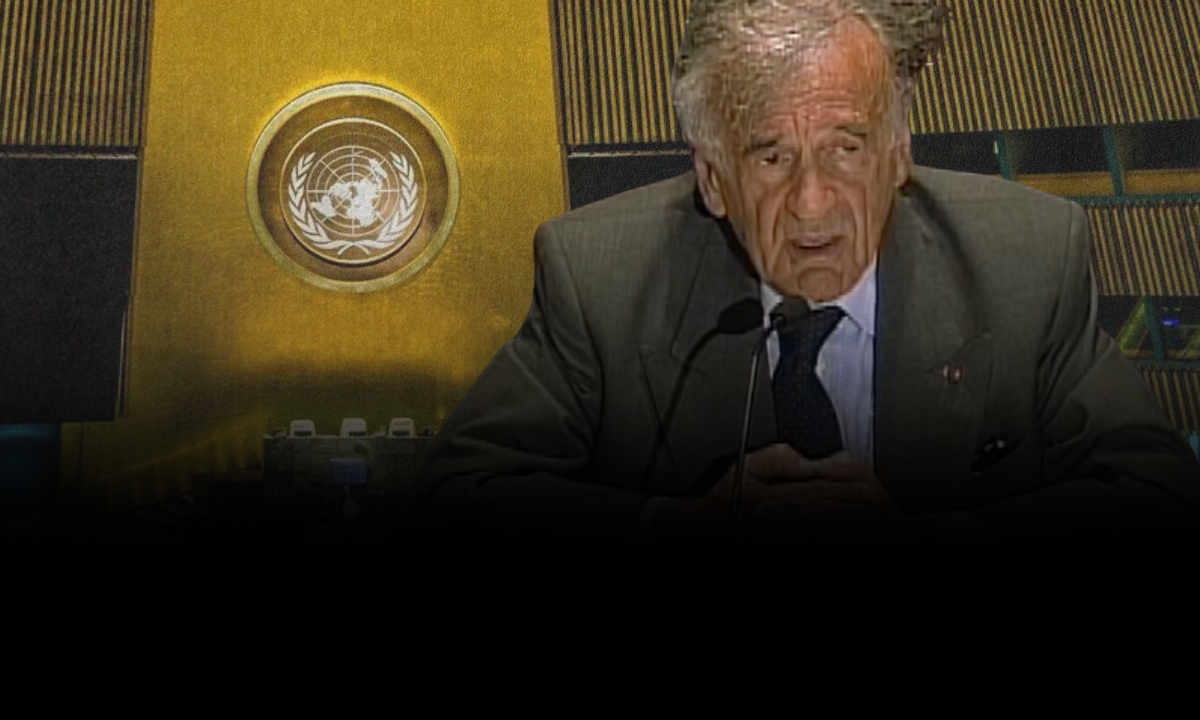

UN Watch has recently obtained and published for the first time Elie Wiesel’s powerful testimony before the United Nations during a seminar on antisemitism on 21 June 2004.
Transcript:
Elie Wiesel: My dear friend, Secretary General of the United Nations, I would like to begin with reading from a novel, and I shall conclude reading from another novel.
The first one is called The Plague, written by Albert Camus. It’s a story about a city which suffered from the plague.
Day after day, men, women, and children were taken by death. There was one man, a physician named Doctor Rieux; he was the chronicler of the plague. And at the end of the story, literally the last page of the book, all of a sudden Rieux, the hero, remembered, and I quote him: “I saw the joy, the happiness, the exuberance, the celebration; but I know that such joy is always imperiled.”
He knew, Rieux knew, that those jubilant crowds did not know, but could have learned from books, that the plague virus never dies or disappears for good. That it can lie dormant for years and years in furniture and linen chests. That it bides its time in bedrooms, cellars, trunks, and bookshelves. And that perhaps the day would come when, for the bane and the enlightening of man, it would rouse up its rats again and send them forth to die in a happy city.
That virus, we call it antisemitism.
We thought it disappeared, but it didn’t. And so, in this solemn setting, we are here today to plead to you, Mr. Secretary General, on behalf of my people, an ancient people, who in some quarters continues to be vilified, threatened, offended, and physically marked for humiliation, if not worse.
Call it antisemitism, a term coined at the end of the 19th century, or simply Jew hatred. It is the oldest collective bigotry in recorded history. In fact, one may say that of all the group hatreds in antiquity, antisemitism alone survived antiquity.
It is no longer political, social, or religious or ethnic. It is existential. It is metaphysical. Antisemitism, as you have mentioned, Mr. Secretary General, is sui generis.
Other people, other traditions, other religious communities, other cultures have been persecuted for a variety of reasons, but antisemitism combines them all.
The antisemite doesn’t know me, but he hates me. Actually, he hated me even before I was born. The antisemite hates the dead and not only the living. Otherwise, why are so many cemeteries profanated, causing a sacrilege to all those who have any sense, any feeling for religious life, a religious faith, a religious hope?
There isn’t a week, sometimes a day, without an antisemitic incident in Europe. A young Israeli visiting Berlin was assaulted in the street in broad daylight yesterday. Last week, a young Jewish student was stabbed in Paris in broad daylight. A number of European Jews told me, of course, in confidence, that they live in fear. Who would have thought that Jews would live in fear 60 years after the worst tragedy of human history?
Incitement to hate and violence continues to fill the pages and occupy the TV screens in many—too many—Muslim countries. Under the pretext of blaming Israel’s policies, which they outrageously exaggerate and acerbate and demonize, some intellectual thinkers encourage hatred towards the entire Jewish people.
And why not say it? Antisemitism has even managed to penetrate the UN atmosphere. Had it not been for your courageous intervention, Mr. Secretary General, the infamous resolution comparing Zionism to racism, I think, would still be in effect. You, behind the scenes, as I know, did everything possible, and you succeeded. But Durban—there your efforts were less successful, and instead of being a conference against hatred, it became a conference of hatred for Israel the state and Israel the people.
As you said it, Mr. Secretary General, the United Nations was created not only to put an end to aggression and war, but also to protect values, ideals of humanity, and to shield innocent victims of fascism and Nazism. But then you know, that I and some of us here belong to a people that have been the principal targets of Nazism and fascism.
And so we turn to the United Nations today, together with you, Mr. Secretary General, and we ask the leadership of the world to fulfill its mission and use its political and moral authority to outlaw the plague which antisemitism is.
You know, I have devoted, like you, most of my adult life to combat many evils of society: apartheid, willful persecution of innocence, intolerance, racism, fanaticism, and indifference to other people’s sufferings and other people’s fears—I have devoted my life to that. But I never thought that I will have to fight antisemitism. And 60 years after the war, 60 years after the inauguration of the United Nations, here we are.
Naively, I was convinced that antisemitism died in Auschwitz, and now I realize my mistake. It didn’t. Only the Jews perished there. Antisemitism is alive, and well, in too many lands. But then, it has always been.
In the ’30s of the last century, many intellectuals, writers, poets, painters were antisemites and weren’t even embarrassed by it. I could give you the names of writers, famous writers, who in France and in Germany, they belonged to antisemitic circles and weren’t embarrassed; they said, “Only words.” But now we know what words can do. Was it King Solomon in the Ecclesiast who said, “Words can kill just as they can heal”? And some words killed.
And so, speaking of antisemitism in this special place, in this particular setting, one wonders: Doesn’t the organized world and its moral and intellectual leadership remember the consequences of antisemitism?
Some of us in this audience endured those consequences. We know what it means, and we know where it leads. We were there. We saw our parents, we saw our friends die because of antisemitism.
And so this is my plea to the United Nations, which I issue together with you, my friend, Mr. Secretary General: Help us fight it. Help us disarm it.
To do so would be in the interest of the United Nations, for it would serve the cause of humanity at large. For hatred is dangerous. Hatred is contagious. Hatred is a cancer that goes from limb to limb, from person to person, from group to group.
He or she who hates Jews hates all minorities, all those who are different. He or she who hates Jews will end up hating everybody, and then himself. So therefore I believe that when we urge you to fight antisemitism with vigor, talent, imagination, devotion, it is because we want to save other people as well.
And so, in conclusion, I will read from the next novel. It’s a story of a little city, a shtetl, and there was a pogrom, and at the end, at the end, the enemies set the entire Jewish quarter on fire—happened in the 16th century. And the chronicler, the one who survived, wrote:
“I was stepping back and back, but the distance remained unchanged. The prey of death, the price of life. The city was burning, and I watched it burn. The house of study, the trees and the walls whipped by fire and wind, the cobblestones shattered, the Jewish quarter, the churches and the schools, the stores and the warehouses—yellow and red, orange and purple flames escaped from them, only to return at once. The shelter and the orphanage, the tavern and the synagogue, joined by a bridge of fire. The cemetery was burning, the police station was burning, the cribs were burning, the library was burning, the Jewish part and the Christian part were burning. On that night, man’s work yielded to the power and judgment of the fire, and suddenly I understood, with every fiber of my being, why I was shuddering at this vision of horror. I had just glimpsed the future.”
Mr. Secretary General and Shashi, and friends here, we must prevent the world from entering that fear of that future, and the choice is always ours.
“Antisemitism has even managed to penetrate the U.N. atmosphere… Naively, I was convinced that antisemitism died in Auschwitz, and now I realize my mistake.”
— Nobel Peace Prize laureate Elie Wiesel addresses the United Nations, 21 June 2004 pic.twitter.com/p4JvFS4iNR
— UN Watch (@UNWatch) October 20, 2026